Interior and North Sent the NDP’s Resource Map Back Stamped No
The preliminary map is not subtle: across resource-country B.C., Conservative wins and leads turned the NDP’s rural credibility problem into a seat-by-seat receipt.
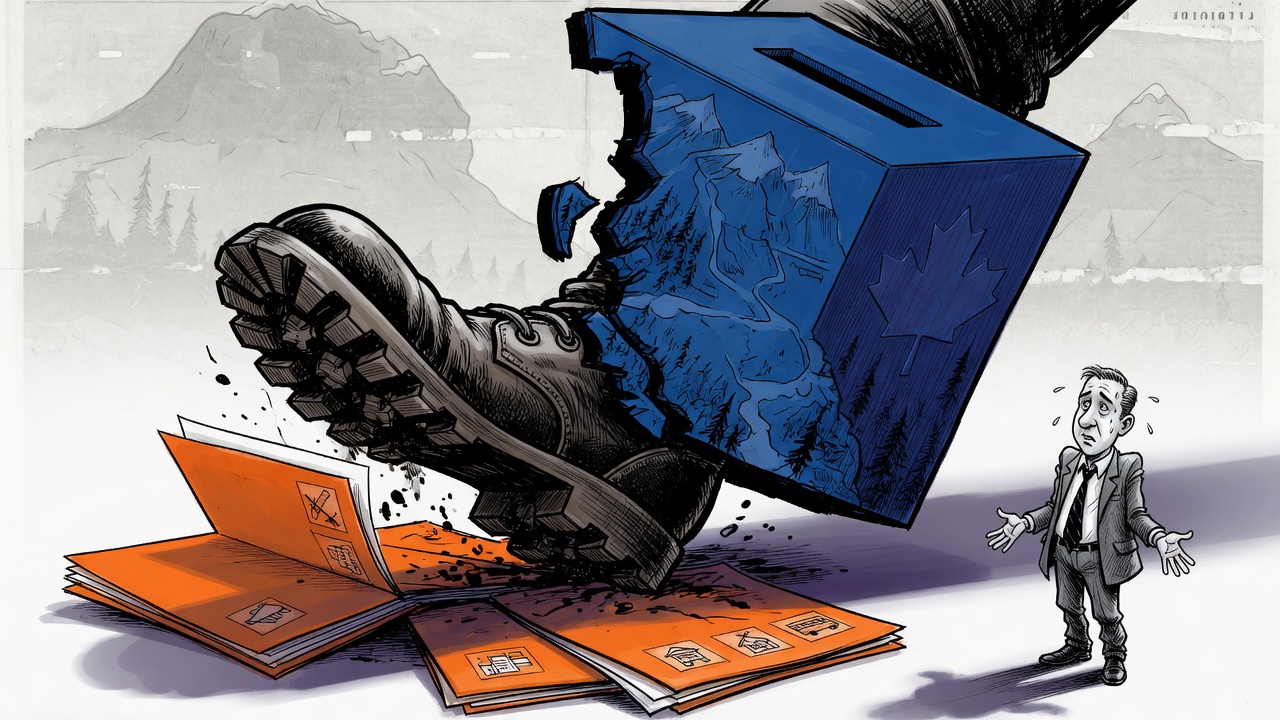
The 2026 B.C. election map did not just change government. It exposed where the NDP’s message failed hardest. In the Interior and the North — the regions that carry forestry towns, mines, gas fields, mills, long highways and rural emergency rooms — the preliminary result is a wall of Conservative blue.
CityNews’ regional results list Conservative winners or leaders in almost every Northern district it tracked: Bulkley Valley-Stikine, Nechako Lakes, Peace River North, Peace River South, Prince George-Mackenzie, Prince George-North Cariboo, Prince George-Valemount and Skeena. The listed NDP exception in the North was North Coast-Haida Gwaii.
The Interior list tells the same story. CityNews showed Conservative wins or leads in Cariboo-Chilcotin, Columbia River-Revelstoke, Fraser-Nicola, Kamloops Centre, Kamloops-North Thompson, Kelowna Centre, Kelowna-Lake Country-Coldstream, Kelowna-Mission, Kootenay-Rockies, Penticton-Summerland, Salmon Arm-Shuswap, Vernon-Lumby and West Kelowna-Peachland. The NDP exceptions listed were Kootenay Central and Kootenay-Monashee.
Elections BC’s candidate results underline the scale. In Cariboo-Chilcotin, Conservative leader Lorne Doerkson had 14,218 votes, or 76.90%, to the BC NDP candidate’s 3,123 votes, or 16.89%, with counting complete but results not official. In Kamloops-North Thompson, Conservative Ward Stamer had 17,232 votes, or 64.78%, to the NDP’s 7,617 votes, or 28.63%. In Kelowna-Mission, Conservative Gavin Dew had 13,590 votes, or 58.68%, to the NDP’s 6,427 votes, or 27.75%.
Those numbers do not prove one single cause. They do prove that resource-region voters delivered a broad verdict while forestry, land-policy uncertainty, rural health access and project credibility were all part of the campaign backdrop. CityNews reported Doerkson’s victory speech explicitly naming Kitimat, Fort St. John, Prince George, Quesnel and Williams Lake in an economy built around LNG, gas, mills, mines, ports and working towns. The same report said the Conservative platform promised to repeal DRIPA and expand natural gas and LNG development.
The Writ’s post-election analysis put the provincewide preliminary picture at Conservatives 64 seats, BC NDP 27, Greens 2, with Elections BC reporting 99.57% of polls at that point. It called the result a Conservative landslide and noted that mail ballots and final counting were still outstanding.
That caveat matters. The final count can move close ridings. It cannot make this regional pattern disappear. The NDP asked British Columbians for another mandate. In the Interior and North, the preliminary answer was not close.