Small Businesses Don’t Need Another Eby Loan — They Want the Cost Machine Turned Off
CFIB’s election platform is a blunt warning: B.C. entrepreneurs are not asking Victoria for better slogans. They are asking it to stop making survival harder.
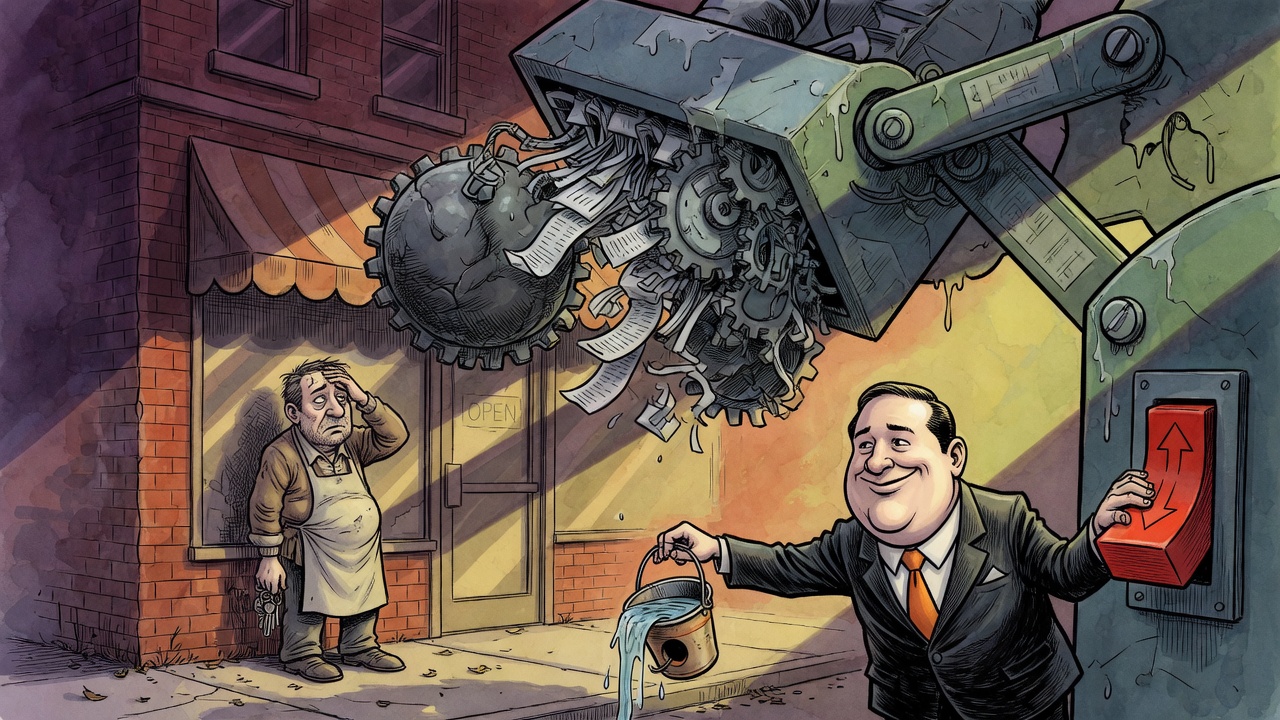
David Eby is offering small businesses another lifeline from Victoria. The Canadian Federation of Independent Business is describing something more basic: a province where too many owners no longer believe Victoria understands the machine it has built around them.
CFIB’s B.C. Election 2026 platform says the province is in an “entrepreneurial drought,” with more businesses closing than opening for five consecutive quarters. It says 27% of B.C. small businesses describe their condition as weak or critical, 56% would not advise someone to start a business today, and 92% are not confident the provincial government has their back as a business owner. CFIB is non-partisan and says it does not endorse or oppose any party or candidate.
That matters because the NDP’s Oct. 7 small-business pitch is mostly a rescue pitch. Eby promised a $500-million Small Business Tariff and Wildfire Relief Fund, with interest-free loans of up to $1 million for up to 72 months, plus a $5,000 youth hiring tax credit and export-diversification support. Tariffs and wildfires are real pressures. But loans do not switch off the cost machine. They help firms borrow their way through it.
CFIB’s platform points to five structural tests instead: lower the cost of doing business, hold the line on payroll costs, cut red tape, get the province’s books in order, and repeal the PST expansion. Those are not fringe complaints. They go straight at the daily math of running a shop, hiring staff, renewing a lease, absorbing insurance, navigating forms and wondering whether today’s deficit becomes tomorrow’s tax bill.
The PST file is especially revealing. CFIB says the province paused the expansion of PST to professional services on Sept. 18, but that the pause is temporary and the expansion remains in law. In plain English: business owners still have to price uncertainty into decisions the government says it has paused. If Eby wants credit for listening, he can repeal the measure in legislation, not leave it hanging over the counter like a storm cloud.
The deficit warning is just as concrete. Budget 2026 projects deficits of $13.3 billion in 2026-27, $12.2 billion in 2027-28 and $11.4 billion in 2028-29, while taxpayer-supported debt is forecast to rise to $189 billion over the fiscal plan. Small businesses are right to ask whether that red ink eventually comes back as higher taxes, higher fees or delayed permits.
None of this means every CFIB prescription must be accepted whole. It means Eby should answer the benchmark in public. How many costs will he remove, not refinance? Which red-tape deadlines will be enforceable? Will he repeal the PST expansion, yes or no? And if 92% of small-business owners say they do not trust Victoria to have their back, why should another campaign loan fund be treated as enough?