Canada’s Largest Fentanyl Superlab, One Public Case. B.C. Needs the Organized-Crime Ledger.
An industrial-scale drug bust should trigger an industrial-scale public accounting.
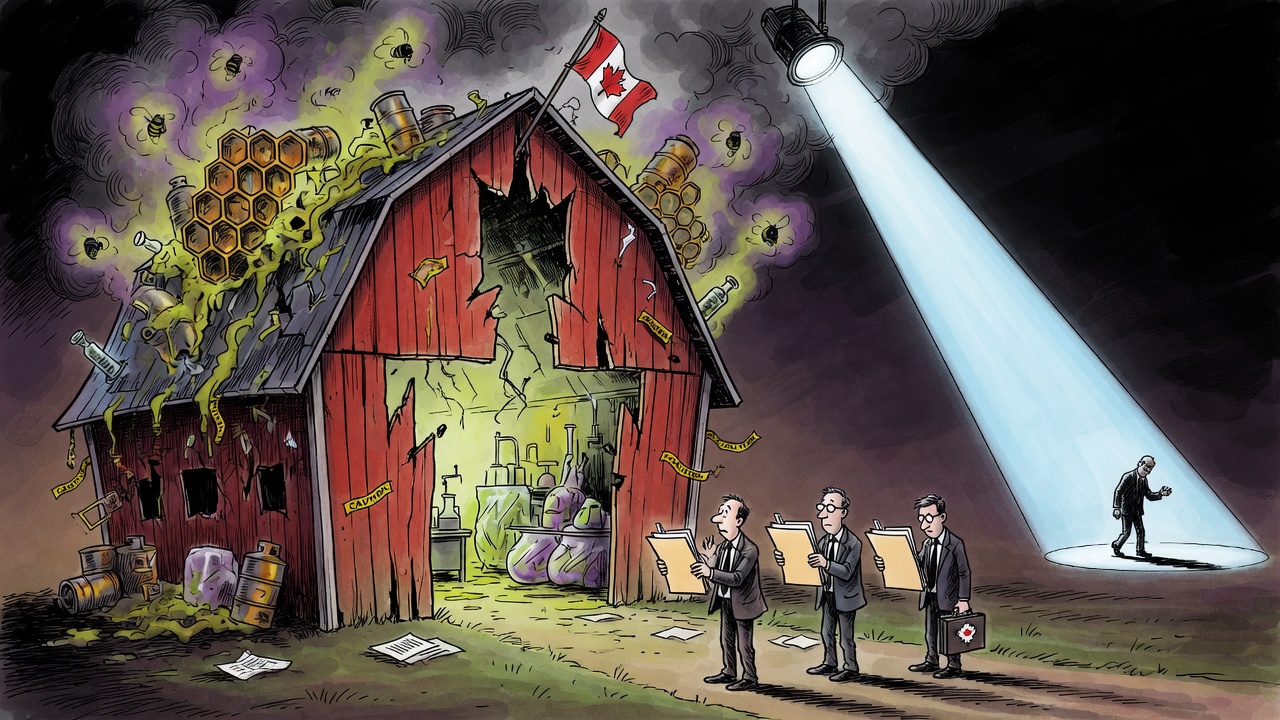
British Columbians were told in 2024 that federal police had dismantled something extraordinary: a rural Falkland drug superlab tied to associated Surrey locations, loaded with fentanyl, methamphetamine, cocaine, MDMA, precursor chemicals, firearms, explosives, silencers, body armour and cash.
That should have been the beginning of a public accountability trail. Instead, the newest public development raises a blunt question: where is the rest of the organized-crime case?
Global News reported September 4 that Gaganpreet Singh Randhawa pleaded guilty in B.C. Supreme Court to several drug-trafficking and firearms-related charges, and that he is the only person charged in connection with the massive operation so far. The Vancouver Sun/Canadian Press report cited in the candidate file said Randhawa pleaded guilty to trying to send 310 kilograms of methamphetamine to the Philippines through boxes delivered to a Richmond shipping company in September and October 2024.
Those are court and reporting facts. They do not prove who else was involved. They do not mean future charges are impossible. They also do not let Victoria shrug and point at Ottawa.
Yes, the RCMP operation was federal policing. Yes, Crown decisions are supposed to be independent. But the toxic-drug disaster, organized-crime infiltration, rural lab sites, chemical supply chains, court capacity and community safety fallout are B.C. problems landing on B.C. streets, B.C. emergency rooms and B.C. families.
The original RCMP release said investigators seized 54 kilograms of fentanyl, 390 kilograms of methamphetamine, 35 kilograms of cocaine, 15 kilograms of MDMA, six kilograms of cannabis, massive amounts of precursor chemicals, 89 firearms and $500,000 in cash. Police also said the combined fentanyl and precursors could have amounted to more than 95 million potentially lethal doses. That is not a neighbourhood stash. It is an industrial operation.
So the Eby government owes voters a public-safety ledger, not a press-conference memory. How many industrial drug-production sites has B.C. identified since the Falkland seizure? How many clandestine-lab investigations are awaiting prosecution support? What has changed on precursor monitoring, rural enforcement, organized-crime intelligence sharing, border-export disruption and specialized court capacity? How much did cleanup cost, who paid, and what provincial standards now apply when a toxic lab is found on rural land?
None of those questions requires politicians to interfere with an active case. They require government to prove it has a strategy beyond celebrating takedowns after police do the dangerous work.
The public can accept that complex organized-crime cases take time. What the public should not accept is silence after a “largest in Canada” fentanyl lab produces one visible accused and no clear B.C. plan to stop the next one. If this was a national-scale catastrophe in waiting, the accountability response should be national-scale too — starting in Victoria.
Sources and records
- Global News: Only 1 person charged after RCMP dismantle Canada’s largest super lab
- Vancouver Sun / Canadian Press archive: Man connected to Falkland drug lab pleads guilty to trying to send boxes of drugs to Philippines
- RCMP archived release: Federal investigators take down the largest, most sophisticated drug superlab in Canada