Site C’s $47M Fish Shuttle Is The Bill After The Dam
The Peace River megaproject now needs a mechanical workaround for a migration problem critics warned about before the concrete set.
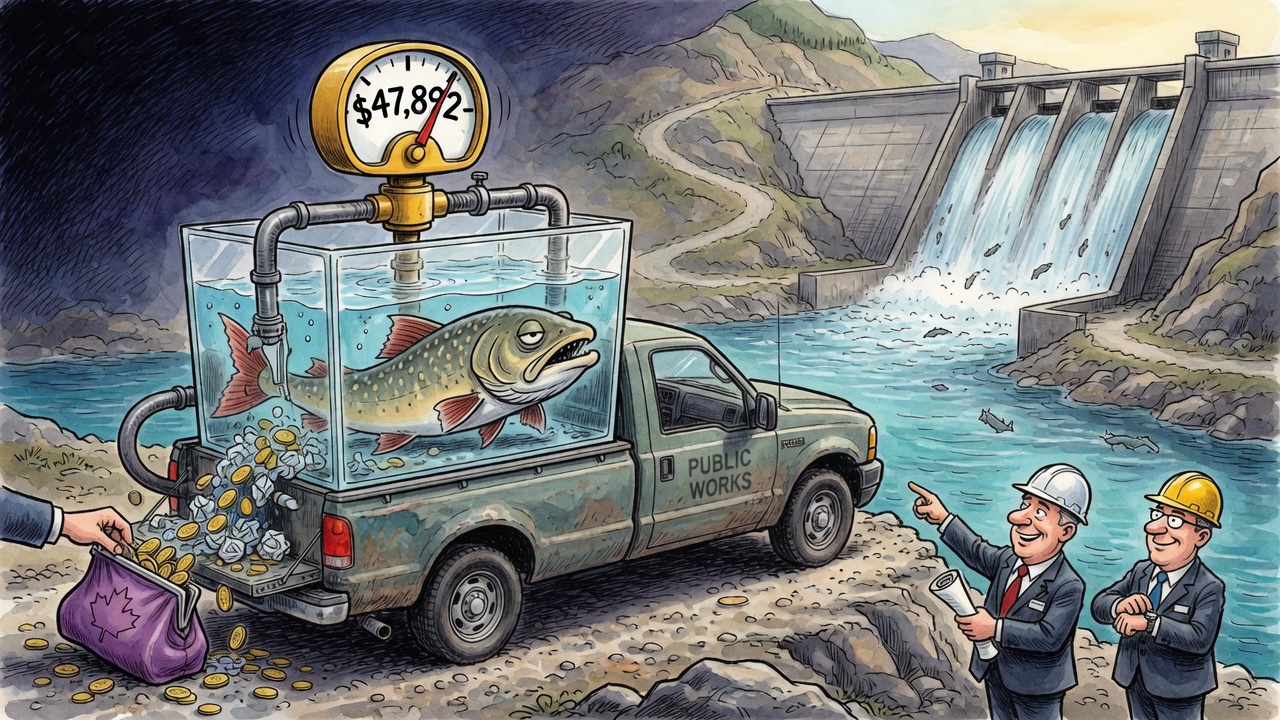
Site C’s fish problem is not an abstract environmental footnote. It is a truck, a tank, a lift system and a bill.
The Tyee reports that bull trout and other fish are being captured near the foot of the Site C dam, lifted through an elevator-like fish lock, sorted, anesthetized, loaded into transport pods, trucked as far as 50 kilometres upstream and released into the Site C reservoir, recently renamed Dreamer Lake. BC Hydro’s own Site C fish page confirms the basic approach: fish are captured and tagged at upstream passage facilities, then transported by truck upstream past the dam site.
The cost is the accountability hook. The permanent fish-passage facility is now reported at $47.2 million, more than quadruple an initial $10.6-million figure. The Tyee reports annual operating costs were initially estimated around $1.5 million, with about $1 million in the facility’s first full operating year and higher costs expected in the near term before stabilizing.
For that money, the results deserve scrutiny. The Tyee reports 316 bull trout were transported past the dam last year — only a little more than one-quarter of the roughly 1,200 bull trout BC Hydro said historically migrated past the dam site. The same reporting says the facility was out of service seven times for 55 days during the seven months it was supposed to operate, including the entire month of June, with problems involving a chain drive, winch cables, a stem nut and a computer system.
None of this changes the basic history: Site C began before the NDP took office. But David Eby’s NDP cannot hide behind that forever. The party chose to continue carrying the political and financial defence of Site C. The province later renamed the completed dam after former premier John Horgan. Ratepayers now inherit not just the electricity asset, but the long tail of mitigation, monitoring and workaround costs.
The official Site C page says fish and aquatic monitoring continues through the first 30 years of operations, from 2024 to 2053. That is a generation-long admission that the project changed fish habitat, health, survival and movement in ways that require constant management.
There is a serious energy conversation to have in B.C. about demand from homes, industry, mines, transmission lines and LNG. But that conversation should not pretend megaprojects become clean simply because the ribbon is cut. If a public dam needs a $47.2-million fish shuttle to work around its own barrier, taxpayers and ratepayers are entitled to ask what else was minimized, deferred or renamed as “mitigation.”
Site C is no longer just a construction debate. It is an operating ledger. And the fish truck is one line item British Columbians can actually see.