Eby’s ALR Processing Plan Opens Farmland With A 5% B.C. Product Test
The NDP says the proposal is about food security. The threshold tells B.C. farmers to ask who really gets the benefit.
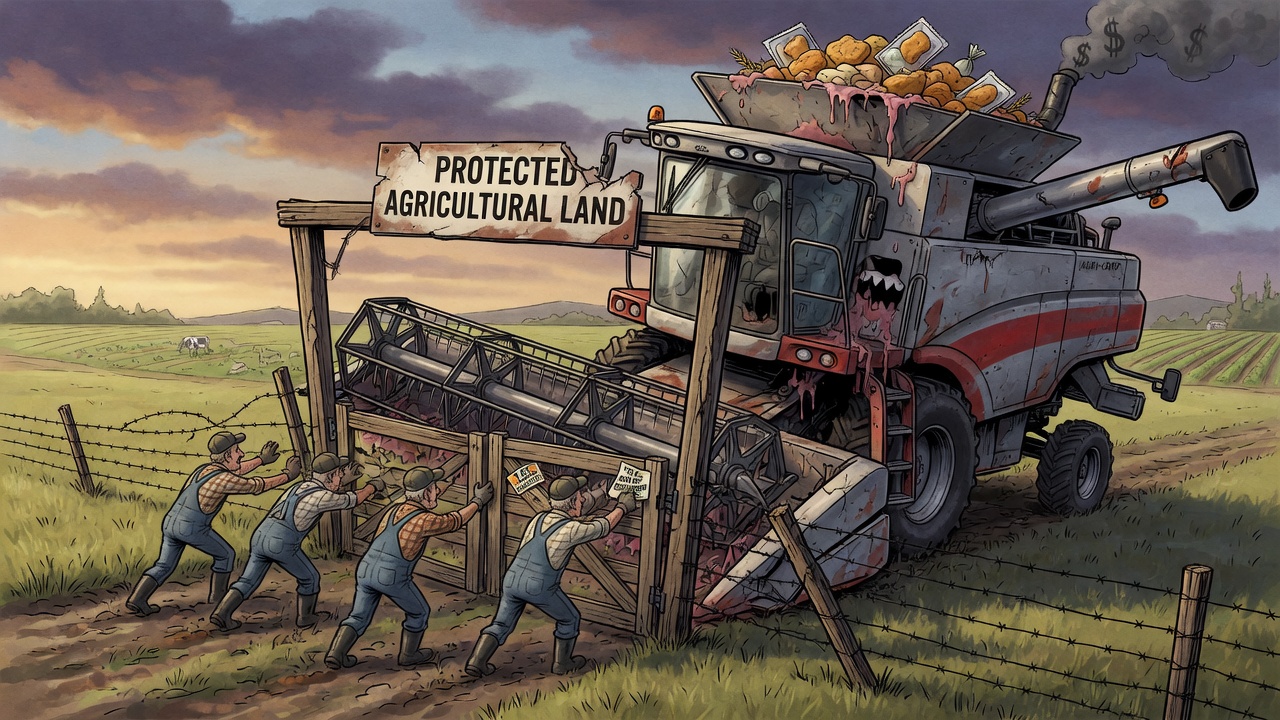
The Eby government is asking British Columbians to trust a major change to the Agricultural Land Reserve. The question is why that trust should come so cheaply.
CBC reported Aug. 19 that proposed changes to food-processing rules on B.C.’s ALR are drawing mixed reviews from Vancouver Island farmers. The core fact is not complicated: the province’s proposal would let food processors build or operate on lower-quality ALR land without Agricultural Land Commission permission, so long as 5% of the primary product being processed is grown or raised in B.C.
That is a startlingly low bar for a land base the province itself says exists to protect agriculture. Current rules generally allow processing in the ALR without ALC approval when at least half the product comes from the farm itself or from fellow member farms of an industry association. The proposed new path would apply to Class 5-7 soils, and Class 4 land if the parcel is serviced when the rule comes into force. Government says the Lower Mainland and Fraser Valley impact would be limited to about 500 to 1,000 hectares, while roughly 90% of ALR farmland there would be excluded.
Those guardrails matter, but they do not answer the obvious accountability question: if the goal is B.C. food security, why is the B.C.-grown requirement only 5%? A processor could meet the local threshold while relying overwhelmingly on inputs from elsewhere. That may still be lawful under the proposal. It should not be sold as automatic protection for local farmers without proof.
The province says the change would strengthen food security, attract investment, create jobs and build processing capacity during trade uncertainty and global supply-chain disruption. That is the government’s claim. It also says soil testing, local-government permits and other approvals would still be required, and that the 50% rule would remain for other ALR land.
Farmers quoted by CBC are not all opposed. Ben Glassen, who operates a small farm and abattoir near Nanoose Bay, said removing the 50% rule could help small producers process for neighbours and get local food to market. That is a real benefit worth taking seriously.
But the warning is just as real. Niki Whittaker of the Comox Valley Farmers Institute said the proposal could open the door for big business with only a small local component. Russell Dyson of Coleman Meadows dairy farm warned that processing capacity is needed, but not at the cost of sacrificing agricultural soils or inviting land speculation by large processors.
That is where David Eby’s government needs to stop hiding behind the phrase “food security” and publish harder safeguards. A 5% threshold, scarce farmland and corporate access to ALR parcels are not minor details. They are the policy. If Victoria wants farmers to believe this is for them, it should prove the land will not become another speculative asset class with a token B.C. ingredient.