B.C.’s Forced-Treatment Law Just Hit a Charter Wall
The court did not abolish involuntary admission. It told Victoria that forced psychiatric treatment without proper consent safeguards is not good enough under the Charter.
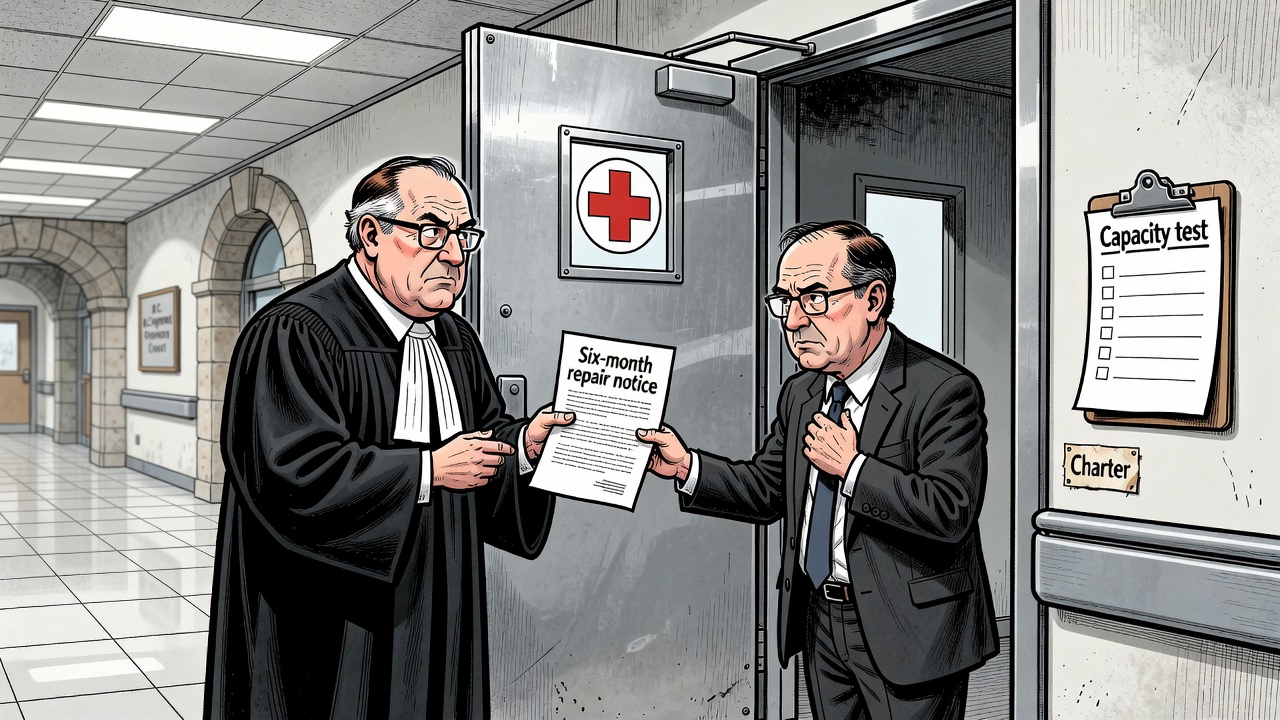
B.C.’s mental-health system has just been handed a constitutional repair order.
In Council of Canadians with Disabilities v. British Columbia (Attorney General), released July 28, 2026, the B.C. Supreme Court concluded that parts of the province’s consent and representation laws unjustifiably infringed sections 7 and 15 of the Charter for people involuntarily detained for psychiatric treatment. Canadian Press, reported by Castanet on July 31, summarized the practical result: the province has six months to reform the laws.
The ruling is precise, and that matters. The court said the Council of Canadians with Disabilities was not challenging B.C.’s involuntary admission regime or the importance of psychiatric treatment. The case focused on the treatment-consent machinery: whether B.C. could remove the usual presumption of capacity and allow a facility director to consent to psychiatric treatment for an involuntary patient.
Justice Heather Blake found B.C. was an “outlier” in Canada. According to the judgment, B.C. was the only jurisdiction whose mental-health legislation had no statutory requirement or framework to assess an involuntary patient’s capacity to make treatment decisions, gave the detaining facility unilateral power to treat a capable involuntary patient against their will, and provided no independent oversight of a physician’s incapacity assessment.
That is a serious indictment of the legal architecture behind a system Victoria keeps asking British Columbians to trust. The court found the impugned provisions denied involuntary patients the benefit other B.C. patients have: if capable, the ability to direct their own health care. It also found the regime perpetuated the stereotype that people with mental disorders lack capacity.
The court did not pretend the public-interest side is simple. It accepted that the purpose of the legislation was pressing and substantial, and it suspended its declarations for six months so the Legislative Assembly can respond. The judgment also noted that more than 16,000 patients were involuntarily admitted under the Mental Health Act in 2023/24, which is why an immediate legal vacuum would carry real risk.
But the government did not get the 12 months it asked for. The court said six months was enough, pointing to the long life of the litigation and the Legislature’s ability to act quickly when it repealed the old deemed-consent section during the trial.
For the Eby government, the accountability test is now concrete. It must produce Charter-compliant legislation that protects patients who truly cannot decide while respecting those who can. That means capacity assessment rules, meaningful review, and clear limits on state power before any further expansion of involuntary care is sold as a public-safety solution.
British Columbians can support urgent mental-health care and still demand lawful safeguards. The court has now said B.C.’s old approach crossed the constitutional line. Victoria’s next draft will show whether the NDP learned the lesson.