Eby’s Mental-Health Beds Are Years Away. Patients Are Waiting in ERs Now.
Partial B.C. data shows psychiatric patients can wait hours — and in one Interior Health case, more than nine days — for a bed while the province’s new facilities are scheduled for 2027 and 2028.
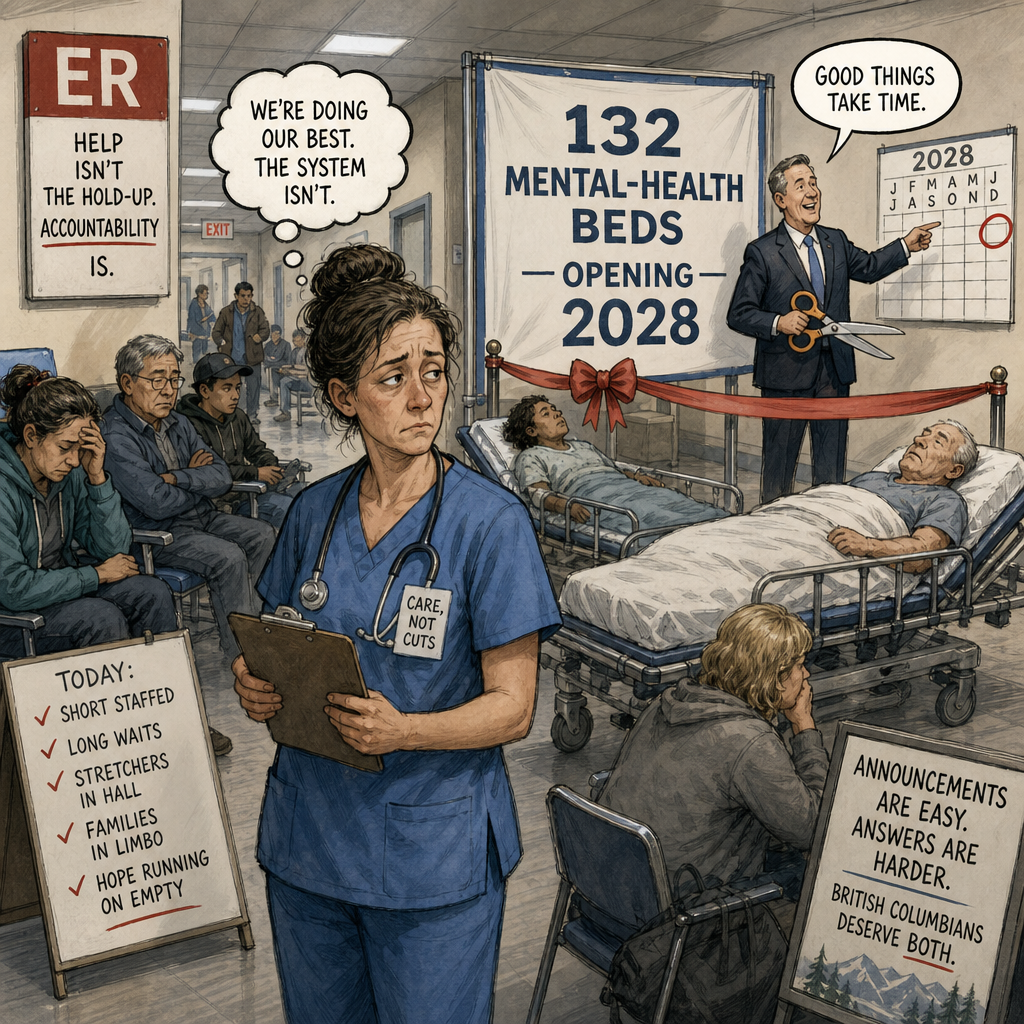
Premier David Eby’s government announced 132 new involuntary-care beds this month. That headline sounds immediate. The timeline is not.
The B.C. government’s July 10 release says Prince George is slated for a 72-bed facility and Surrey for a 60-bed facility. In Prince George, the first 24 beds are expected by December 2027 and the remaining beds by the end of 2028. Surrey’s 60-bed facility is expected to open in spring 2028. That is the government’s own schedule.
Meanwhile, Canadian Press reporting published by CityNews Vancouver on July 28 shows the pressure inside emergency rooms now. B.C. health officials could not provide provincewide wait-time data for psychiatric patients waiting in ERs for a hospital admission, CP reported, though several local health authorities supplied partial figures.
Those partial figures are serious enough. Interior Health said the longest wait for a psychiatric bed last year was just over nine days, with one patient waiting that full amount of time. Island Health said patients waited an average of 21 hours in the ER for a psychiatric-unit bed in 2025, up from 13 hours in 2019.
This is not an argument against treatment beds. People with severe mental illness, addictions and brain-injury needs deserve care that is safe, timely and humane. It is an argument against pretending a ribbon-cutting announcement in 2026 solves an emergency-room bottleneck before 2028.
CP also reported that B.C. has 1,438 psychiatric beds, equal to about 25 per 100,000 people. The same report cited 2022 expert-panel guidance that 30 beds per 100,000 is a minimum and 60 per 100,000 is optimal. On that measure, B.C. is below the minimum, even before considering population growth, staffing constraints and the toxic-drug crisis pressures health authorities themselves identify.
The accountability gap is basic: if Victoria cannot publish provincewide psychiatric ER-to-bed wait times, how are patients, families, nurses, doctors and taxpayers supposed to measure whether the system is improving?
The NDP has made mental health, addictions and public safety a central governing file. It should therefore be judged on delivery, not announcement language. How many people are waiting in ERs today? How long are they waiting by health authority? How many beds are closed or unusable because staffing is not available? What interim capacity exists before the promised Prince George and Surrey beds open?
Those are not partisan questions. They are patient-safety questions. Eby’s government can claim compassion. The test is whether it can produce timely beds, public wait-time data and measurable relief before another patient spends days in an emergency room waiting for psychiatric care.