Eby’s Skills-Training Promise Is Collapsing on Campus
The NDP says it is building a skilled economy. B.C.’s public colleges and universities are cutting programs, jobs and student supports.
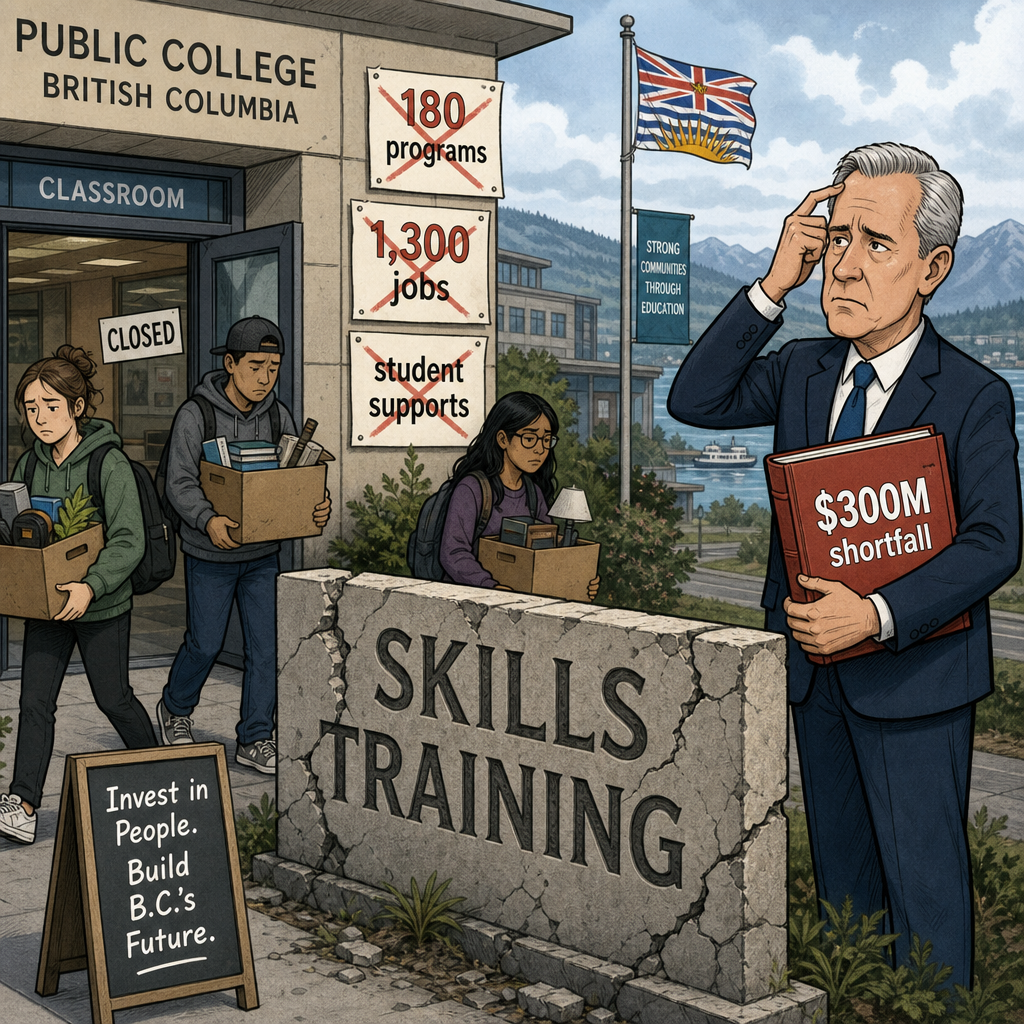
A government cannot claim to be solving the labour shortage while the public training system is cutting the very programs students need.
David Eby’s NDP wants credit for building a skilled economy. The numbers now coming from B.C.’s post-secondary sector tell a very different story.
BC Policy Solutions released a June 9 report describing what it calls the public post-secondary system’s worst funding crisis. Its topline finding is stark: 19 of B.C.’s 25 public post-secondary institutions are projected to operate at a loss, with an estimated $300 million annual shortfall. That is not a one-campus problem. It is a provincewide warning light.
The cuts are not abstract accounting entries. The report says that since 2024, public institutions have cut or suspended more than 180 programs, laid off more than 1,300 faculty and staff, and closed more than 45 student services. Those services include counselling, advising, Indigenous student supports, library hours and cafeteria access. In plain terms: fewer courses, fewer instructors and fewer supports for students trying to train for work in B.C.
The Tyee’s coverage underlined where the pressure is landing hardest: colleges and teaching universities. It reported more than 200 faculty losses at Langara, 35 programs cut or suspended at Capilano University, 32 at Vancouver Island University, and 26 at North Island College. These are exactly the institutions that serve commuter students, mature students, rural students and people trying to retrain close to home.
The NDP cannot say it did not know the file was in trouble. In November 2025, the province announced an independent post-secondary sustainability review, acknowledged significant financial pressures, and said Don Avison would deliver recommendations by March 15, 2026. Students and staff are entitled to ask what relief has arrived while campuses continue cutting.
Budget 2026 makes the accountability problem sharper, not softer. The fiscal plan projects deficits of $13.3 billion in 2026-27, $12.2 billion in 2027-28 and $11.4 billion in 2028-29, with taxpayer-supported debt expected to reach $189 billion over the plan. A government running deficits that large still has to prove it can protect core services. On post-secondary education, the evidence points the other way.
The fair conclusion is not that every institutional decision belongs personally to the premier. The fair conclusion is that B.C.’s NDP government owns the system it funds, regulates and reviews. When campuses cut programs, lay off instructors and strip student supports while Victoria waits on reviews and manages record red ink, the “skills training” message collapses.
British Columbians do not need another slogan about the economy of the future. They need a government that can keep the classroom doors open.