The Report Card Is In: Eby’s NDP Is Underwater on Every Major File
This is not just a horse-race poll. It is an issue-by-issue public report card — and the marks are failing.
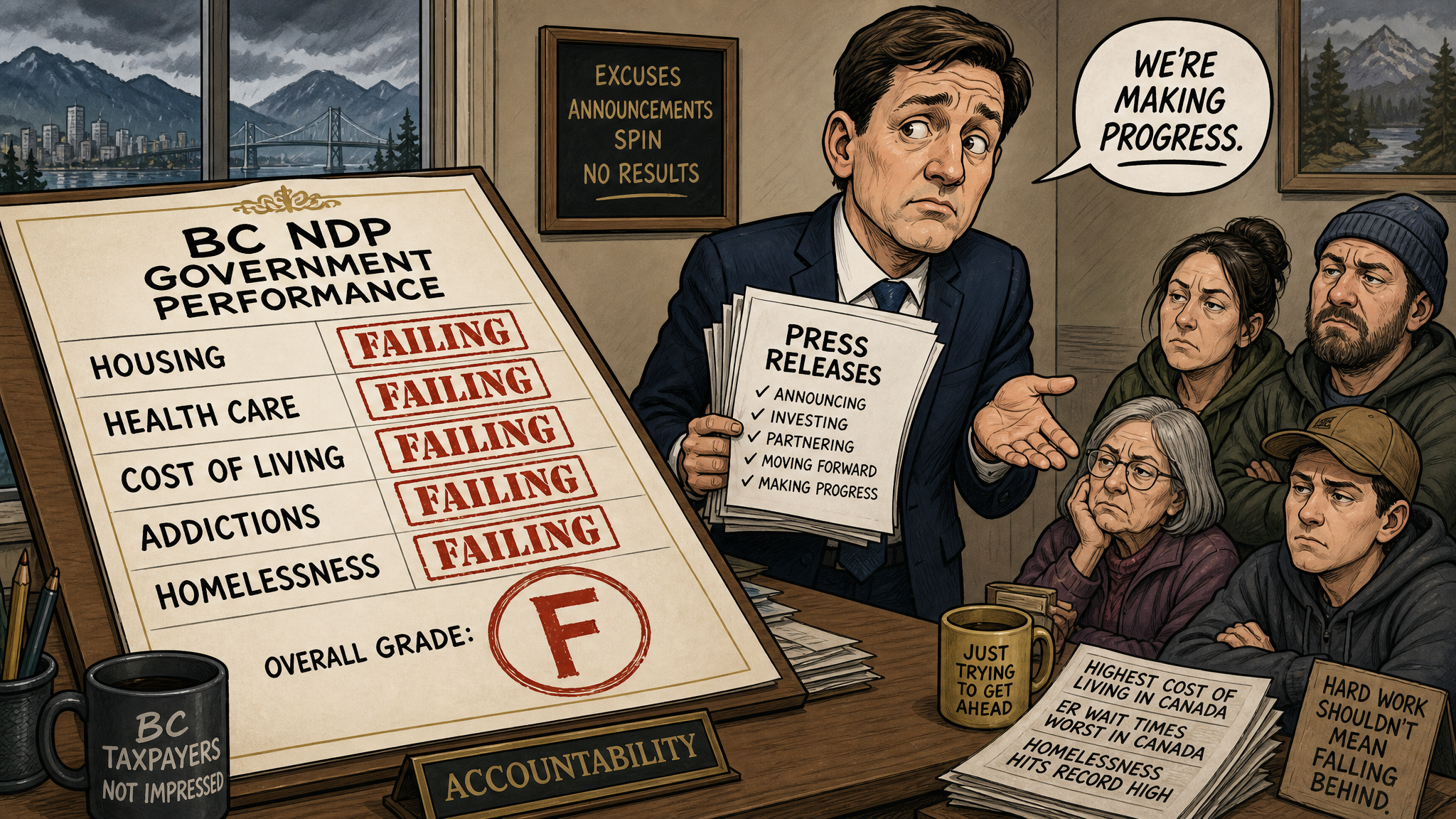
When every major file is underwater, the problem is not messaging. It is performance.
Angus Reid’s latest B.C. poll should be read as more than a mid-term horse race. It is a public report card on David Eby’s NDP government, and the result is blunt: on every major issue measured, British Columbians gave the government a net-negative assessment.
The headline number is hard to spin. Angus Reid says British Columbians are three times as likely to say the province is on the wrong track as the right track: 60% wrong track versus 19% right track. That is not a narrow grumble about one file. It is a broad vote of non-confidence in the direction of the province.
The worst marks land on the issues people feel every day. Angus Reid reports the NDP’s net score at -74 on poverty and homelessness, -73 on drug use and addictions, -67 on housing affordability, and -66 on the cost of living. Those are not abstract partisan numbers. They describe files where the NDP has made repeated announcements, spent public money, and asked voters to judge the government by outcomes.
Health care, another core NDP promise area, is also deeply negative. Angus Reid reports that 25% of British Columbians say the province has done well on health care, while 68% say it has done poorly. After years of staffing promises, urgent-care announcements and hospital ribbon-cutting, the public verdict is still that the system is not working well enough.
The voting numbers underline the same problem. Among decided voters, Angus Reid reports the BC Conservatives leading the NDP by 11 points. It also reports stronger voter retention for the Conservatives than the NDP: 94% of 2024 Conservative voters still with that party, compared with 76% retention for the NDP. Polls can move. Elections are not held inside a survey. But voter retention is a warning sign when the governing party is also losing the issue-by-issue argument.
The legally careful point is simple: this poll does not prove what will happen in the next election. It does show that, in this June 2026 survey, the NDP government is viewed negatively across every major file Angus Reid tested. That matters because governments do not get to campaign only on intentions. They are judged on whether housing became affordable, whether emergency rooms stayed open, whether streets became safer, whether addiction policy reduced harm, and whether family budgets became easier to manage.
Eby can blame global pressures, Ottawa, municipalities, or the opposition. Some pressures are real. But the public report card Angus Reid released this week is about the provincial government’s performance. On that measure, British Columbians are saying the NDP is failing the files it most often claims to own.