Claire Rattée Challenged the NDP on Jobs. The Numbers Back the Warning.
The fight is not just about one MLA’s Facebook Reel. It is about whether the NDP can keep dismissing economic warnings while B.C. workers, young job seekers and investors see the warning lights flashing.
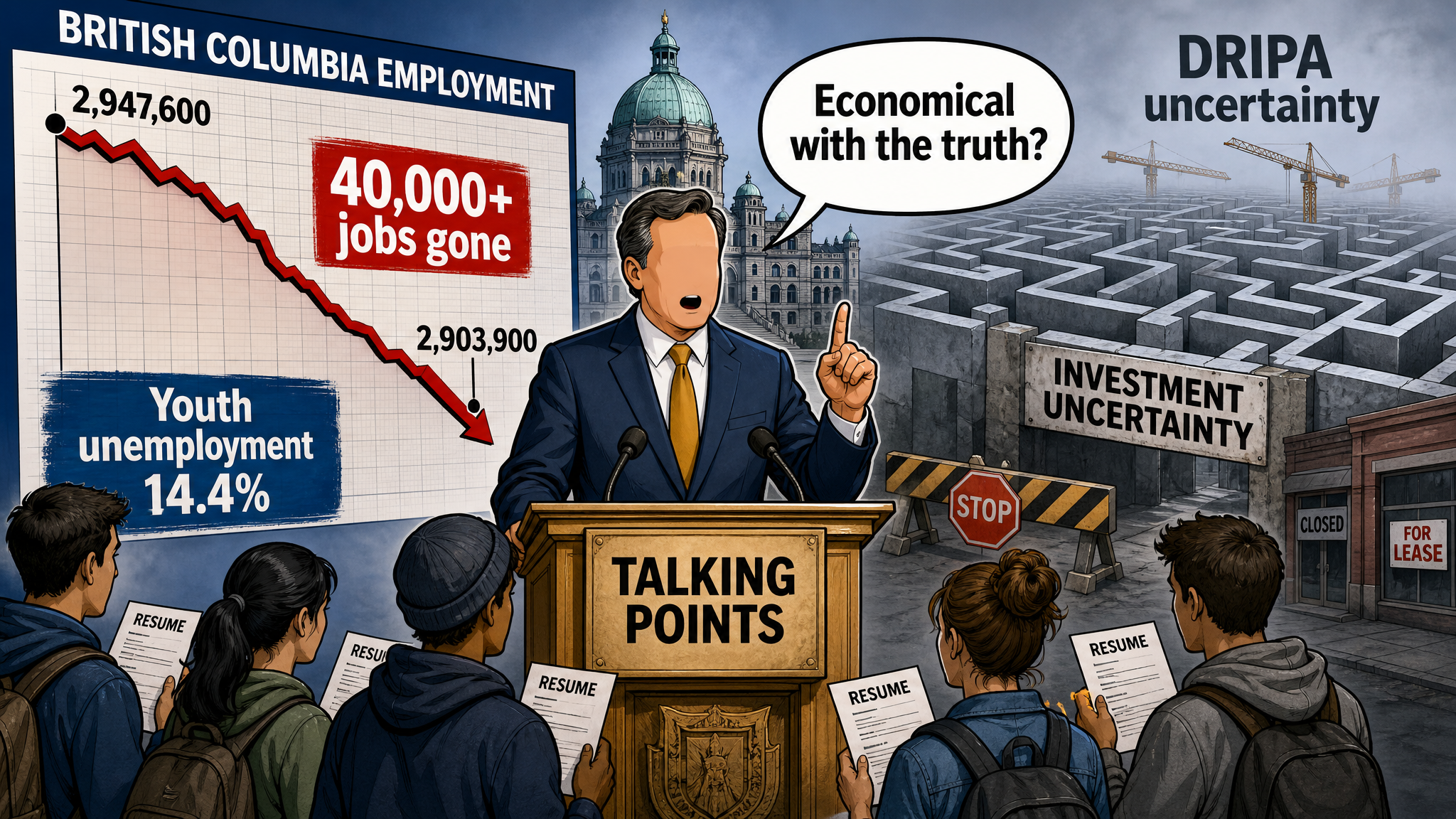
Editorial cartoon generated for iVoteNDP.com, May 18, 2026.
Source video
Claire Rattée, MLA for Skeena, posted a Facebook Reel saying the Minister of Jobs and Economic Growth accused her of being “economical with the truth.” Her post pointed to B.C. job losses, youth unemployment and business concerns about DRIPA. We checked the core claims against public data.
Claire Rattée’s warning should not be waved away with a clever line from the minister. The public numbers support the central point: B.C.’s labour market is weaker than the government wants to admit, young workers are facing a punishing job market, and business confidence around DRIPA has become an economic issue the NDP cannot talk-point away.
That does not mean every political claim in a Facebook post should be repeated without checking. It means the responsible answer is to test the numbers. On the major claims, the record is uncomfortable for the government.
What the jobs data shows
Statistics Canada’s April Labour Force Survey reported that Canada recorded a net employment decline over the first four months of 2026, concentrated overwhelmingly in full-time work. CityNews Vancouver separately reported, using Statistics Canada figures, that B.C. lost more than 40,000 jobs over the first four months of 2026 and that the province’s unemployment rate reached 6.8% in April.
Using Statistics Canada table 14-10-0287-02 for British Columbia, seasonally adjusted employment for people aged 15 and over stood at 2,947,600 in January 2026 and 2,903,900 in April 2026 — a drop of roughly 43,700 jobs. The same table shows B.C.’s youth unemployment rate at 14.4% in April.
| Measure | January 2026 | April 2026 | Change / status |
|---|---|---|---|
| B.C. employment, 15+ | 2,947.6k | 2,903.9k | −43.7k |
| B.C. unemployment rate, 15+ | 6.1% | 6.8% | Up 0.7 points |
| B.C. youth unemployment, 15–24 | 13.8% | 14.4% | Elevated |
What checks out
- The “40,000-plus jobs” warning checks out against B.C. employment levels from January to April 2026.
- The 14.4% B.C. youth unemployment figure checks out using Statistics Canada’s provincial table.
- The broader national youth picture is also weak: Statistics Canada reported youth unemployment at 14.3% nationally in April, above the pre-pandemic average.
DRIPA is now part of the jobs story
Rattée’s post also linked the jobs warning to investment confidence and DRIPA. That connection is no longer just partisan rhetoric. The Business Council of British Columbia released a May 2026 member survey showing 98% of respondents were “very concerned” about DRIPA’s current implementation, while 74% said they were decreasing investment plans in B.C. and 35% said they were reducing hiring plans.
The survey does not prove every lost job was caused by DRIPA. B.C.’s economy is also exposed to tariffs, trade uncertainty, interest rates, construction costs and global market swings. But the survey does prove something politically important: major employers are telling the province that policy uncertainty is changing investment and hiring behaviour.
The NDP cannot answer warning signs with insults
The minister is free to dispute an opposition MLA. That is politics. But when the numbers are this stark, calling someone “economical with the truth” is not enough. The government owes British Columbians a serious answer to three questions:
Questions for the NDP
- Why has B.C. employment fallen by more than 40,000 since January?
- What is the government doing for young workers facing a 14.4% unemployment rate?
- How will the NDP restore investment certainty when BCBC’s own survey says business concern around DRIPA is near-unanimous?
The NDP can blame tariffs. It can point to training programs. It can highlight selected investments. But it cannot seriously claim everything is fine while the labour market weakens, young people struggle to find work, and business leaders say uncertainty is cutting into investment plans.
The bottom line: Rattée’s political framing can be debated. The warning signs cannot. B.C. has a jobs problem, a youth employment problem, and a trust problem around investment certainty. That is the truth the government should be dealing with.
Sources
Claire Rattée Facebook Reel, May 18, 2026; Statistics Canada, Labour Force Survey, April 2026; Statistics Canada table 14-10-0287-02; CityNews Vancouver report on B.C. job losses; Business Council of B.C. DRIPA survey release.