Eby Calls Record Debt an Investment — While B.C. Loses 40,000 Jobs
The Premier compared borrowing for infrastructure to buying a family home. But the same week, B.C. faced pressure over a record deficit, rising debt and job losses in the first four months of 2026.
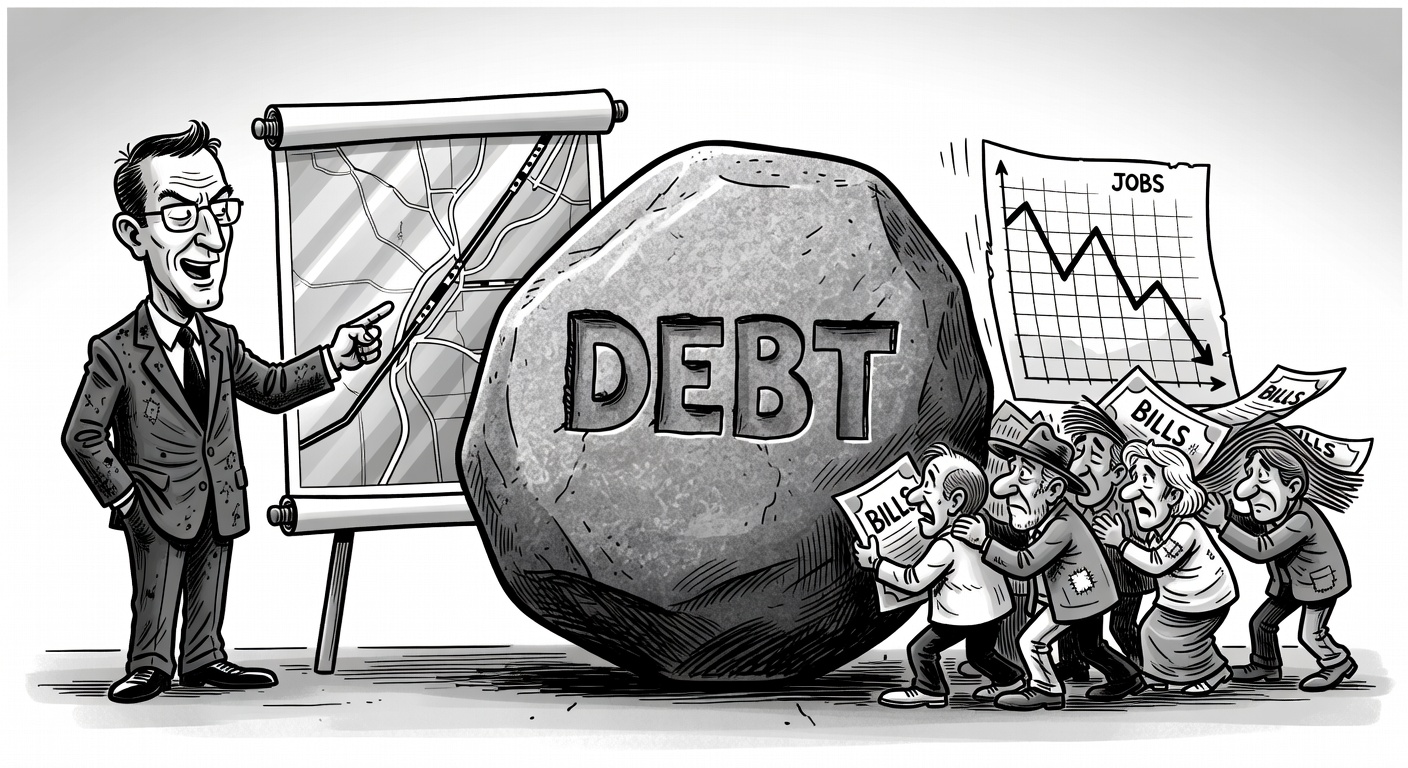
Editorial cartoon generated for iVoteNDP.com, May 9, 2026.
Source article
Canadian Press via iNFOnews, “Eby defends debt as required to build for the future, improve infrastructure,” May 8, 2026 — read the report. B.C. Budget 2026 release — read the government release.
Premier David Eby is now trying to sell British Columbia’s debt pile as a family investment.
Speaking Friday at the Surrey-Langley SkyTrain extension site, Eby defended government borrowing by comparing it to taking out a mortgage to buy a home. The Canadian Press reported that he told reporters debt rises dramatically when a family borrows to buy a house, but that the purchase is an investment in the future.
Infrastructure can be an investment. No serious person disputes that transit, hospitals, schools and roads cost money. The accountability problem is what the NDP is asking British Columbians to accept at the same time: a record deficit, rapidly rising debt, strained services and a weak jobs picture.
The numbers behind the speech
The Canadian Press report cited Budget 2026’s forecast of a $13.3-billion deficit, provincial debt of $183 billion, and debt projected to reach $235 billion by the 2028 fiscal year. It also reported that Eby’s leadership has come under pressure over the deficit, DRIPA, and job numbers showing B.C. lost 40,000 positions in the first four months of 2026.
What is confirmed
- Eby made the debt-as-investment argument at the Surrey-Langley SkyTrain extension site.
- The extension is expected to be completed in 2029, with eight stations under construction, according to the report.
- Budget 2026 forecast a record $13.3-billion deficit.
- The Canadian Press reported provincial debt at $183 billion, projected to reach $235 billion by the 2028 fiscal year.
- The report also cited 40,000 B.C. jobs lost in the first four months of 2026.
The mortgage analogy does not answer the accountability question
A mortgage is only responsible if the household can carry it. The same principle applies to government. Borrowing for infrastructure may be defensible, but only if the government is honest about total costs, interest pressure, project discipline and the economic conditions underneath the plan.
The NDP’s own Budget 2026 release says the province is making “careful choices” to protect services and grow the economy. It points to health care, education, social supports, skills training and a strategic investment fund as reasons for the spending path. Those are the government’s arguments, and voters should hear them.
But voters should also ask why, after years of NDP control, the answer to every pressure point is still more borrowing, more taxes and another promise that the payoff is just around the corner.
The bottom line: Eby can call debt an investment. British Columbians are entitled to ask whether the NDP has earned the trust to manage the mortgage.
Sources
Canadian Press via iNFOnews, May 8, 2026; Province of B.C. Budget 2026 release, March 3, 2026.