Ottawa’s Forestry Cheque Is a Receipt for the NDP’s B.C. Mill Crisis
The federal money matters. It also underlines how much damage B.C.’s forestry sector says still depends on provincial choices.
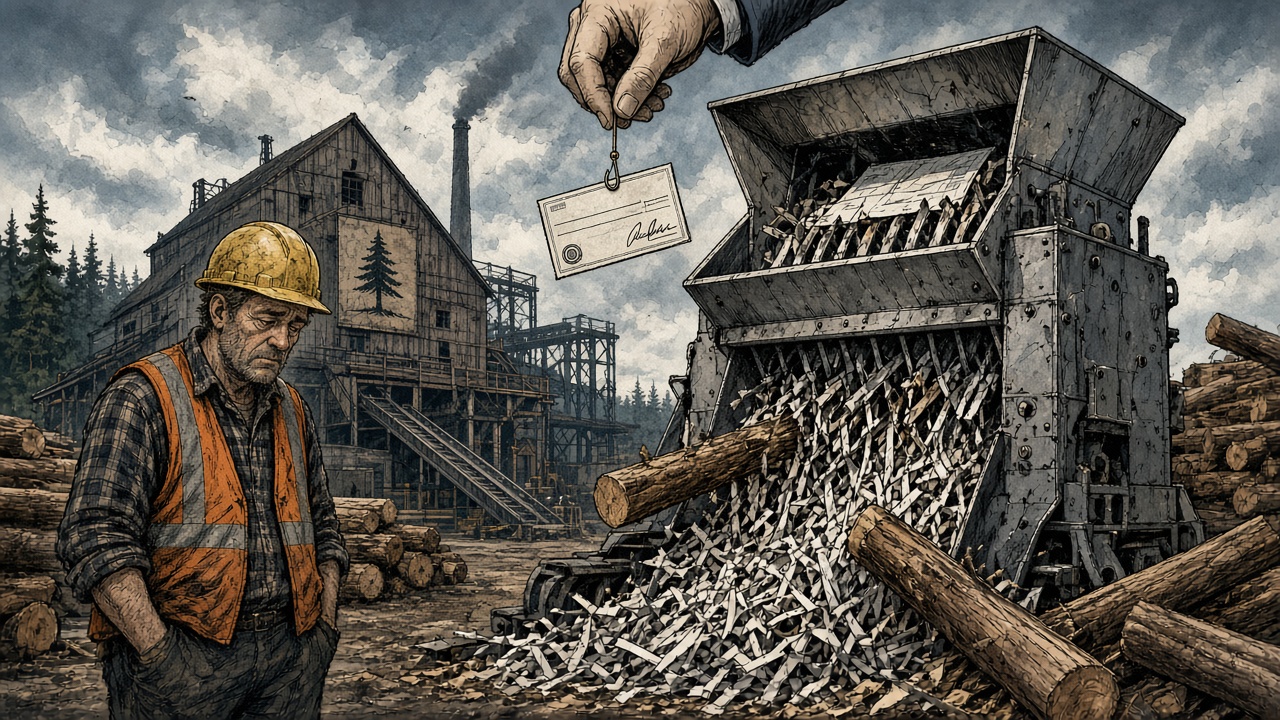
Ottawa is putting a big number on Canada’s forestry crisis: $6.5 billion. For British Columbia, that should be treated as help, not vindication. A federal cheque does not erase the provincial record that left mill towns asking whether fibre, permitting and competitiveness were being managed with any urgency.
The Canadian Press reports the federal budget includes $6.5 billion for Canada’s forest sector over six years, starting in 2027-28, while the exact share for B.C. remains unclear. The package includes $4 billion for a forestry-sector accelerator, $2 billion for facility and equipment modernization, and $500 million aimed at fibre supply through better forest management, stewardship and technology.
Those numbers are real. So is the warning attached to them. Kim Haakstad, president and CEO of the BC Council of Forest Industries, told The Canadian Press it is still unclear how much will flow to B.C. and said funding alone “cannot resolve the strain on our competitiveness.” Her stated test was practical: a clear strategy, concrete actions and timelines, more wood moving, investment attraction, and protection for forestry jobs and communities.
That is the part the outgoing NDP government cannot spin away. The sector is not only asking for money. It is asking for conditions that allow companies to operate, invest and keep mills tied to local paycheques. Haakstad also warned that because the new federal funding begins in 2027-28, timely implementation is essential while companies face immediate pressure.
The September record makes the same point even more sharply. B.C. forestry groups wrote to Premier David Eby saying the industry was at a “breaking point.” The groups acknowledged U.S. trade pressures are outside the premier’s control, but they also said many conditions are “homegrown”: provincial costs, regulations, policies, permitting processes and fibre-access decisions. Their ask was not abstract. They called for a crisis group led by the premier’s office and for B.C. to get economically viable wood moving.
Outgoing forests minister Ravi Parmar called the federal money a “good start” and said it reflected NDP advocacy. B.C. should demand its fair share. But advocacy is not the same as delivery. If a province has to wait for Ottawa while its own sector says provincial barriers are helping decide whether companies survive, the accountability question remains squarely in Victoria.
The hard truth is that a rescue package can expose failure as clearly as it can relieve it. B.C. forestry needs capital, modernization and trade relief. It also needs a provincial government that can answer the mill-town question in plain language: how much economically viable wood will move, under what rules, by what date, and with what result for workers?
Until those answers exist, the $6.5-billion headline is not a finish line. It is a receipt. Ottawa may be writing part of the cheque, but B.C.’s NDP spent years writing the conditions that made the crisis harder to survive.
Sources and records
- InfoNews / Canadian Press: Doerkson backs budget, hopes for big cut of forestry funds
- CityNews Vancouver / Canadian Press: forestry funding and B.C. reaction
- CityNews Vancouver / Canadian Press: B.C. forestry sector letter to Premier David Eby
- Global News / Canadian Press: forestry industry at breaking point