Eby’s $90M Tariff Package Can’t Patch B.C.’s Forestry Bottlenecks
Tariffs are real pressure. But the forestry sector’s own crisis letter points to provincial bottlenecks grants cannot solve.
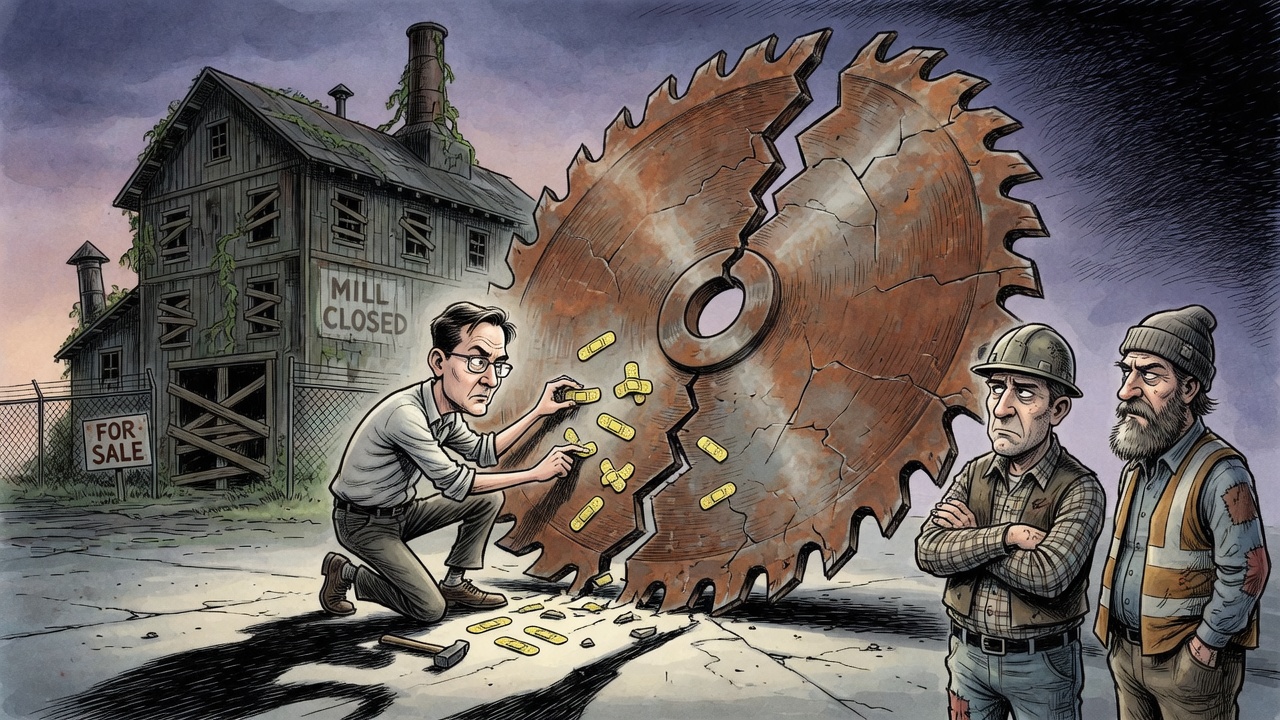
David Eby’s government has put a new number on its tariff response: $90 million. The province says the package will support businesses and communities affected by U.S. tariffs, with forestry applications prioritized and expedited because the forest sector is seeing the largest impact.
The money is split across existing programs: $30 million for a renewed BC Manufacturing Jobs Fund, $30 million for the Integrated Marketplace initiative, $15 million for rural economic infrastructure, and $15 million to expand BuyBC promotion beyond agriculture. Those may be useful tools for individual companies. They are not, by themselves, a forestry rescue plan.
The reason is sitting in the sector’s own September 4 letter to the Premier. Fifteen organizations representing workers, manufacturers, contractors, communities and businesses called for a Forestry Crisis Action Group led by the Premier’s Office. Their ask was not simply more financial assistance. They called for economically viable wood to move, costs to come down, regulatory barriers to be removed, fibre supply to stabilize, operating businesses to be protected, and forestry workers to be retained rather than retrained after closures.
That is a direct challenge to Victoria, because the letter draws a clear line between international trade pressure and provincial responsibility. U.S. tariffs are outside B.C.’s control. But many costs, regulations, permitting processes and Crown-fibre access decisions are made here.
The scale of the problem is also not hidden. A BC Conservative release citing the forestry letter says B.C. has lost 21 mills since 2023 and roughly 15,000 forestry jobs since 2022. It also points to the sector’s call to move from a Crown timber harvest projection of roughly 29 million cubic metres toward 45 million cubic metres. The open letter says that increase could generate almost $600 million in additional annual government revenue, based on COFI estimates.
The province’s new announcement says forestry-sector and forest-reliant community applications will be moved to the front of the funding line. That may help some operators survive the next invoice. But applications are not logs. Grants are not permits. Advertising campaigns are not fibre at a mill gate.
If the NDP wants this package to be more than a UBCM-stage Band-Aid, it should publish a forestry crisis ledger: how many permits are delayed, how much merchantable timber is tied up, what cost increases are being frozen or deferred, which ministers own each bottleneck, and how many jobs and facilities the plan is meant to protect.
Tariffs deserve a response. So do provincial failures that make B.C. mills less able to withstand those tariffs. The question for Eby is whether his government will fix the machine, or keep posing beside the bandages.