B.C.’s Decriminalization Pilot Changed Police Stats. The Health Outcomes Didn’t Move.
The NDP sold decriminalization as part of a life-saving response. New peer-reviewed evidence says the clearest measurable result was policing, not health.
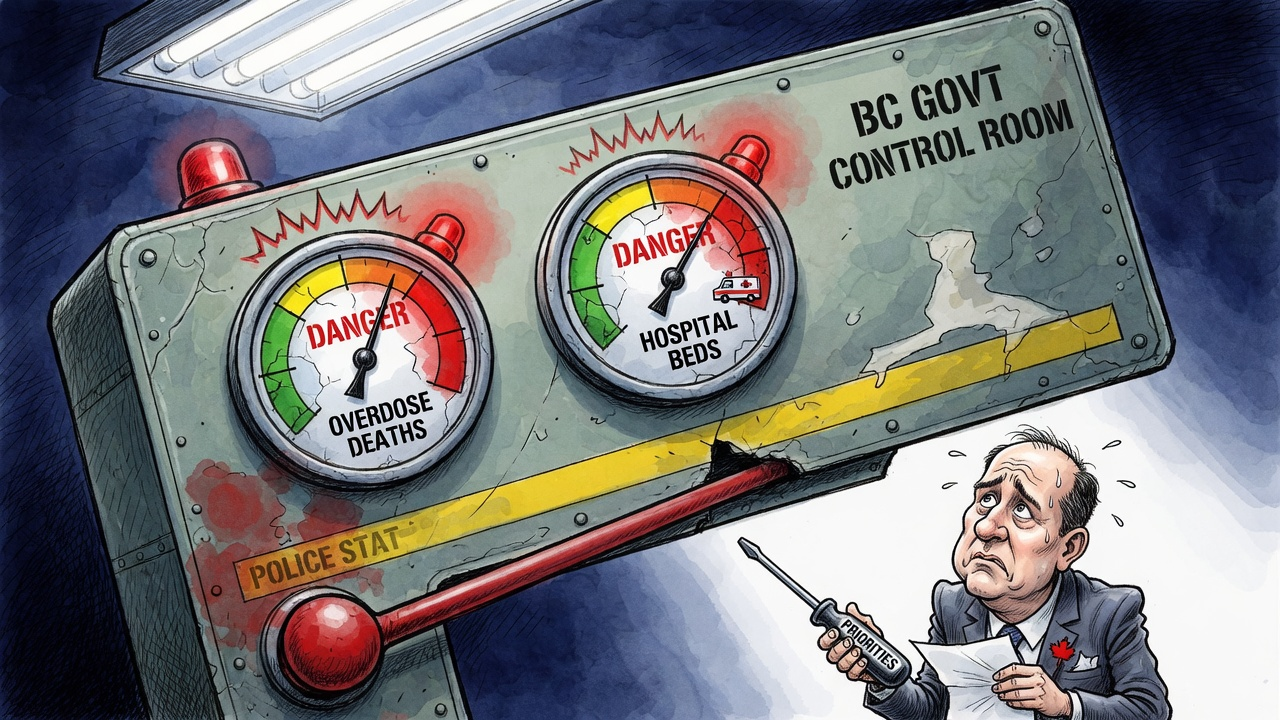
B.C.’s decriminalization pilot has always required a hard distinction between intentions and outcomes. The intention was public health: reduce stigma, help people come forward, and make contact with care easier. The outcome now documented in a new Canadian Medical Association Journal study is narrower and more uncomfortable for the NDP government.
The study examined data from August 2020 to March 2025, comparing B.C. with other Canadian jurisdictions before and after decriminalization began in February 2023, and after partial recriminalization in May 2024. It found that police-recorded possession incidents in B.C. fell after decriminalization, with an incidence rate ratio of 0.61, then rose after recriminalization, with an incidence rate ratio of 1.68. That is a real policing change.
But the same study reports no significant comparative change after decriminalization for opioid-related hospitalizations, stimulant-related hospitalizations, or drug-toxicity deaths when B.C. was compared with the relevant regions. The authors’ interpretation is blunt: decriminalization changed police-reported possession incidents but was insufficient on its own to affect health outcomes.
That does not prove decriminalization caused deaths. It does not settle debates over prescribed alternatives, public disorder, involuntary care, housing or treatment capacity. Those are separate questions. But it does undercut the idea that changing possession enforcement could be presented as a major health-policy win without clear evidence that deaths and hospitalizations were moving differently in B.C.
The province’s own decriminalization page says the 2023 pilot was intended to make it easier for people struggling with addiction to come forward for help. It also says the exemption expired on January 31, 2026 and was not renewed. In other words, the government launched the experiment, defended it through controversy, narrowed it after public pressure, and then let it end.
That sequence demands an honest after-action review. How many people were actually connected to care through the pilot? What services were available when police stepped back? Which warnings were ignored? Which metrics were used by cabinet before the program changed, and which were only discovered later?
The NDP cannot ask British Columbians to judge this file by compassion alone. Compassion without measurable delivery leaves vulnerable people exposed, families grieving, neighbourhoods strained and frontline workers improvising around policy gaps.
If decriminalization mostly changed the police ledger, then David Eby’s government owes the public a health ledger: deaths, hospitalizations, treatment access, outreach contacts, referral completion, public-safety impacts and cost. The lesson should not be partisan spin. It should be accountability for a policy that promised more than fewer possession files.
Sources and records
- Canadian Medical Association Journal: population-level time-series analysis of B.C. decriminalization and recriminalization
- Drugs and Alcohol Ireland record and abstract for the CMAJ study
- Government of B.C.: decriminalizing people who use drugs in B.C.
- BCCDC: decriminalization in B.C. background
- NewsForBC: accountability summary of the CMAJ findings