UBCM Just Backed a Raw-Log Export Ban. Eby Needs a Jobs Ledger.
B.C. local governments are warning that forestry towns cannot rebuild mills and paycheques while high-value fibre keeps leaving as raw logs.
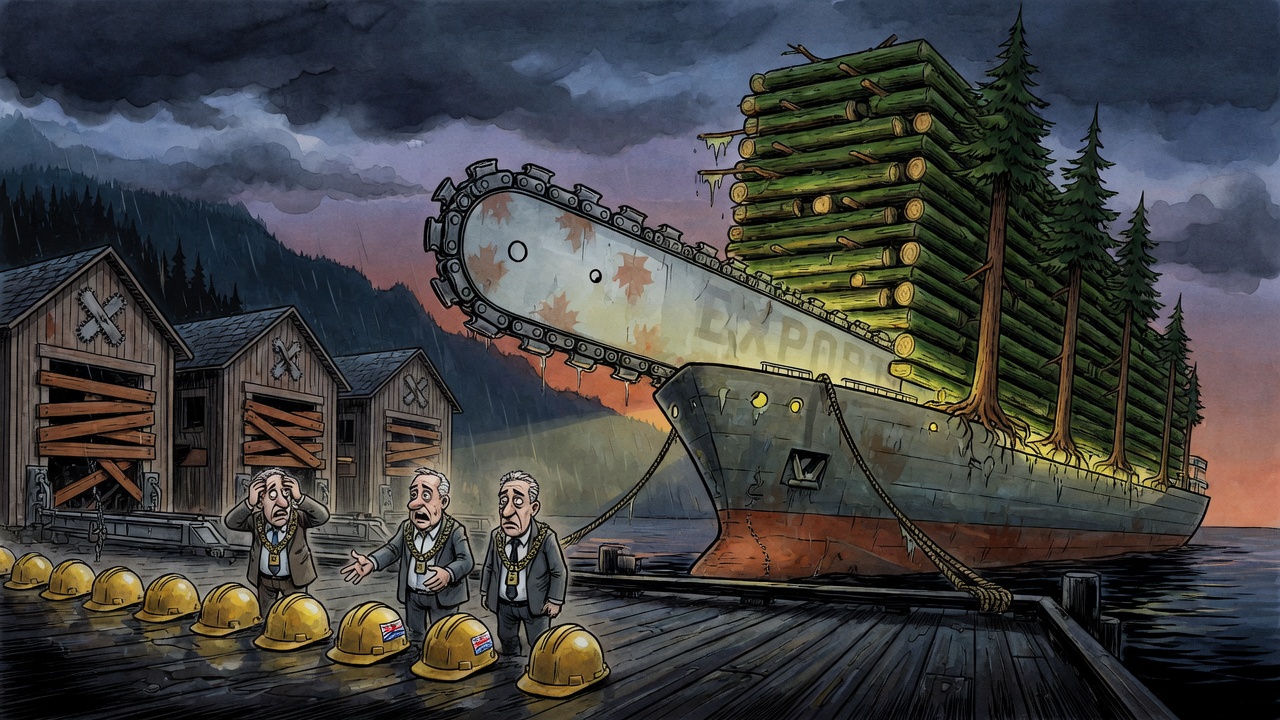
B.C.’s forestry crisis just got another local-government warning label. On Friday, Black Press reported that the Union of B.C. Municipalities endorsed Nanaimo’s request that the province ban raw-log exports out of British Columbia. UBCM met September 16 to 18 and voted on resolutions it will use to advocate for policy and legal changes, including a ban on raw logs and lumber cants leaving B.C.
The resolution is blunt about why this matters. It says inadequate and unaffordable fibre supply has been identified as a key factor behind curtailments and permanent closures at B.C. sawmills and pulp mills, with employment and tax income lost in resource-based communities. It also says 2.8 million to 3.5 million cubic metres of raw logs have been exported annually from B.C. over the last five years.
That is the accountability problem for David Eby’s government. The NDP keeps promising value-added forestry, stable communities and good resource jobs. But local governments are now saying the province cannot credibly talk about manufacturing more at home while raw fibre keeps moving offshore and mills keep fighting for supply.
The current provincial system is not a total free-for-all. As the News Bulletin noted, B.C.’s Forest Act requires logs to be offered to domestic buyers before export under a surplus test. Nanaimo Coun. Paul Manly’s warning cuts through the bureaucracy: as more mills close, it becomes easier to claim there is a surplus. In other words, the policy can become self-reinforcing. Fewer mills mean fewer domestic buyers; fewer buyers make exports easier; exports then leave fewer reasons to invest in local processing.
The government’s own forestry-economics report adds scale. According to the 2025 Economic State of British Columbia’s Forest Sector, the value of log exports remained around $400 million in both 2024 and 2025. China was the largest destination in 2025 at $220 million, followed by Japan at $100 million and the United States at $40 million. Those are not abstract figures for coastal and resource communities. They represent a real public-policy choice about where value is added and where paycheques are anchored.
A ban is not a magic wand, and government has a duty to show trade, legal and operational implications honestly. But that cuts both ways. If Victoria rejects or delays Nanaimo’s demand, it should publish the full ledger: annual log-export volumes by region, domestic offers and refusals, mill closures and curtailments, the number of jobs attached to lost processing capacity, and the tax-base impact on communities.
Forestry towns have heard enough slogans about transition. UBCM has put the question back on the province’s desk: is B.C. building a value-added forest economy, or simply managing the paperwork while raw logs and local paycheques leave the dock?