Eby Paused the PST Expansion. The Budget Hole Didn’t Pause.
B.C. delayed a tax increase days before it was supposed to hit professional services. The relief is real. So is the fiscal question.
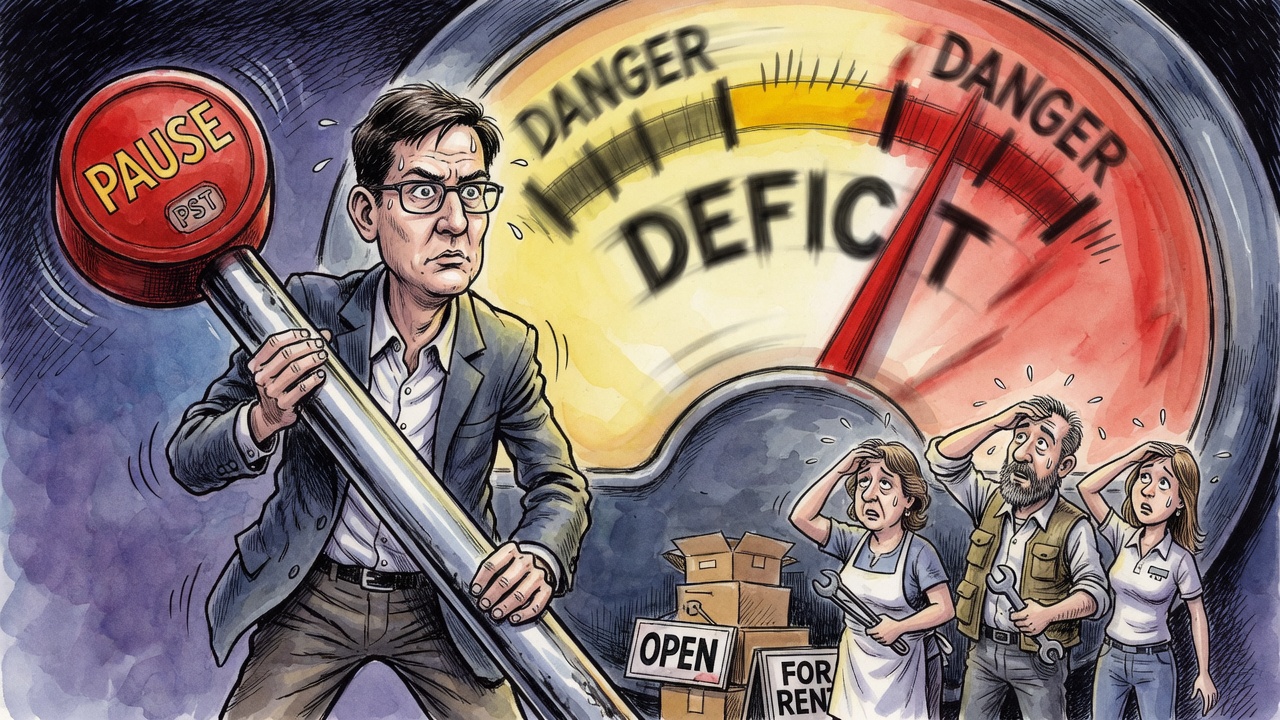
David Eby’s government has admitted, by its own action, that now is the wrong time to load another cost onto B.C. businesses.
On September 18, the Province said it is pausing the planned October 1, 2026 expansion of PST to professional services. The government framed the decision as a response to international trade disruption and said delaying the change would give employers, local governments and people “breathing room.” Global BC reported the same day that the expansion would have applied to a long list of professional services, including security and accounting.
That relief matters. Businesses warned for months that a new seven per cent tax on essential services would raise costs in an economy already under strain. Global reported in May that the Greater Vancouver Board of Trade launched its “Stop the Squeeze” campaign over the planned expansion, while exemptions were also set to disappear for some goods and services such as clothing and footwear services, basic cable television and landline telephone services.
But the pause also exposes the budget problem the NDP created for itself. Budget 2026 listed “Expand PST to certain professional services” as effective October 1, 2026, with taxpayer impacts of $261 million in 2026-27, $534 million in 2027-28 and $563 million in 2028-29. Those numbers were not campaign-trail chatter. They were in the Province’s fiscal plan.
Now the same government says the pause is worth approximately $260 million in 2026-27. In plain language, the NDP first built a budget around taking that money, then told businesses it would not take it yet because conditions are too uncertain. Both cannot be spun as steady fiscal management.
The government also announced new tariff-related business supports on September 18. Its own release lists an additional $30 million for the BC Manufacturing Jobs Fund, $30 million for the Integrated Marketplace initiative, $15 million for the Rural Economic Diversification and Infrastructure Program, and $15 million to expand BuyBC beyond agriculture. That is a separate spending package, described by the Province as a combined $90 million in new measures.
There is a legitimate policy case for helping exporters, manufacturers and forestry-reliant communities face U.S. tariff pressure. There is also a legitimate accountability question: if the tax was harmful enough to pause today, why was it budgeted to start in less than two weeks?
British Columbians do not need another slogan about flexibility. They need the ledger. Which programs will be reduced, which revenues will replace the paused PST expansion, or how much more borrowing will cover the difference? Until the NDP answers that, the pause is not a fiscal plan. It is a climbdown with an unpaid invoice.
Sources and records
- B.C. government: B.C. pauses PST expansion to professional services amid ongoing trade uncertainty
- Global BC: B.C. pauses planned provincial sales tax expansion
- B.C. Budget 2026/27–2028/29 fiscal plan
- Global BC: “Stop the Squeeze” campaign wants B.C. to remove expanded PST
- B.C. government: New supports for businesses, communities affected by U.S. tariffs