B.C. Parents Still Paying $52 A Day While Others Hit $10 Child Care
The NDP can call child care a signature affordability promise. Parents can read the bill.
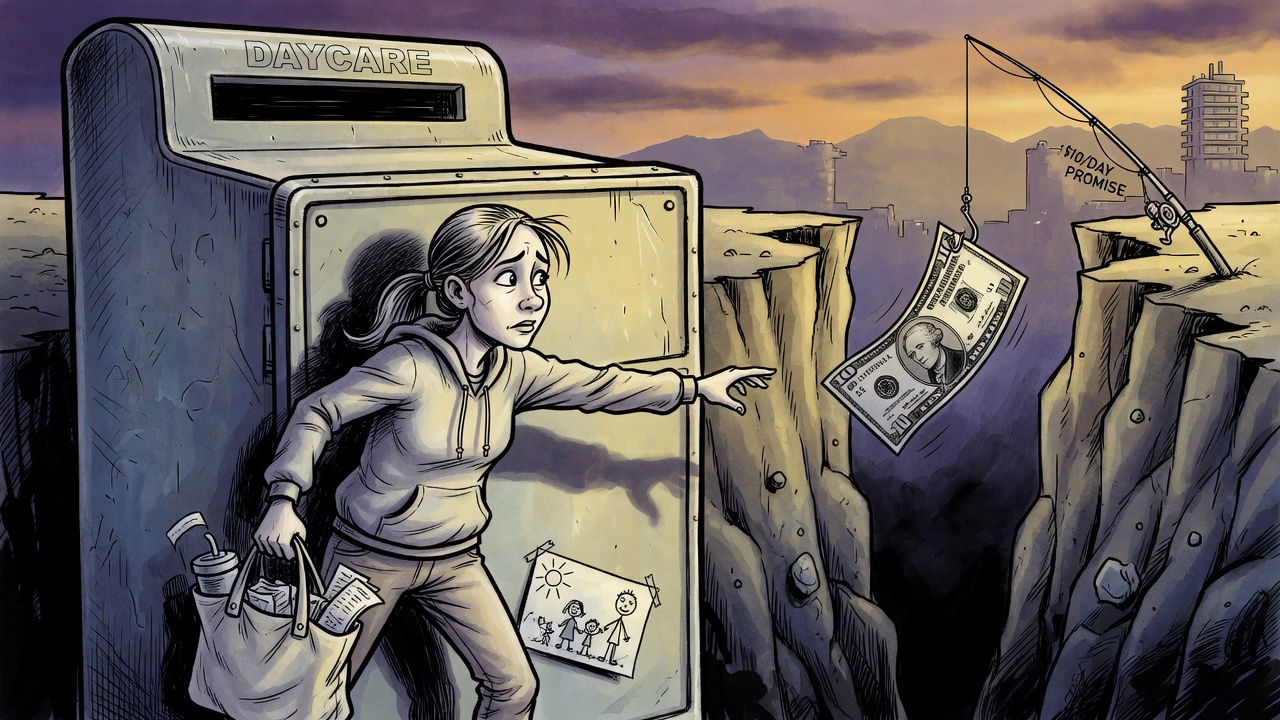
B.C. parents do not need another ribbon-cutting about the dream of $10-a-day child care. They need to know why, five years after the federal-provincial child-care deal, many families are still paying several times that amount while other jurisdictions have moved to clear fee caps.
A new Canadian Centre for Policy Alternatives report, released Aug. 19, compared licensed child-care fees in 35 Canadian cities. Its conclusion for British Columbia is brutal: the B.C. cities in the survey are the most expensive for infant care. The report says median infant fees in surveyed B.C. cities range from $28 a day in Kelowna to $52 a day in Richmond. For preschool-age care, B.C. again sits at the expensive end, with median fees ranging from $24 to $42 a day in those same cities.
That does not mean every B.C. parent pays $52 a day, and it does not mean the federal Canada-Wide Early Learning and Child Care program produced no savings. The report says parents with infants in B.C. cities are still saving roughly $300 to $500 a month compared with what fees would likely have been without the program. But that is exactly the accountability point: lower than the old unaffordable price is not the same as delivering the $10-a-day promise.
Other governments made the system simpler for parents. The CCPA report says Quebec, Newfoundland and Labrador, Prince Edward Island, Manitoba, Saskatchewan and Nunavut have set or maximum fees at or around $10 a day. Alberta is at $15. Ontario is at $22. B.C., by contrast, still relies on a market-fee structure where different providers charge different amounts and parents hunt for scarce spaces in a confusing lottery of availability, subsidy status and price.
CBC reported that Education and Child Care Minister Lisa Beare was not available for an interview. In a statement, Beare said the province is concerned about structural inequities in the existing $10-a-day program because access is not based on need but on a lottery system. The government has therefore put a three-year pause on expansion while it works with families, providers, Indigenous partners and Ottawa on what it calls a more inclusive, affordable and sustainable system.
That explanation admits the problem without solving it. If the program is inequitable, fix the entry rules. If the market-fee model is too complex, publish the path to a cap. If operators need stable funding, show the funding formula. But asking families to wait through a three-year pause while bills remain two, three, four or five times the headline promise is not an affordability plan.
David Eby’s government has spent years branding child care as proof the NDP understands working families. The test now is whether that branding survives contact with the monthly invoice. A parent paying $28, $42 or $52 a day is not living in a $10-a-day system. They are living in a promise gap — and the government owes them a date, a cap and a plan.