Highway 5 Heavy-Haul Bottleneck Shows B.C.’s Infrastructure Plan Has a Weight Limit
The B.C. Conservative Caucus says Highway 5 heavy-haul restrictions will last two years. Official CVSE rules show why the permit bottleneck matters.
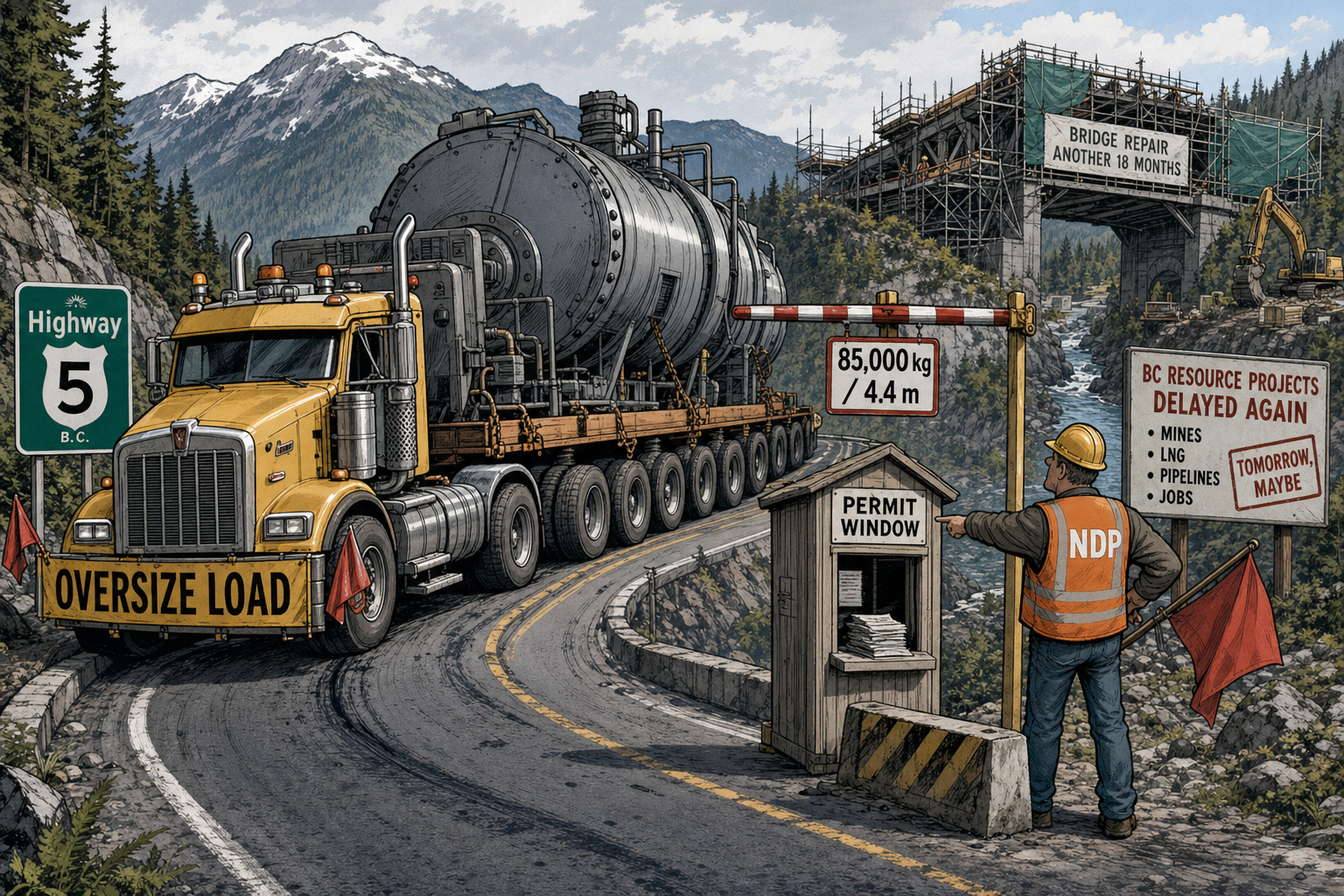
British Columbia can announce resource jobs, mine projects and construction targets all day. But if the province cannot move oversized equipment through a core Interior corridor, those announcements run into a very practical limit: the road.
On August 13, the B.C. Conservative Caucus said government restrictions on the Highway 5 heavy-haul corridor between Kamloops and Highway 16 are causing serious problems for truckers and the wider economy while bridge repairs are carried out. The caucus said oversized or overweight freight on that corridor is restricted for the next two years to a maximum weight of 85,000 kilograms and a width of 4.4 metres.
Those numbers are not random. The province’s own extraordinary-load page says the Commercial Transport Program is responsible for special authorizations, approvals or permits for vehicles or loads that exceed 85,000 kilograms, exceed 4.4 metres wide outside listed pre-approved routes, or exceed the Commercial Transport Procedures Manual’s policy limits. CVSE’s public site also says commercial-vehicle programs are delivered through Ministry of Transportation and Infrastructure field offices and its Victoria head office.
That means this is not just a private trucking complaint. It is a provincial infrastructure and permitting problem. If the bridge work is necessary, government still has to manage the economic consequences of narrowing the practical route for heavy-haul operators. The question is whether Transportation Minister Mike Farnworth’s ministry had a credible corridor plan ready before the restriction hit.
Harman Bhangu, the Conservative transportation critic, accused the NDP of being “caught flat-footed” and said Farnworth knew the work was coming. Kerry-Lynne Findlay said costs go up and projects are delayed when equipment cannot move, and called for one clear permit system. Those are partisan allegations, but the underlying demand is fair: British Columbians should be able to see the route options, permit timelines, temporary engineering limits, and mitigation plan for affected carriers.
The caucus also claimed one company lost hundreds of thousands of dollars because it could not retrieve rented equipment from northern B.C., and another lost about $75,000 in work after failing to get permits for an alternate route. Those claims should be tested publicly, not waved away. If the figures are wrong, the ministry should correct them with evidence. If they are right, the government owes truckers and resource employers an explanation for how a two-year constraint became their bill to pay.
This is the pattern British Columbians keep seeing: big promises at the podium, then bottlenecks in the system. A government serious about growth would publish a plain-language Highway 5 heavy-haul plan now: affected bridges, expected duration, approval thresholds, alternate corridors, average permit-processing times, emergency contacts and compensation or mitigation options where public planning failures caused avoidable losses.
Until then, the NDP’s infrastructure message has a weight limit. The province cannot build a stronger resource economy while leaving the people who move the equipment stuck at a permit window.