Eby’s Smoke Mask Rollout Looks Like a Patchwork Health Plan
If wildfire smoke is a serious health threat, British Columbians deserve more than limited pickup counters and instructions to ask locally for clean air.
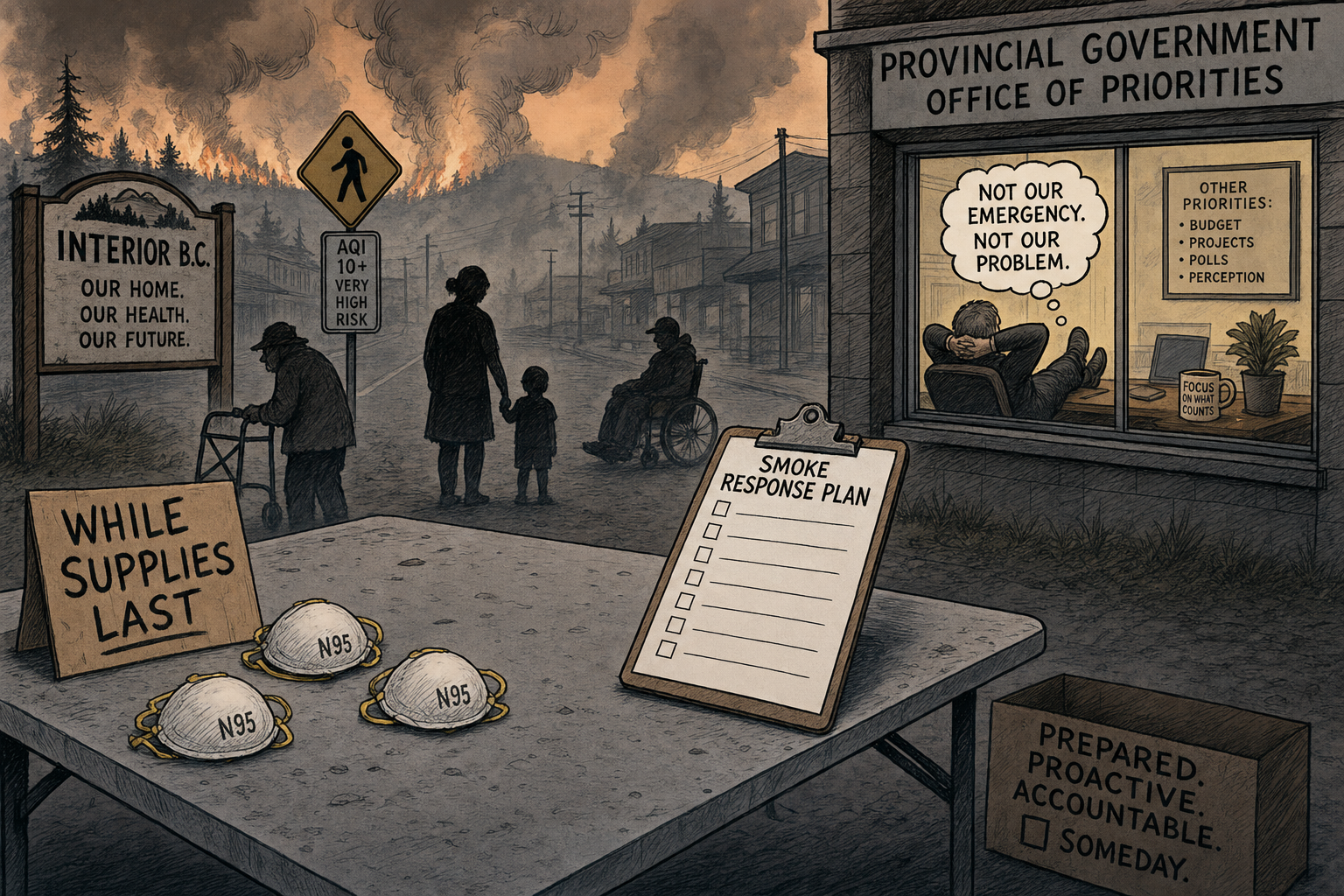
Wildfire smoke is not a minor nuisance. The Ministry of Health’s own August 15 bulletin says smoke exposure can affect health in the short term and the long term. Its quick facts name headaches, irritated eyes, sore throat, coughing, wheezing, worsened heart and lung conditions, and possible long-term chronic-disease risks including heart disease and dementia.
That is why the government’s free-mask announcement deserves scrutiny. B.C. says N95 respirator masks and medical masks are available at no cost through the Canadian Red Cross, with N95s now available in communities in the Interior Health region to help people reduce exposure to wildfire smoke. The problem is not that masks are useless. The problem is that the access model looks thin for the risk the government is describing.
The official pickup list is a patchwork. Ashcroft, Lake Country, Merritt, Peachland and Williams Lake sites are listed with weekday business hours. Kamloops has several locations, including two business improvement associations and a Salvation Army site with Monday-to-Thursday hours. Kelowna residents are directed to the UBC Okanagan campus-security dispatch office. One Richmond constituency office is also listed. The bulletin says masks may be available at no cost, “while supplies last.”
For vulnerable people, that matters. Smoke does not wait for office hours. Seniors, people with asthma, heart disease or diabetes, pregnant people, infants and young children are specifically named by the province as higher-risk groups. A serious public-health response should answer practical questions: who can get masks after hours, how rural residents without easy transportation are covered, how many masks are available, and whether the supply is enough for repeated smoke days.
The same bulletin tells people to check with local governments or First Nations for clean-air locations. It also says Emergency Management and Climate Readiness can reimburse communities for incremental costs from opening clean-air centres or extending public-space hours. Reimbursement is not the same as a clear provincial service standard. It leaves residents dependent on local capacity during a provincewide wildfire emergency.
Island Social Trends connected the announcement to the new health minister, Ravi Kahlon, who took over the health file one day earlier. That timing makes this an early test. The test is not whether the ministry can point to a mask table. It is whether British Columbians can see a provincewide health-protection plan that matches the smoke risk B.C. is now putting in writing.
David Eby’s government should release the operational numbers: supply counts by community, expected resupply dates, after-hours access, clean-air centre coverage, and the trigger for scaling beyond a short list of pickup desks. If wildfire smoke is a long-term health threat, the response cannot be a scavenger hunt.