Nanaimo’s Vandalism Problem Is Testing the NDP’s Repeat-Offender Pilot
B.C. points to Nanaimo as part of its chronic-property-offending model. Downtown businesses are still describing the damage after the announcement.
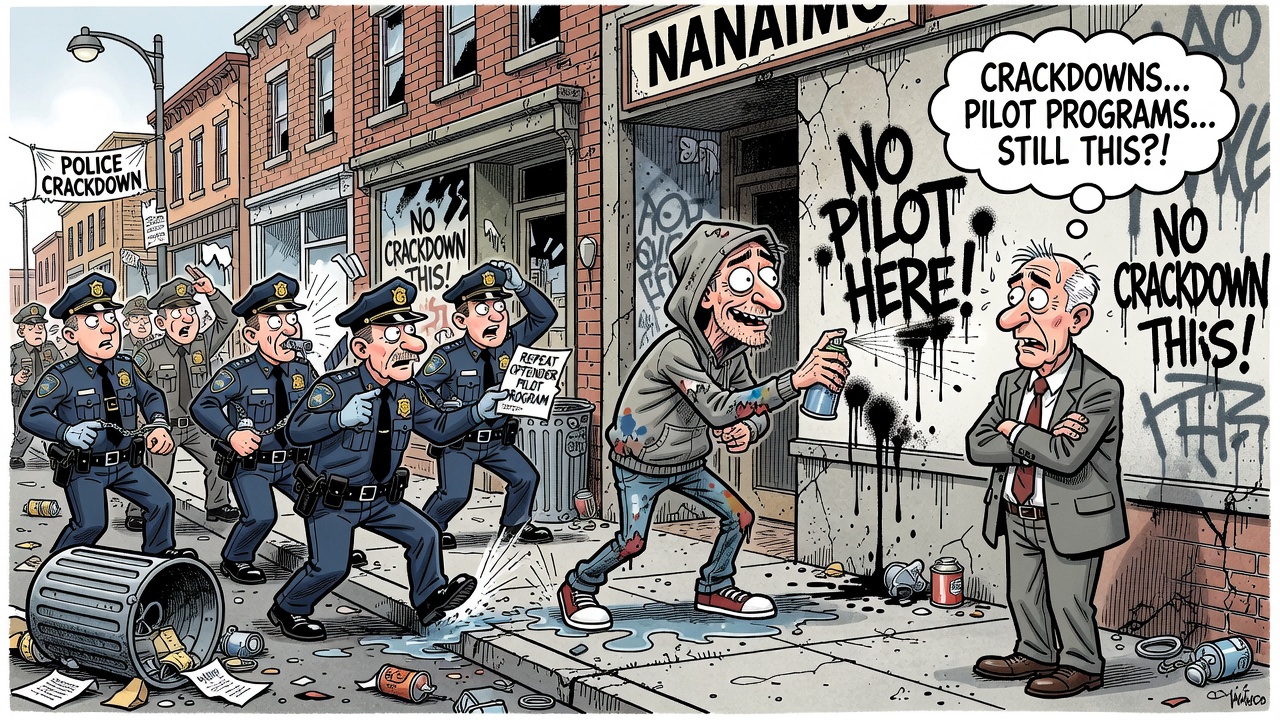
The NDP government wants British Columbians to believe its repeat-offender strategy is moving from announcement to results. Nanaimo is now a street-level test of that claim.
CBC reported on August 14 that some downtown Nanaimo businesses say vandalism continues despite a recent police crackdown. The story described extra RCMP enforcement on July 28 and 29 around Diana Krall Plaza, where police said they made 10 arrests, seized drugs and weapons, and recovered almost $1,000 in cash. Nanaimo RCMP framed the action as part of a longer effort to increase police visibility downtown.
That enforcement may address immediate incidents. It does not prove the underlying public-safety problem is fixed. CBC reported that an employee at Rumours Consignment said the store’s rooftop air-conditioning unit was ripped off the building on Wednesday. The same employee argued that enforcement alone will not bring lasting change, pointing instead to housing and wraparound supports.
Other downtown voices made the same distinction. CBC quoted business owners who said they were seeing the aftermath of sweeps and theft pressures, while Deborah Hollins of the Nanaimo Family Life Association said enforcement is only one part of the solution. CBC also reported that the Hub, a downtown resource centre formerly run by the association, closed in March. That is a key fact: if the province promises both accountability and support, the public is entitled to ask where the support capacity actually is.
The government cannot dismiss this as a local anecdote. Its own June 22 public-safety release, updated August 4, said small-scale pilots of the Chronic Property Offending Intervention Initiative had been underway in Kelowna, Nanaimo and Nelson since November 2025. The same release said Budget 2026 invests $16 million over two years to establish 13 new intervention and monitoring hubs provincewide, and said the model can include enhanced supervision, closer police-Corrections-prosecution coordination, and connections to housing, mental-health and addiction supports.
That is the right mix on paper: enforcement for chronic property offending, supports for complex needs, and clearer accountability for repeat offences. But Nanaimo businesses are not paying for paper. They are paying for repairs, security, lost merchandise, insurance headaches and the daily uncertainty of trying to operate in a downtown where confidence is fragile.
This should not become a cheap attack on homelessness. Homelessness, disorder and crime are not the same thing, and CBC’s story was careful about that. The accountability target is government performance. If Nanaimo is a pilot site, residents should see public metrics: how many chronic property offenders are being supervised, how many are connected to housing or treatment supports, what offences are falling, what damage is still rising, and what changed after the Hub closed.
David Eby’s government has named the problem. It has named the program. Now Nanaimo needs evidence that the model is making downtown safer — not just evidence that another crackdown happened.