Eby’s Cabinet Shuffle Moves the Same Problems to New Desks
The humane response is to wish Brenda Bailey well. The accountability question is why B.C.’s deficit, health-care crisis and jobs file are being passed around the same cabinet table.
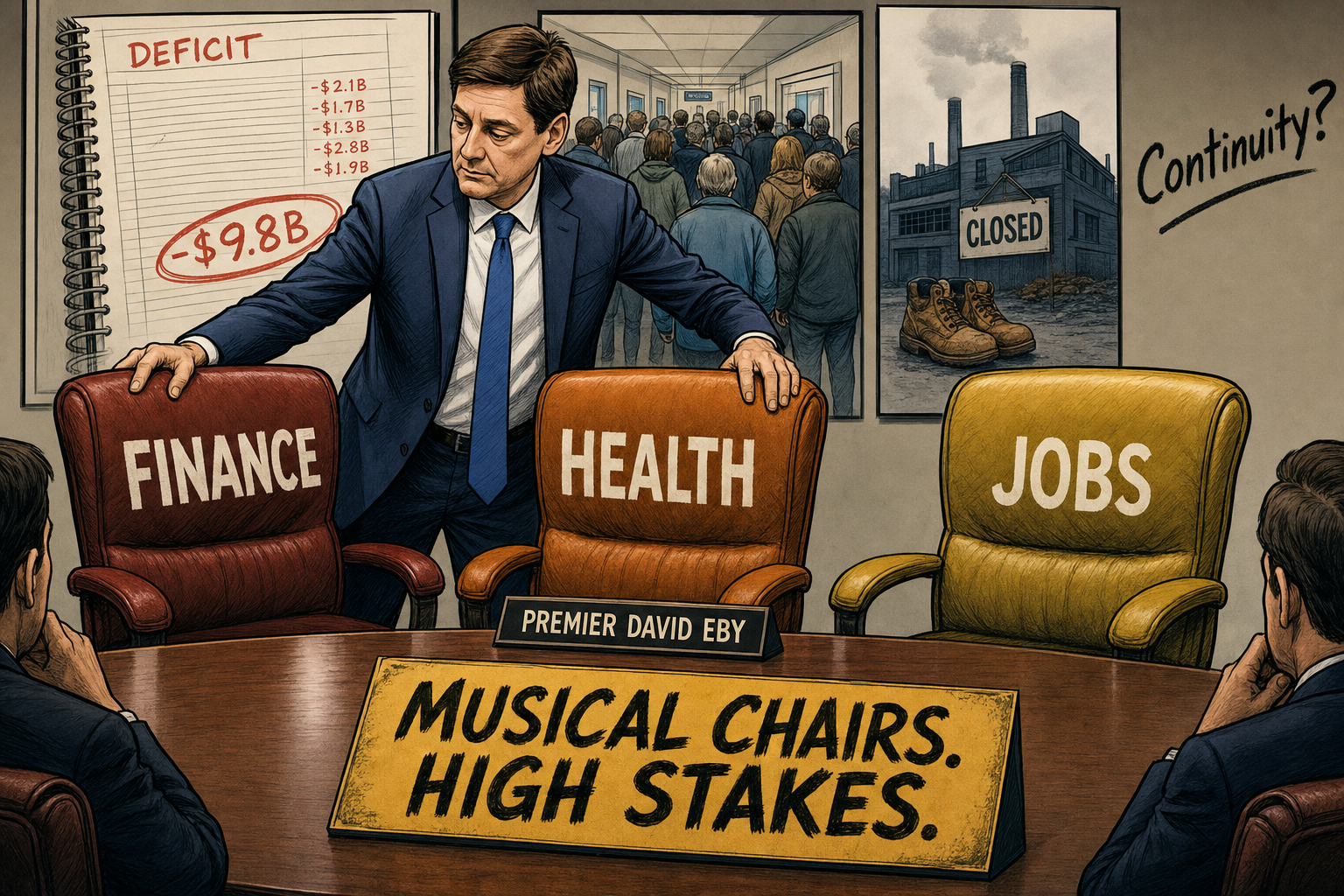
First, the human part: Brenda Bailey deserves privacy, treatment time and a full recovery. The political issue is not her diagnosis. It is David Eby’s claim that a sudden reshuffle can give British Columbians “continuity” on three of the biggest files in government.
According to The Canadian Press, Eby announced Friday that Health Minister Josie Osborne will take over Finance, Jobs Minister Ravi Kahlon will move to Health, and Bailey will move to Jobs. Energy Minister Adrian Dix will fill in at Jobs while Bailey receives treatment. CBC reported Eby said budget preparations are already underway, with deadlines and milestones to be set out in September.
That timeline explains the mechanics. It does not answer the accountability question. Finance is not a quiet caretaker file. Bailey delivered the latest fiscal update this week showing B.C.’s 2025-26 deficit at $7.7 billion, $3.3 billion lower than the previous estimate but still a major shortfall. Now Osborne, who was responsible for health care, inherits the budget table just as ministries begin lining up for money.
Global News reported UFV political scientist Hamish Telford’s blunt assessment that Osborne “struggled in health” and that the move from Health to Finance will be difficult because Health is the big-spending ministry and Finance is the ministry that has to say no. That is the point. A minister who has been asking for system resources is now responsible for the restraint, priorities and trade-offs across government.
Kahlon’s move is just as revealing. The Health Ministry is where B.C. families feel the government most directly: emergency-room closures, long waits, staffing gaps and access problems. If the answer is to move the Jobs minister into Health, then the public deserves more than a new nameplate. It deserves measurable targets, public reporting and consequences for missed benchmarks.
Eby can make a compassionate personnel decision and still owe voters a hard explanation of performance. This is the same cabinet table rotating the same pressures: deficit management, health-care delivery and economic credibility. Calling that continuity may be technically accurate. It is also the problem.
The test is simple. If the shuffle is more than musical chairs, Eby should publish the September budget milestones, the health-care delivery targets Kahlon is expected to meet, and the jobs-and-economy measures Bailey will inherit. Otherwise, British Columbians are being asked to trust that the same government which created the mess will fix it by changing seats.