Eby’s Bald Range Wildfire Review Must Not Be a Blank Clipboard
After the Bald Range wildfire forced mass evacuations and exposed Highway 97 fragility, the promised review needs public terms, dates, routes and decision records.
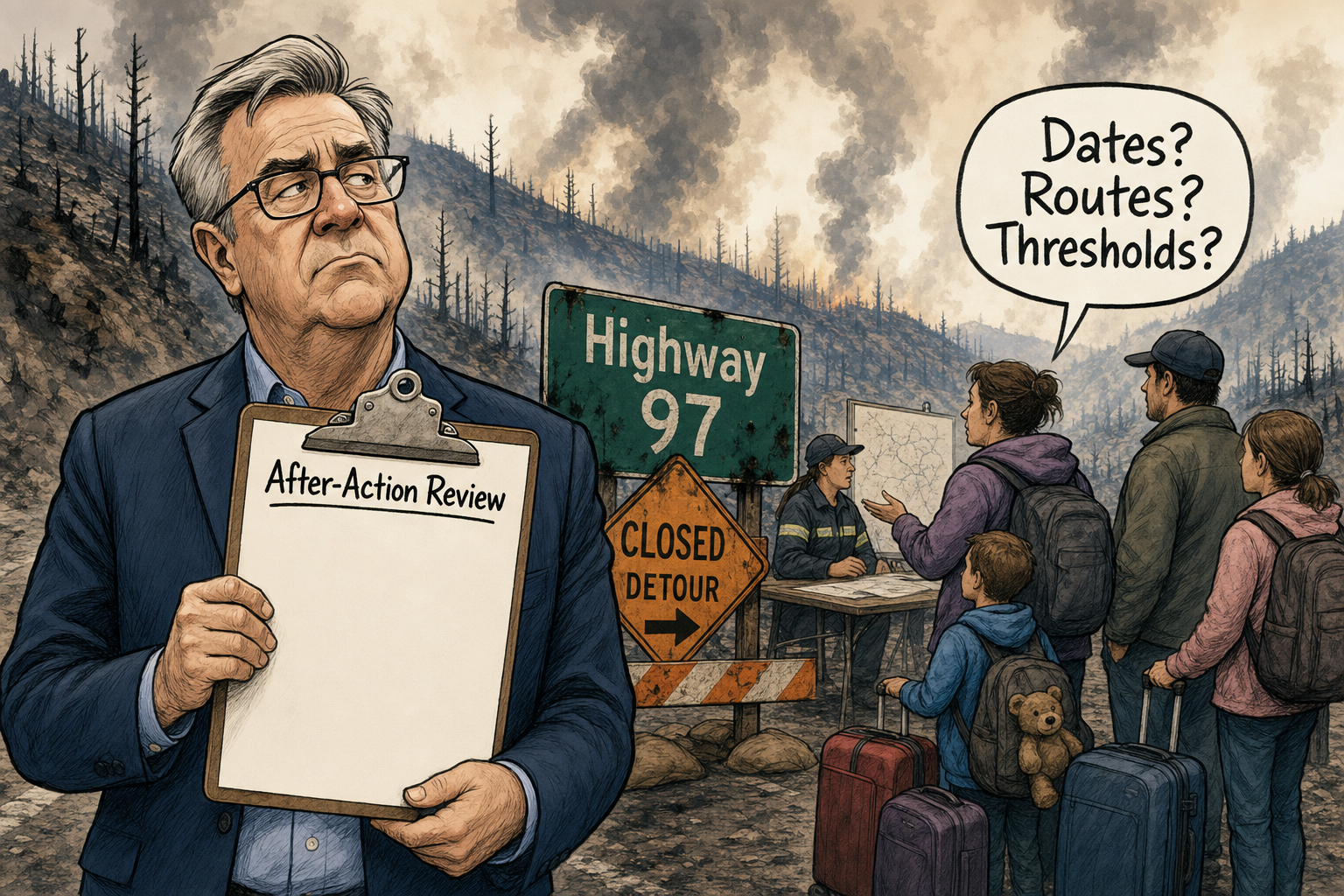
Premier David Eby now says B.C. will review the emergency response to the Bald Range wildfire near Summerland. That promise is necessary. It is not enough.
CBC’s Wednesday evening wildfire file reported the Bald Range fire at 184 square kilometres, with more than 12,000 people evacuated since Friday, numerous homes destroyed, damage assessments still underway, and one confirmed fatality involving an 80-year-old woman fleeing with family. The same CBC file said provincial and local authorities described a horrific fire that overwhelmed officials as it spread faster than modelling had predicted.
The Associated Press reported the broader evacuation scale at more than 20,000 people and said crews had to stop fighting the fire to help residents escape. That is not a routine incident. It is a public-safety stress test of planning, warning systems, evacuation routes, staffing, communications and the province’s assumptions about how fast fire can overrun communities.
Eby told the CBC there were lessons to take from how quickly the fire grew, saying this may be the province’s new normal. If that is true, then the review cannot be an internal debrief that disappears into government process language. It needs public terms of reference, a due date, named agencies, decision timelines and a plain-English action list.
The first question is timing: when did provincial and local officials know the fire had outrun modelling, and when did operational priorities shift from suppression to evacuation support? The second is warning: what did residents receive, when, and through which channels? The third is capacity: what resources were requested, what arrived, and what was unavailable when the fire accelerated?
The fourth question is infrastructure. CBC reported Eby addressed the need for alternative routes after Highway 97 was closed through Summerland, cutting the only direct paved north-south route through the Okanagan Valley. He said the province would work with the local community and the Ministry of Transportation on prioritization. That cannot remain a vague sentence. Okanagan residents deserve a route-by-route options paper, cost ranges, risks, timelines and the reasons previous warnings did not produce a resilient backup.
No review can undo the loss people are now facing. But a narrow, private review would add insult to damage by asking evacuees to trust the same system without seeing its records. British Columbians do not need another clipboard photo-op. They need the questions released in advance, the evidence preserved, the findings made public, and each accepted fix assigned to a minister, a budget line and a deadline.