B.C.’s Treaty Ledger Lists 135,425 Hectares — and Future Costs Marked TBD
The issue is not whether modern treaties matter. The issue is whether the public ledger is plain enough when Crown land commitments and future costs sit in the same note.
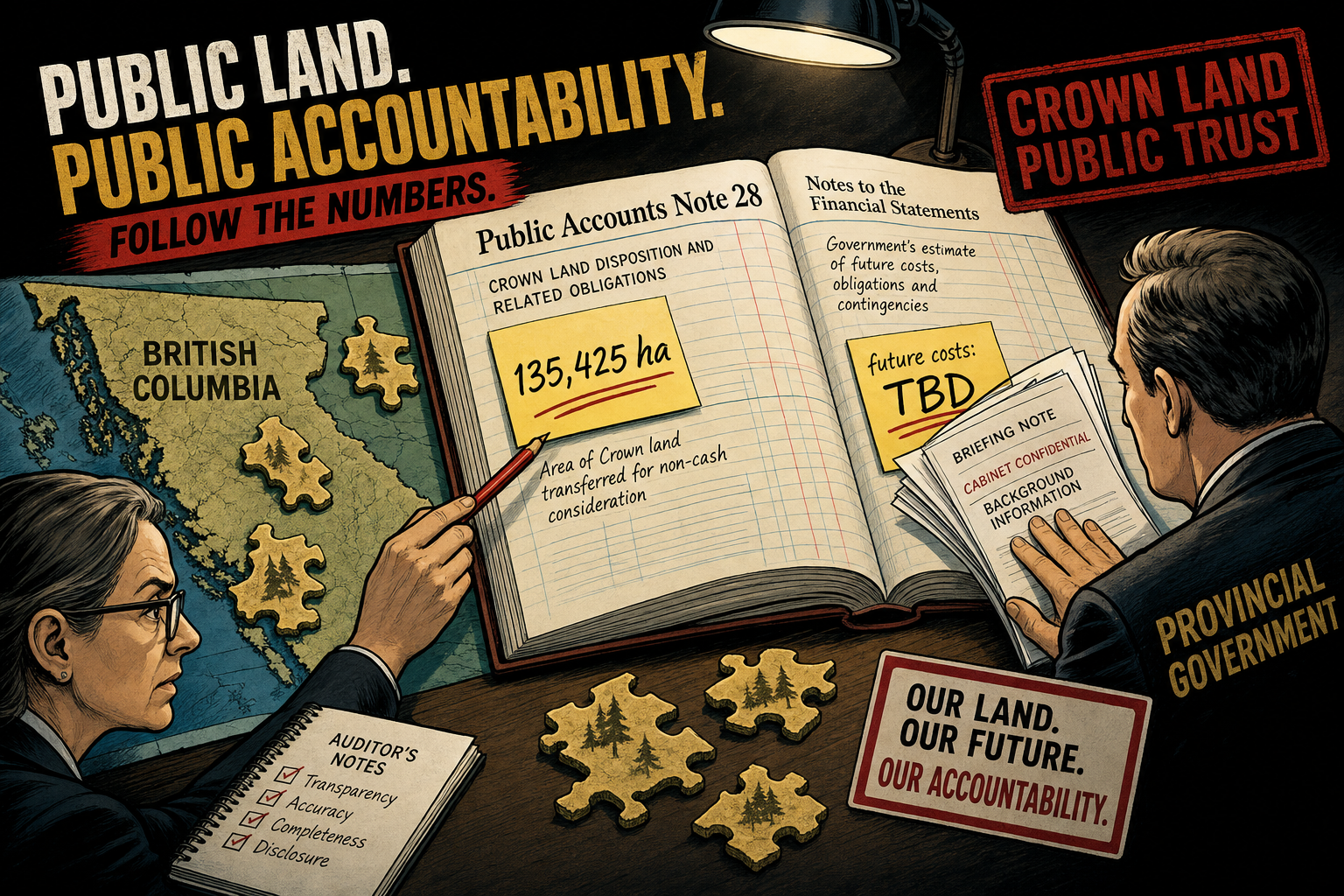
B.C.’s treaty accounting deserves more sunlight than a dense note near the back of the Public Accounts. In Note 28 of the 2025-26 Public Accounts, the province lists current commitments of provincial Crown land for Final Agreement and Incremental Treaty Agreement tables. Add the entries together and the total is 135,425.3 hectares.
That number should be discussed plainly. It is larger than many British Columbians will ever encounter in a budget speech, a news release, or a campaign talking point. The Public Accounts list major entries including Kitsumkalum at 45,789 hectares, Kitselas at 35,290 hectares, Wuikinuxv at 13,946 hectares, In-SHUCK-ch at 9,474 hectares, and Yekooche at 5,960 hectares.
This is not an argument against Indigenous rights, modern treaties, or reconciliation. It is an argument for honest public accounting. The same official note says treaty negotiations between B.C., Canada and First Nations began in 1994 and are expected to result in modern treaties defining the boundaries and nature of First Nations treaty settlement lands. As of March 31, 2026, the province reported 37 First Nations Groups in active or completed negotiations, representing 61 current or former Indian Act bands.
The government’s own negotiations page says the Ministry of Indigenous Relations and Reconciliation negotiates treaties and other arrangements to create economic certainty over Crown land and resources, and that the ministry works with First Nations, federal counterparts, agencies, interest holders, industry, local government and the public. That is exactly why the ledger has to be readable outside government.
The most important line in Note 28 may be the one after the land list. The province says treaties and other incremental agreements will also trigger implementation costs and may result in compensation to third parties. It then says those costs are not determinable at this time. The note also says some First Nations pursue claims through litigation and that any provincial liability is not determinable.
Those are material caveats. They do not make the agreements wrong. They make the public-accountability duty stronger. British Columbians should be able to see what land is committed, which files are involved, what costs are known, what costs are unknown, and how local governments, interest holders and affected communities are being kept informed.
David Eby’s government cannot ask the public to trust a reconciliation agenda while leaving the practical accounting buried in specialist language. If 135,425.3 hectares are already listed in the province’s own Crown-land commitment tables, the next step should be a plain-English treaty ledger: agreement by agreement, hectares, status, implementation obligations, potential third-party compensation, and the disclosure process for communities.
Reconciliation does not require a foggy ledger. It requires the opposite: clear numbers, fair process, and public records strong enough to earn confidence.