B.C.’s Auditor Found a $7.1B Hole in the Contract Ledger
The deficit headline is only the surface. The independent auditor says the Public Accounts also failed to disclose billions in future contract obligations the public needs to see.
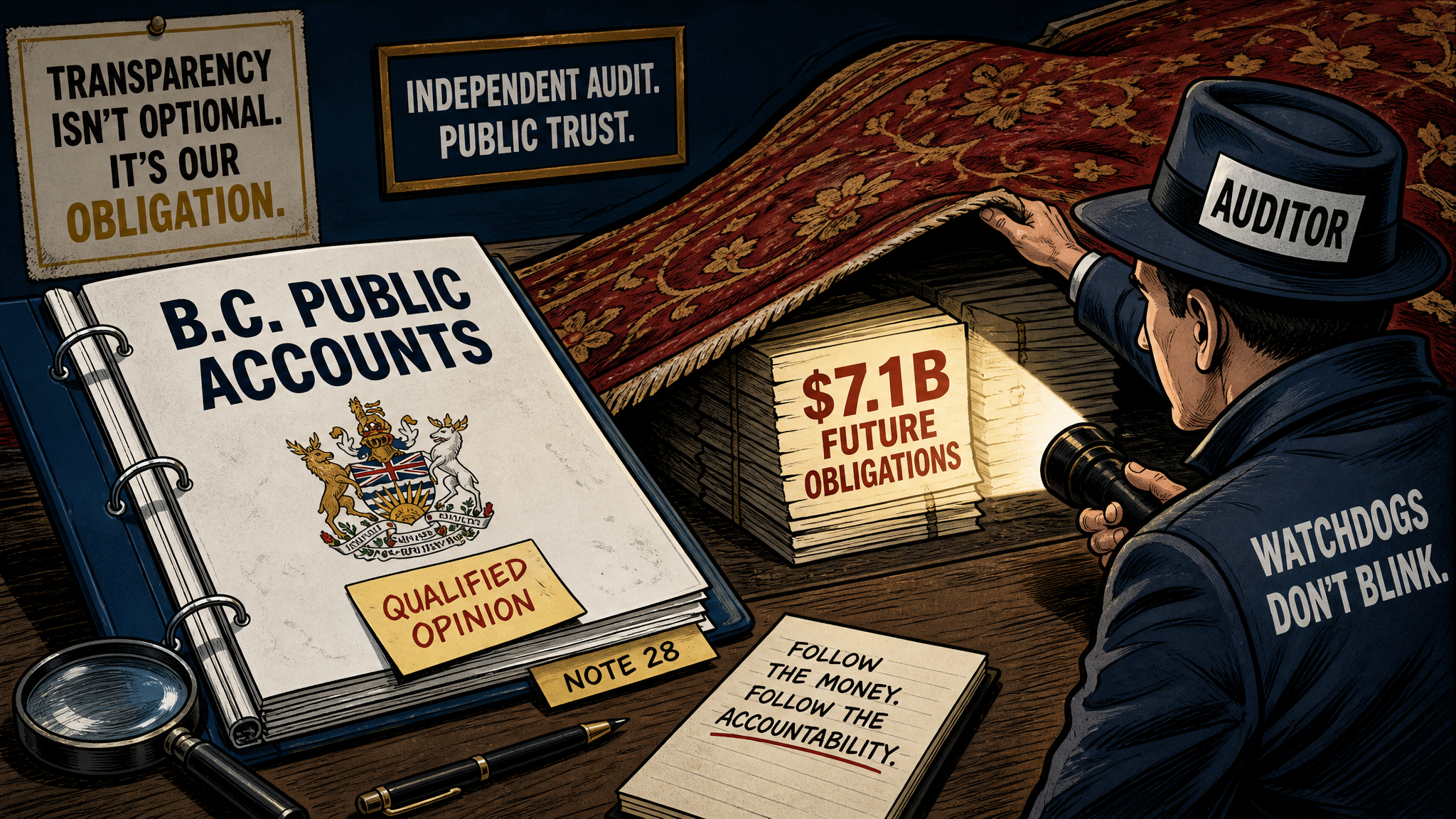
B.C.’s 2025-26 Public Accounts should not be reduced to one deficit headline. The more damaging accountability issue is inside the independent auditor’s report: the auditor gave the province’s consolidated Summary Financial Statements a qualified opinion and identified incomplete disclosure of future contract obligations.
A qualified opinion is not a routine pat on the back. Auditor General Michael Pickup says the statements present fairly in all material respects except for the effects of the matters described in the basis for qualified opinion. One of those matters is the province’s treatment of deferred revenue. The other is even more direct for taxpayers trying to understand what government has already committed them to pay.
The auditor says Canadian public sector accounting standards require disclosure of contractual obligations that commit government to expenditures for a considerable period into the future. That disclosure matters because it tells readers how much of tomorrow’s public money is already spoken for today.
According to the auditor, the consolidated Summary Financial Statements did not provide all required disclosures. The report says certain larger contracts, along with many contracts below the government’s $50-million disclosure threshold, were not disclosed in Note 28, the note covering contingent liabilities and contractual obligations.
The estimated size of the omission is not small. The auditor’s table lists an understatement of contractual obligations totalling $7.068 billion: $1.880 billion in 2027, $1.204 billion in 2028, $870 million in 2029, $697 million in 2030, $588 million in 2031, and $1.829 billion in 2032 and beyond.
This is exactly the kind of information British Columbians need when debt is rising and the government is asking the public to trust its fiscal plan. The point is not that every contract is bad. The point is that the public ledger must be complete enough for MLAs, journalists, taxpayers and service users to judge the commitments already made in their name.
The deferred-revenue qualification also undercuts any easy political spin. The auditor says the province’s method represents a departure from Canadian public sector accounting standards when contributions do not meet the definition of a liability. As of March 31, 2026, the auditor says deferred revenue, annual deficit and accumulated deficit were each overstated by $10.76 billion, with revenue understated by the same amount; $0.91 billion related to the current fiscal year.
That does not make the government’s fiscal position simple. It makes it more important to show the math plainly. British Columbians are looking at deficits, debt, capital promises, service pressures and future contractual obligations at the same time. When the auditor says billions in contractual obligations were left out of the required note, the answer should not be spin. It should be a corrected, plain-English ledger.
The accountability test is basic: disclose the contracts, explain the threshold, reconcile the auditor’s $7.068-billion estimate, and show taxpayers the future bills before government celebrates the books.