Prince George’s Demolished Motel Shows the NDP Housing Model Needs a Ledger
A 44-unit temporary supportive-housing site is coming down. The public deserves a clear accounting of replacement capacity, costs and results.
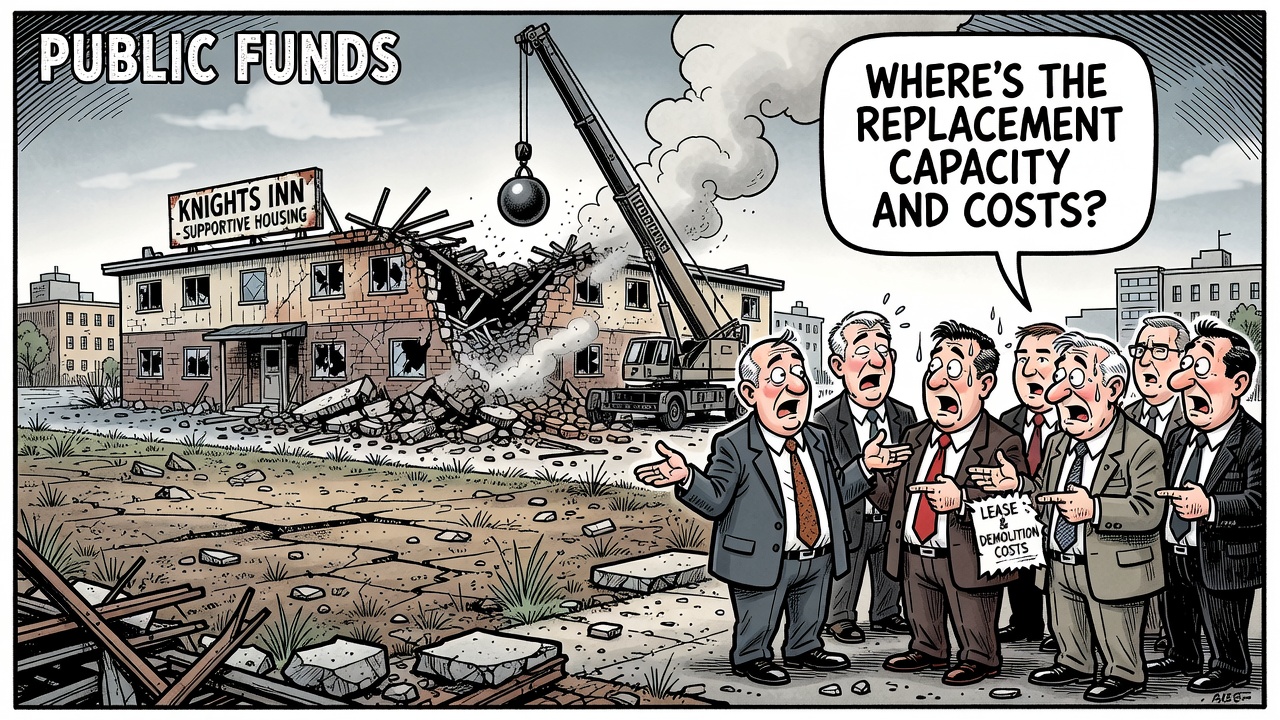
Prince George is about to lose a very concrete piece of B.C.’s supportive-housing experiment: a former motel that became temporary housing, then a city redevelopment asset, and now a demolition site.
CBC News reported August 10 that the City of Prince George is demolishing the former Knights Inn Motel at 650 Dominion Street to make way for future downtown redevelopment. Workers were expected to begin tearing down the building Monday morning. The site sits inside the city’s Civic Core District planning area, where Prince George is considering long-term municipal-property changes including a performing arts centre, a new ice arena, a mixed-use hotel and residential housing.
None of that is automatically wrong. Downtowns need renewal. Aging buildings do reach the end of their useful life. The question is whether the public ever gets a clean ledger when emergency housing is treated as temporary inventory.
CBC reported B.C. Housing had used the former Knights Inn as a 44-unit temporary supportive-housing site since October 2021. The facility was part of Prince George’s push to increase supportive housing while meeting legal requirements tied to closing the Moccasin Flats homeless encampment. In October 2023, the city bought the building for $4.1 million and allowed B.C. Housing to lease it for two years.
The money matters. CBC reported B.C. Housing paid its 24-month lease fees upfront, contributing $1.134 million toward the purchase price. The provincial housing agency also agreed to contribute a fixed $450,000 toward demolition costs, while total demolition costs are $1.4 million. The lease expired March 30, 2026. CBC reported all occupants had been moved to other supportive housing in the city by July.
That last fact is important. This is not a claim that former residents were abandoned into homelessness. The reported record says they were moved to other supportive housing. But that does not end the accountability question. It starts it.
If 44 temporary units were removed from the system, where are the replacement units, how many are net-new, and what support levels do they carry? How much did B.C. Housing spend per year for the temporary motel capacity? What did taxpayers receive for the lease contribution and demolition contribution? And if the motel was always a short-term answer, when did the province set out the permanent-housing plan for the people and pressure it was meant to stabilize?
The City’s Civic Core District page says the plan is meant to strengthen the local economy, improve downtown vibrancy and enhance quality of life. Those are legitimate goals. But in a city still dealing with homelessness, encampment pressure and downtown disorder, housing capacity cannot disappear into redevelopment language.
Premier David Eby’s NDP government often sells supportive housing as proof of action. Prince George’s Knights Inn file shows why action also needs accounting. Temporary sites may be necessary. But after five years, millions in public commitments and a scheduled demolition, British Columbians deserve a simple answer: did this model create durable housing capacity, or just move the crisis from one address to the next?