Federal Shelter Help Should Not Be the Backup Plan for B.C. Evacuees Sleeping in Cars
When evacuees report 14-hour ESS waits, B.C. owes answers about reception-centre capacity, staffing and accommodation planning.
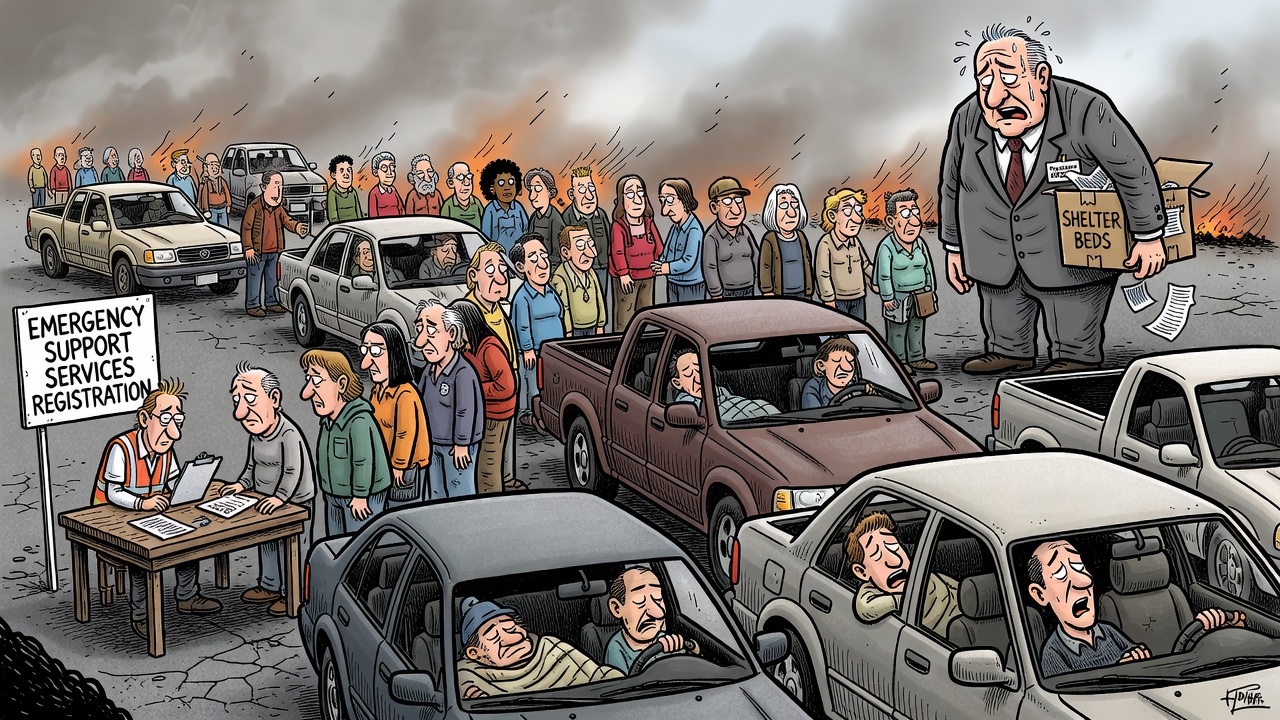
B.C.’s wildfire emergency has exposed a basic service-delivery question: when people obey evacuation orders, can the provincial support system actually receive them at the speed the crisis demands?
Global News reported August 9 that the federal government approved a B.C. request for assistance to provide shelter and accommodations for wildfire evacuees. Federal Emergency Management Minister Eleanor Olszewski said federal officials had been tasked to work with the province so support reaches “those who need it most.” That help may be necessary. It should not be the first moment the public learns the shelter system is straining.
The human details are sharper than any government statement. Global reported that some evacuees at the Penticton Trade and Convention Centre said they had been sleeping in vehicles after arriving. Allan Jennens told Global he had spent 14 hours in line trying to register for assistance. Kathleen Newman, another evacuee interviewed by Global, said she also had to wait about 14 hours to get registered and said there was “definitely something wrong with our system.”
Those are reported individual accounts, not proof that every evacuee faced the same wait. But they are serious enough to demand a cabinet-level answer. The Penticton centre was receiving people from Summerland, the Regional District of Okanagan-Similkameen and Penticton Indian Band lands. Global reported about 10,000 homes were under evacuation orders in those regions, with more than 3,200 under alert.
Premier David Eby’s August 8 statement said the Bald Range wildfire had grown rapidly, caused significant losses of homes and property, and left some people trapped as conditions changed quickly. The same statement said a key focus was making sure evacuees had a safe place to stay, urged people who could stay with family and friends to do so, and said the province believed it had “sufficient resources at this time.”
That line now needs a dated explanation. If B.C. believed resources were sufficient on Saturday, why were evacuees telling Global they slept in cars and waited roughly 14 hours to register? Was the bottleneck beds, staff, forms, online ESS access, transportation, hotel rooms, communications, or all of the above?
EmergencyInfoBC’s current guidance tells evacuated people to register with Emergency Support Services and stay with family or friends if possible to preserve emergency accommodation for those most in need. That is reasonable triage advice. It is not an excuse for a registration system that appears, from Global’s reporting, to have been overwhelmed at the point of need.
Frontline volunteers, firefighters, RCMP, local officials and reception-centre workers deserve gratitude, not blame. The accountability belongs higher up. B.C. needs to publish reception-centre staffing levels, online-registration performance, accommodation capacity, overflow triggers and federal-assistance timelines. Evacuees did their part by leaving. The province must prove its emergency-support system can meet them when they arrive.