B.C. Can’t Build a Critical-Minerals Economy on a Suspended Training Path
The government is selling critical-minerals jobs. BCIT now says its mining engineering continuation path is suspended for the September 2026 intake.
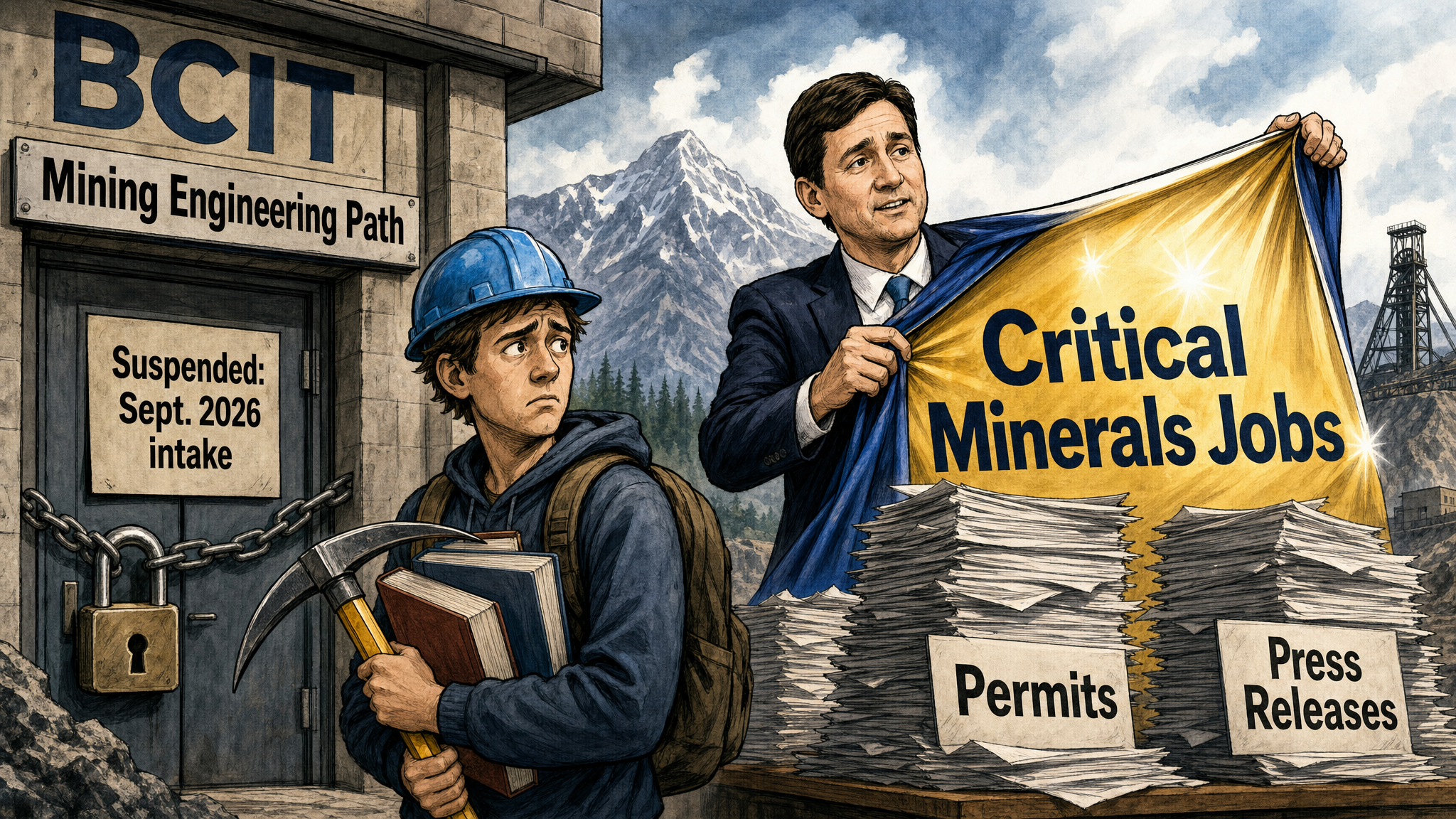
Budget 2026 sells mining as a pillar of B.C.’s economic future. Under the heading “Capitalizing on critical minerals,” the government says exploration investment hit $750 million last year, permitting processes are being sped up, and more than $40 million over three years will go toward capacity, reducing duplication and cutting the permitting backlog.
Then comes the workforce promise. The budget speech says major projects will create a “huge demand for skilled people” and points to $241 million in new funding over three years for training in in-demand skills, higher wages and trades certification.
That sounds like a plan until you check one of the province’s own public training pathways. BCIT’s Bachelor of Engineering in Mining and Mineral Resource Engineering page now states that the program has been suspended, effective for the September 2026 intake. The same page describes the degree as a continuation path for qualified students who complete the first year of the Mineral Exploration and Mining Technology diploma, followed by three more years of full-time study.
BCIT does not describe mining as a minor niche. Its program page calls the mineral resource industry a cornerstone of many communities in B.C. and Canada, and says technical jobs in mining and mineral exploration generally require post-secondary education. Its diploma page says employees are in demand because the sector faces a shortage of qualified professionals as the workforce ages and retires.
The diploma page also tells students that the BCIT mining engineering bachelor’s degree is no longer available as a continuation option because it has been suspended effective Fall 2026. That is the contradiction: the government says B.C. is on the edge of a minerals jobs boom, while a named engineering route at a major public institute is no longer taking the next intake.
There is no need to overstate the case. The public record here does not show the NDP directly ordered BCIT to suspend the degree. But government is responsible for the post-secondary system it funds, the labour-market strategy it advertises and the economic promises it asks voters to believe.
The pressure is not only in classrooms. In June, the Ministry of Mining and Critical Minerals extended a regional pause on new mineral, placer and coal tenures in parts of northwestern and north-central B.C. until January 31, 2027, saying the pause supports land-use planning, First Nations work and engagement. Existing tenures are not affected, but new registrations remain paused in the covered area.
If critical minerals are central to B.C.’s future, the Eby government owes the public more than ribbon-cutting language. It should explain how many mining engineers and technologists the province needs, which seats will train them, how suspended routes will be replaced, and how students are supposed to plan careers in a sector government keeps calling urgent.