Interfor’s Georgia Shift Shows B.C. Forestry Is Losing More Than Mills
When a B.C.-founded forestry anchor shifts corporate gravity south, the issue is not one company memo. It is whether Victoria can still keep investment, jobs and decision-making rooted here.
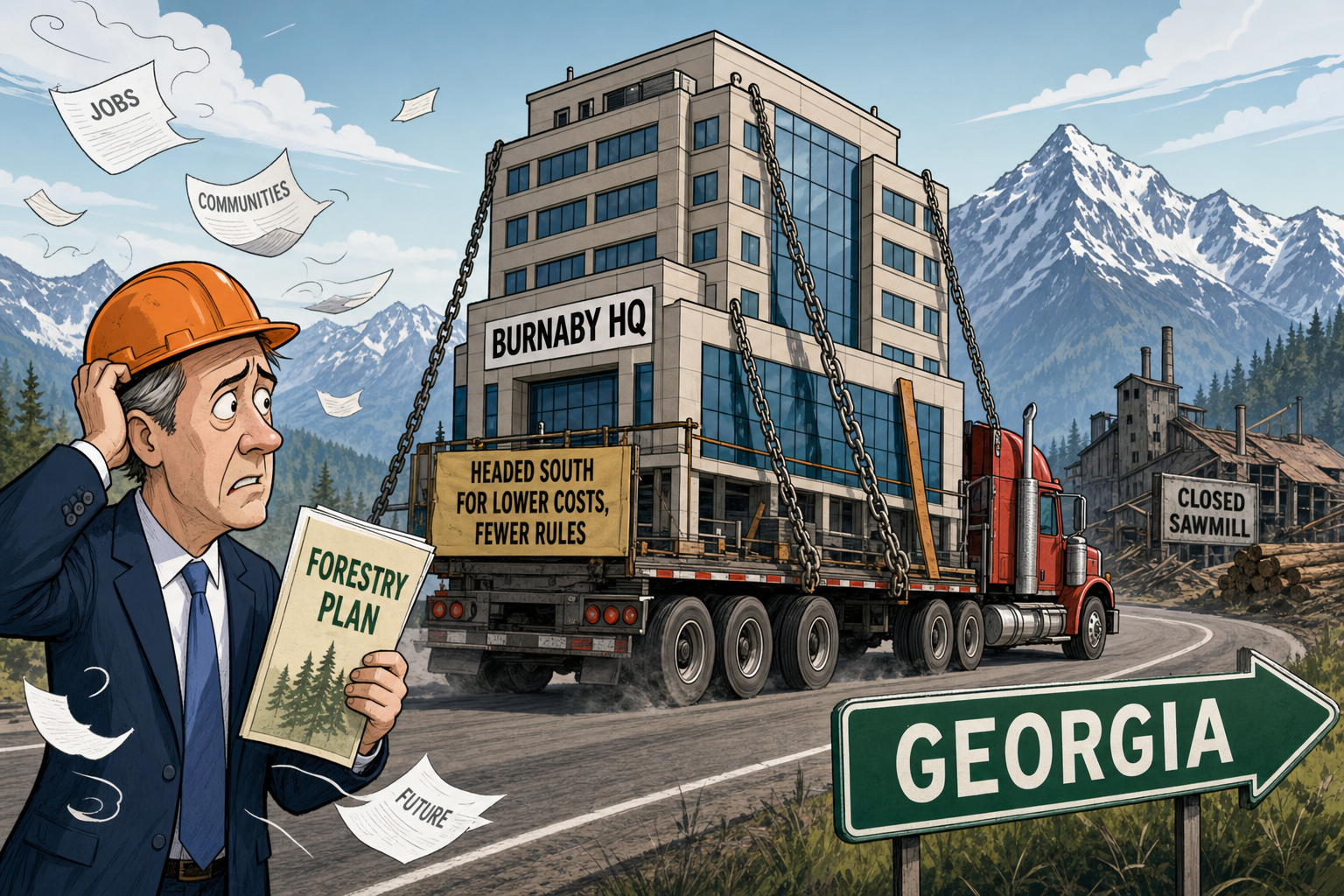
Global News reported July 29 that Interfor, one of British Columbia’s largest forestry companies, is moving head-office functions from Burnaby to the outskirts of Atlanta, Georgia, citing a CEO memo viewed by the Financial Post. The company’s own public contact page still directs general inquiries through a 604 phone number, a reminder of how deeply the brand has been tied to B.C.
Business Examiner reported that the July 9 memo named Peachtree City, Georgia as Interfor’s “primary hub for corporate and functional support,” while saying no layoffs were planned, no timeline was provided and no number of affected positions was disclosed. That careful wording matters. This is not a claim that every B.C. job disappears tomorrow. It is a warning that the centre of corporate decision-making is being pulled closer to where Interfor’s business now largely operates.
According to Business Examiner, Interfor is a top-three North American lumber producer with 28 facilities and 4.4 billion board feet of annual capacity, but B.C. now accounts for only 17% of that capacity. The same report said a May 2026 company presentation showed 58% of operations in the U.S. Southeast and Pacific Northwest, and cited the company rationale that roughly three-quarters of operations are in Central, Eastern and Atlantic time zones.
Premier David Eby and Forests Minister Ravi Parmar can point to trade diversification, market development and mass-timber promotion. A May 2026 B.C. government release said Forestry Innovation Investment would put more than $9 million into market-development initiatives in 2026-27, leveraged by more than $3 million from industry partners. Those programs may be useful. They do not answer the harder question: why is a B.C.-rooted forestry heavyweight shifting its corporate hub away while Victoria says it is building a stronger sector?
The fair critique is not that Eby single-handedly caused Interfor’s decision. Tariffs, exchange rates, fibre supply, global markets and company acquisitions all matter. But B.C.’s government controls the Crown-land framework, permitting climate, tenure rules, land-use certainty and the policy signals that affect whether capital wants to stay. If companies keep shrinking their B.C. footprint, the province cannot hide behind press releases about future opportunity.
B.C. needs measurable forestry competitiveness targets: harvestable-fibre access, permit timelines, value-added investment, mill restarts, manufacturing jobs, and head-office employment. If the government’s strategy is working, it should be able to prove more than spending announcements. If it is not, British Columbians deserve an honest reset before more mills — and more command centres — head for the exit.