100 Mile House ER Closed While Wildfires Made the Detour More Dangerous
The province cannot call rural emergency care “stabilizing” while a community surrounded by smoke is told the nearest emergency room is 95 kilometres away.
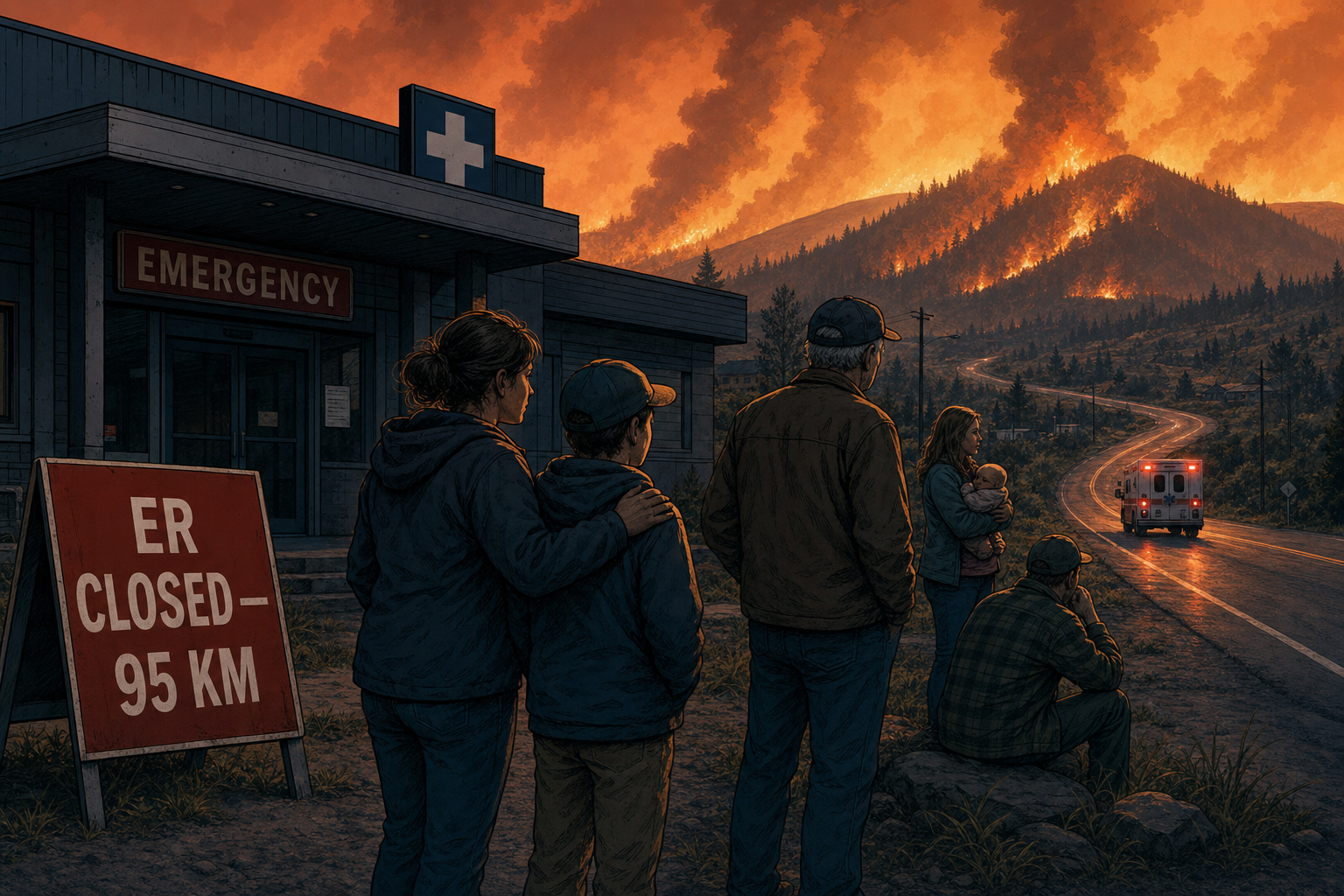
Global News reported Friday that the emergency department at 100 Mile District General Hospital was closed from 7 a.m. to 8 p.m. on August 7 and was expected to close for the same 13-hour stretch on Sunday. Patients needing emergency care were directed to Cariboo Memorial Hospital in Williams Lake, about 95 kilometres away.
That would be serious on any summer weekend. It is harder to defend when wildfires and smoke are already pressuring the region. 100 Mile Mayor Maureen Pinkney told Global that emergency rooms need to be open 24/7 and said summer visitors can double the local service-area population from roughly 20,000 to 40,000.
Pinkney also described the practical risk behind the official diversion notice. She said patients heading for Williams Lake could be driving through smoky skies and past another fire, and warned that if a route closed, other detours could become longer or more complicated. Her question was blunt: when fire and road conditions block normal choices, “How do they get any help?”
The number that should embarrass Victoria is 36. Global reported this is the 36th closure of the 100 Mile House ER so far in 2026, compared with 27 closures in 2025. This is not a one-off staffing hiccup. It is a repeated failure of rural emergency coverage in a community that has already taken its case to the provincial government.
Pinkney said council travelled to Victoria last November to meet ministers about the closures. She said the government told them it was working on the problem, but the response is “not working fast enough.” That is a fair, measured criticism from a mayor dealing with the consequences on the ground.
The province’s defence cannot be averages. Health Minister Josie Osborne has argued in the Legislature that provincewide closure hours are moving in the right direction, while also acknowledging that rural and remote emergency departments are different because the next hospital can be hours away. 100 Mile House proves why that distinction matters. A spreadsheet can show improvement while one community is still told, again and again, to leave town for emergency care.
No one should use this crisis to attack frontline nurses, doctors, paramedics or local administrators. The accountability belongs at the system level. If B.C. has a rural ER stabilization plan, it should be public, community by community, with staffing targets, backup ambulance coverage, wildfire-season contingencies, and clear triggers for extraordinary support when smoke, evacuation pressure or road closures make a diversion unsafe.
Rural British Columbians are not asking for a slogan. They are asking for an emergency room that is open when the emergency arrives.