NDP’s $125M Blind Spot: Bill 2 Makes Fewer Capital Projects “Major” Enough to Report
At the same time B.C. is running large deficits and a $37.7-billion taxpayer-supported capital plan, the NDP government raised the statutory reporting threshold for major capital projects.
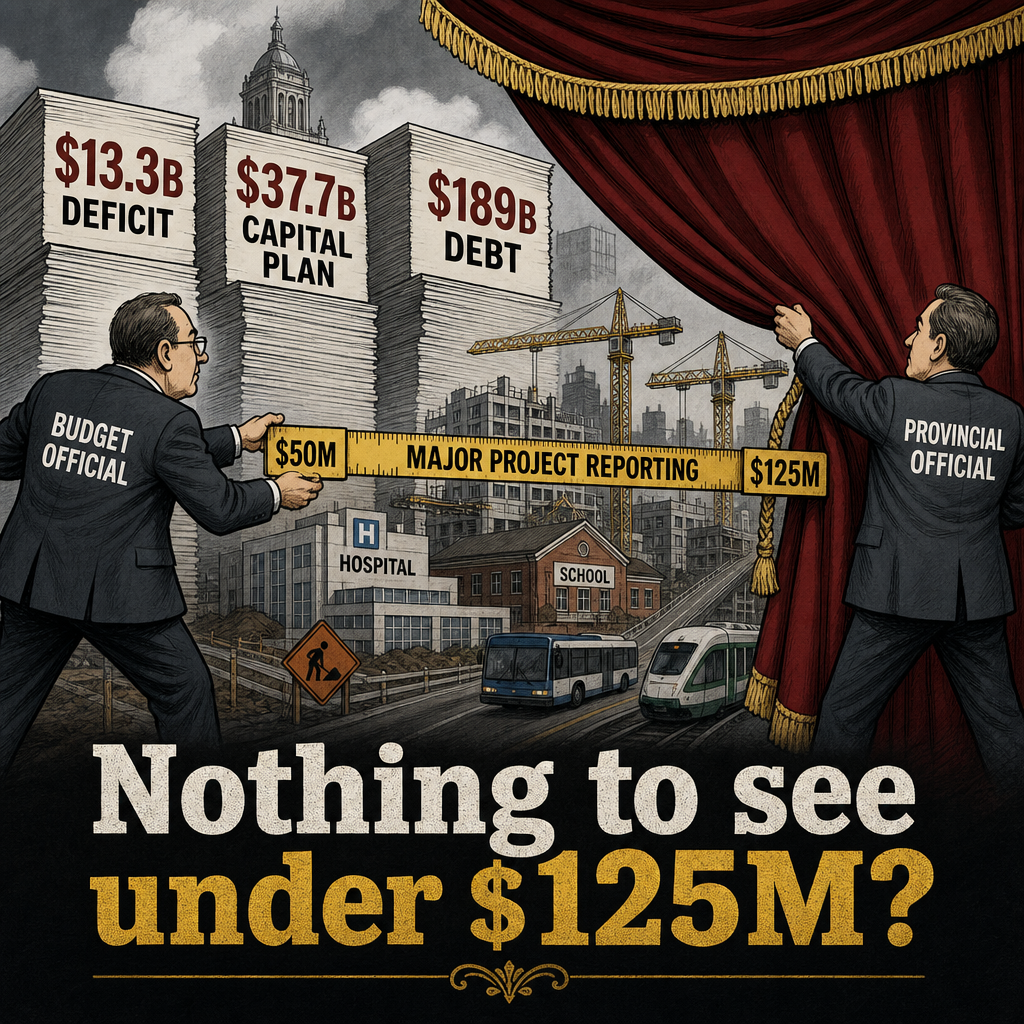
The most important accountability change in Bill 2 may be the quietest one. In second reading on March 5, Finance Minister Brenda Bailey told the Legislature that the Budget Measures Implementation Act, 2026 amends the Budget Transparency and Accountability Act to raise the reporting threshold for “major capital projects” from $50 million to $125 million.
Bailey’s stated reason was inflation: the $50-million threshold was originally set in 2000. That is a real argument, and it should be reported fairly. But it is not the end of the public-interest question. Thresholds decide what gets special attention. Raise the threshold far enough, and a category of expensive projects no longer lands in the same statutory reporting lane.
That matters because Budget 2026 is not a small-budget environment. The government’s own fiscal page projects deficits of $13.3 billion in 2026-27, $12.2 billion in 2027-28 and $11.4 billion in 2028-29. It also says B.C. is planning $37.7 billion in taxpayer-supported capital investments over three years, including health-care facilities, schools, transit and transportation infrastructure.
The debt picture is just as serious. Budget 2026 says taxpayer-supported debt is expected to rise to $189 billion over the fiscal plan. At the same time, the government’s highlights page says B.C. is “strategically sequencing” capital work, adjusting the pace of some projects, and re-pacing or refreshing several approved long-term care, hospital and student-housing projects.
That is exactly when the public needs more light, not less. A hospital expansion, school upgrade, road job or local infrastructure project does not become small simply because it falls below $125 million. For many communities, a $70-million or $100-million project is a generational commitment. Cost changes, timeline shifts and scope decisions still deserve a clear public trail.
The legally precise point is this: Bill 2 does not make every project under $125 million disappear from all public records. It raises the threshold for reporting “major capital projects” under that specific transparency framework. But the political point is just as precise: the Eby government is narrowing the class of projects captured by that trigger while asking taxpayers to carry record-scale capital spending and fast-rising debt.
If the NDP believes $125 million is the right modern threshold, it should show the receipts. Publish the list of projects that would have qualified under $50 million but will not qualify under $125 million. Explain what reporting those projects will still receive. And tell taxpayers why, in a deficit budget, the answer was to move the line upward instead of strengthening capital-project disclosure.