Walbran Sentences Show the NDP Still Has No Durable Forestry Peace Plan
Two Walbran blockade sentences show B.C. forestry conflict is still being pushed through injunctions, arrests and courts instead of a durable land-use settlement.
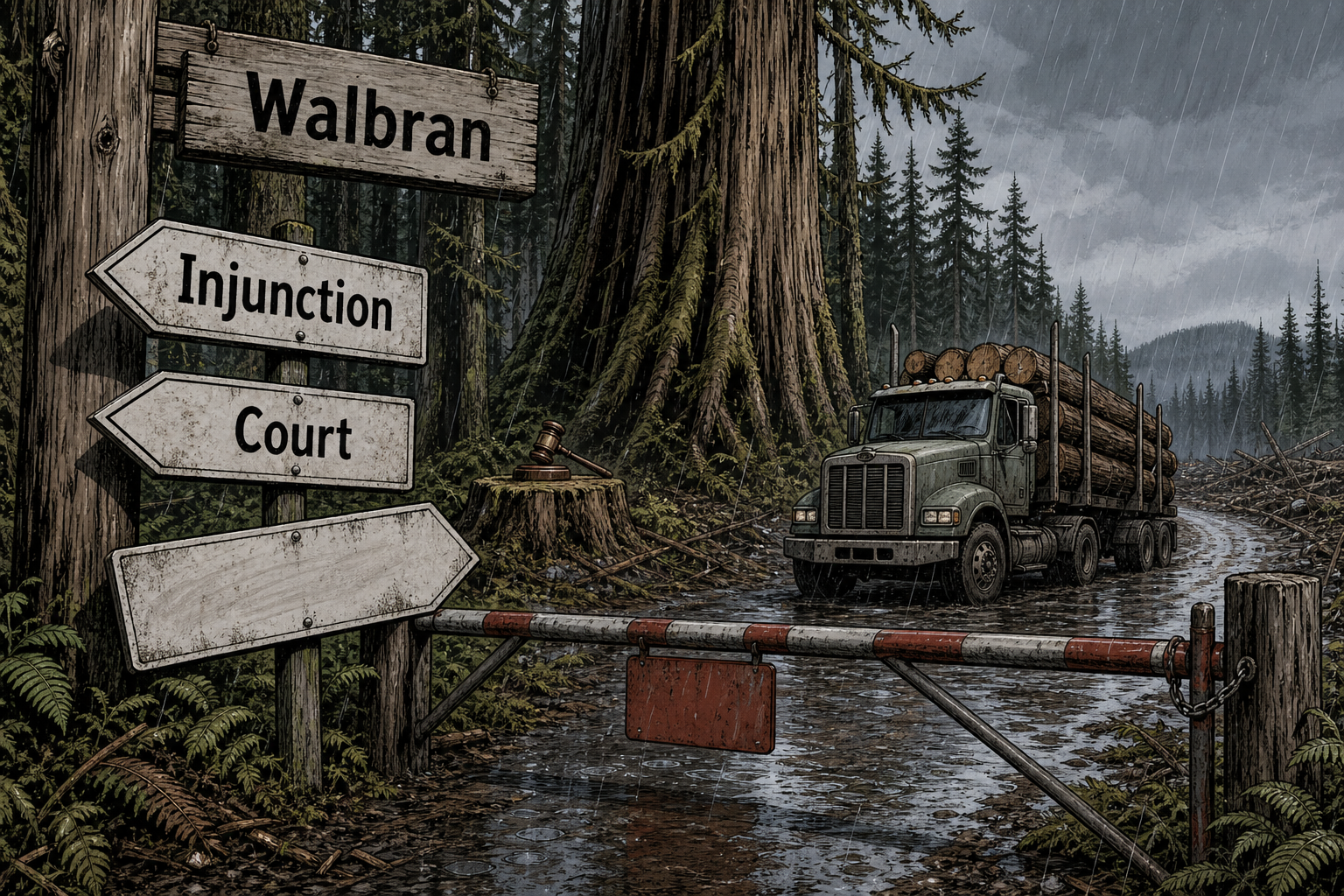
Two Walbran Valley blockade protesters have now been sentenced. That is a court outcome, not a forestry peace plan.
CBC reported Wednesday that Kenni Apt and Zoey Barak pleaded guilty to breaching a November 2025 injunction order that barred protesters from blocking access to the Tsawak-qin Forestry logging site in the Walbran Valley, about 100 kilometres northwest of Victoria. CBC reported that 12 protesters were arrested in total after the company obtained the injunction.
The sentences were specific. Apt received 12 months’ probation with either 75 hours of community service or a $2,250 fine after attaching themself to a large wooden cougar statue inside the injunction area. Barak received seven days in jail after being found in an elevated sling between two trees inside the injunction area.
The facts should be handled carefully. These were guilty pleas to breaches of a court order. CBC reported that Judge Anthony Saunders recognized both people as first offenders and noted their good character. The judge also said harsher sentences could be considered for future offences if actions escalate.
But the larger public issue is not hard to see. B.C.’s forestry conflicts are still moving from logging roads to injunction applications, then to RCMP enforcement, then to court. That is expensive, divisive and unstable for workers, communities, First Nations, companies and environmental groups.
The background makes the government’s accountability problem sharper. CBC reported in November 2025 that the B.C. Supreme Court had granted an injunction to Tsawak-qin Forestry Limited Partnership, described as co-owned by Western Forest Products and the Huu-ay-aht First Nations. CBC also reported that the Pacheedaht First Nation had denounced the blockade on its territory as an obstruction of approved forestry activity.
So this is not a simple story of industry on one side and protesters on the other. It is a collision between old-growth protection demands, approved forestry activity, First Nations interests, policing, courts and a provincial government that keeps promising certainty.
Premier David Eby’s NDP cannot credibly treat that collision as someone else’s file. Land-use certainty is a provincial responsibility. Old-growth policy is a provincial responsibility. Reconciliation frameworks, forestry approvals and public confidence in the rules all run through Victoria.
Walbran shows the cost of ambiguity. If the rules are clear, the government should explain why they are producing recurring injunction fights. If the rules are not clear enough, the government should say what it will change, by when, and how affected First Nations, local communities, workers and conservation advocates will be heard.
What B.C. has today is a legal record: an injunction, arrests, guilty pleas, probation, a fine option, jail time and more proceedings expected this fall. What B.C. still lacks is proof that the NDP has turned the old-growth wars into a durable forestry settlement.