Rural B.C. ER Closures Keep Coming. Where Is Eby’s Stabilization?
Interior Health alerts and local reporting show repeated rural emergency-room interruptions while B.C.’s health minister says closures are tracking in the right direction.
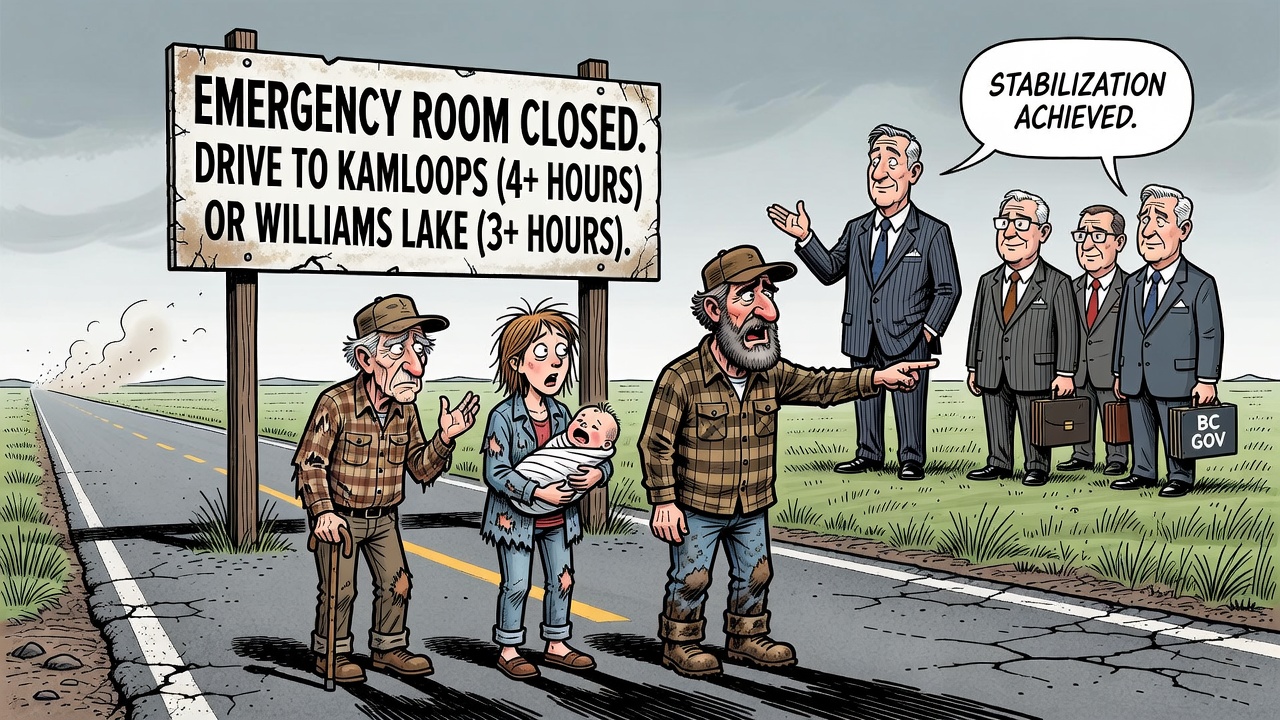
David Eby’s government keeps asking British Columbians to believe the health system is stabilizing. Rural Interior families keep getting a different message: your local emergency room is closed, drive somewhere else.
Interior Health’s own alert page listed new emergency-department interruptions into late July and early August, including Nicola Valley Hospital in Merritt and 100 Mile District General Hospital. On July 28, Interior Health advised 100 Mile House residents that emergency services would be unavailable from 7 a.m. to 8 p.m. on both July 29 and July 30, directing patients to Cariboo Memorial Hospital in Williams Lake. The authority acknowledged the changes could have a “significant impact” and said transparent notification was important.
That is the bureaucratic language. The practical meaning is harsher: in a medical crisis, people are told to call 911 and wait for transport to the nearest available and appropriate facility; everyone else must decide whether to travel, wait, or hope symptoms do not worsen.
Merritt has seen the same pattern. CFJC Today reported that Nicola Valley Hospital’s emergency department closed overnight July 15-16 with little notice, the fourth Merritt ER closure of 2026 at that point. Residents needing emergency care were instructed to make the roughly one-hour drive to Royal Inland Hospital in Kamloops. Interior Health later posted another Nicola Valley interruption for July 26-27, and another on August 2.
Clearwater’s record is even more alarming. CFJC Today reported that Dr. Helmcken Memorial Hospital faced its ninth temporary emergency-room closure of July on July 19-20 and its tenth temporary closure of 2026 overall. Again, residents needing emergency care were told to go to Royal Inland Hospital in Kamloops.
This is not a claim that doctors, nurses, paramedics or local administrators are failing. It is a charge that the NDP’s system-level promises are not matching rural reality. In April estimates, Health Minister Josie Osborne told the Legislature that B.C. recorded 8,645 hours of emergency-room closure in 2024, 7,262 in 2025, and 1,257 hours from January 1 to March 31, 2026. She called that “progress” and said the trend was “tracking in the right direction.”
But the minister also acknowledged the core problem: rural and remote sites are different because the next emergency department can be hours of driving away. She specifically named 100 Mile House as a community that still continues to experience closures and said the issue is serious.
That admission should end the spin. If the government has a rural ER stabilization plan, publish it by community: open shifts, closure hours, staffing vacancies, locum coverage, travel time to the next ER, ambulance backup, virtual-care limits, and dates when residents can expect reliable coverage. If the plan is working, prove it with July and August numbers — not provincewide averages that hide the communities still being diverted.
Rural British Columbians do not need another reassurance campaign. They need an emergency room that is open when the emergency happens.
Sources and records
- Interior Health: Media Centre & Alerts
- Interior Health: 100 Mile District General Hospital emergency-department interruptions, July 28, 2026
- Interior Health: Nicola Valley Hospital emergency-department interruption, Aug. 2, 2026
- CFJC Today: Clearwater emergency department experiences sudden temporary closure overnight
- CFJC Today: Merritt emergency department experiences sudden temporary overnight closure
- B.C. Legislature Hansard: April 28, 2026 Health estimates