After 230 Homes Burned, B.C. Owes Evacuees the Wildfire Threshold
Bradley Creek’s damage estimate, 1,400 evacuees and unsafe return conditions turn the NDP’s “no emergency powers” line into a demand for hard public criteria.
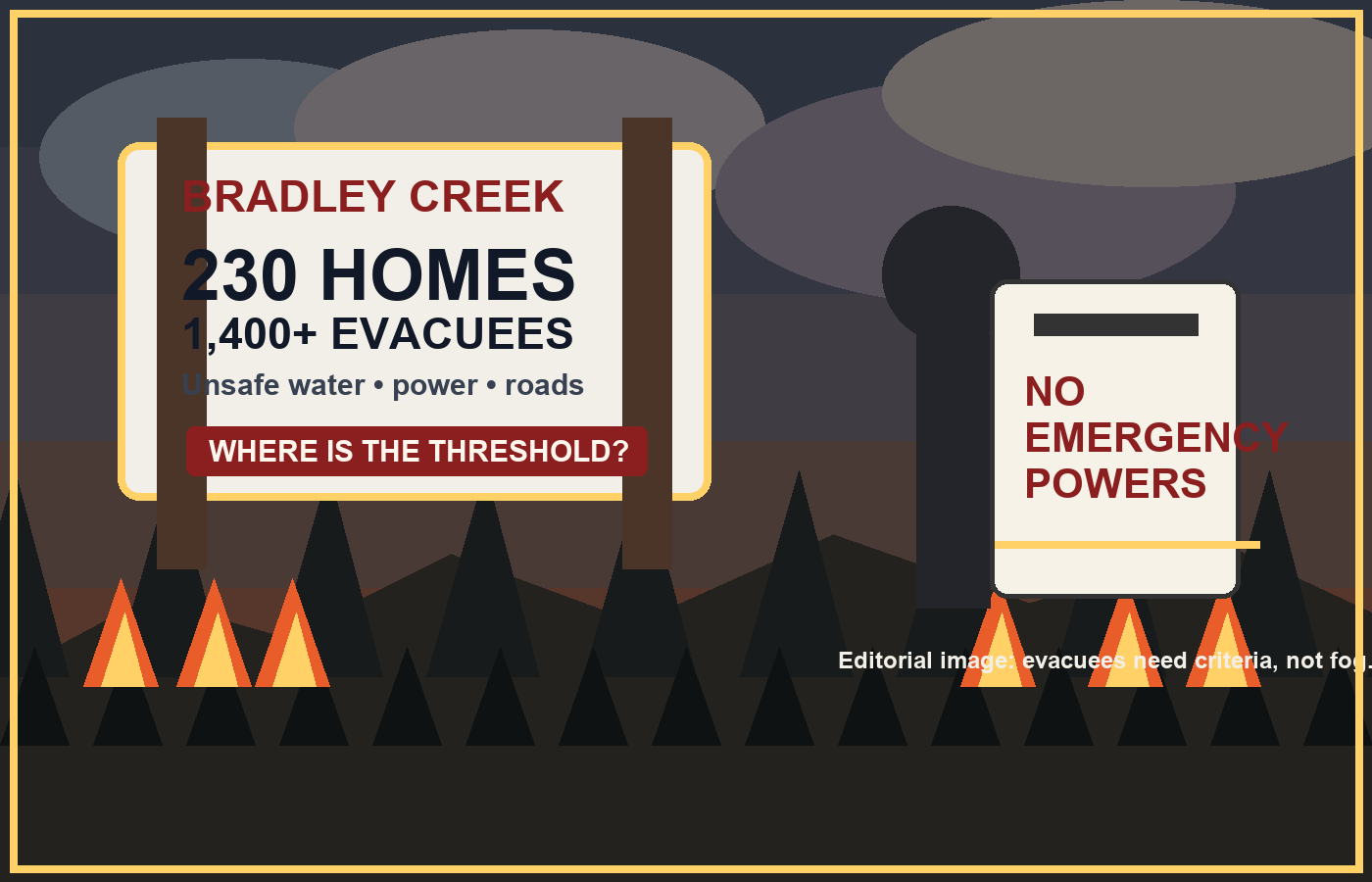
By Tuesday evening, the Bradley Creek wildfire was no longer only a fast-moving fire on a map. It was a damage ledger: an estimated 230 homes destroyed on Okanagan Indian Band land, more than 1,400 evacuees registered for emergency support services in Vernon, evacuation orders still in place, and a do-not-consume notice still affecting community water systems on reserve.
Those facts should force a sharper public answer from David Eby’s government. The question is not whether firefighters are working hard. Castanet reported crews, local departments, out-of-province resources, aircraft, heavy equipment and BC Hydro were all involved around the Bradley Creek fire. The question is what threshold Victoria is using when it says B.C. does not need province-wide emergency powers while communities face active fire, hazardous trees, damaged power infrastructure, unsafe roads and water systems hit by wildfire.
Okanagan Indian Band Chief Dan Wilson said the estimated losses came from a preliminary aerial assessment: about 30 band homes and about 200 non-band homes on leased reserve land. He also said some residents had as little as five minutes to evacuate. Those are not abstract numbers. They are families, documents, medicines, animals, tools, vehicles and lifetimes of possessions left behind in minutes.
The situation remained dangerous Tuesday. Castanet reported Bradley Creek was mapped at 2,852 hectares Tuesday evening, with evacuation orders continuing and the Okanagan Indian Band warning people not to return until damage assessments and hazard work are complete. That warning listed active fire, hazardous trees, damaged power infrastructure, unsafe roads and impacted water systems as continuing public-safety risks.
At the same time, the province’s own wildfire leadership was warning that the broader risk was getting worse. In Tuesday briefing coverage, BC Wildfire Service provincial operations director Cliff Chapman described conditions as “explosive,” citing unusually severe fuel dryness, 85 to 100 km/h winds, heat, no rain and the possibility of dry lightning later in the week. He also said about 600 additional wildfire personnel from Canada and abroad were expected to arrive in coming weeks.
Outside help is welcome. It is also evidence that B.C. is under real strain. If the government’s position remains that existing legal tools are enough, then the public deserves the criteria behind that position in plain language: what evacuation-support capacity exists, where lodging gaps remain, how Indigenous evacuees are being prioritized, what infrastructure restoration timelines are being tracked, and what measurable trigger would change the emergency-powers decision.
That is a transparency demand, not an operational second-guess. Emergency powers should never be used casually. They affect civil liberties, property and resource allocation. But refusing to explain the threshold is not restraint; it is opacity. When 230 homes are believed gone and water, roads and power are unsafe, “trust us” is not an emergency plan.
Victoria should release a dated Bradley Creek recovery dashboard and a province-wide wildfire threshold note: registered evacuees, verified structural losses, ESS capacity, hotel and transportation gaps, critical-infrastructure status, First Nations support measures, incoming personnel and the specific conditions that would justify broader emergency powers. British Columbians can handle the truth. Evacuees deserve it.