Downtown Victoria’s Safety Report Is a Warning Eby Can’t Ignore
If the capital’s downtown still feels unsafe after years of plans and announcements, British Columbians deserve measurable results — not another press-release cycle.
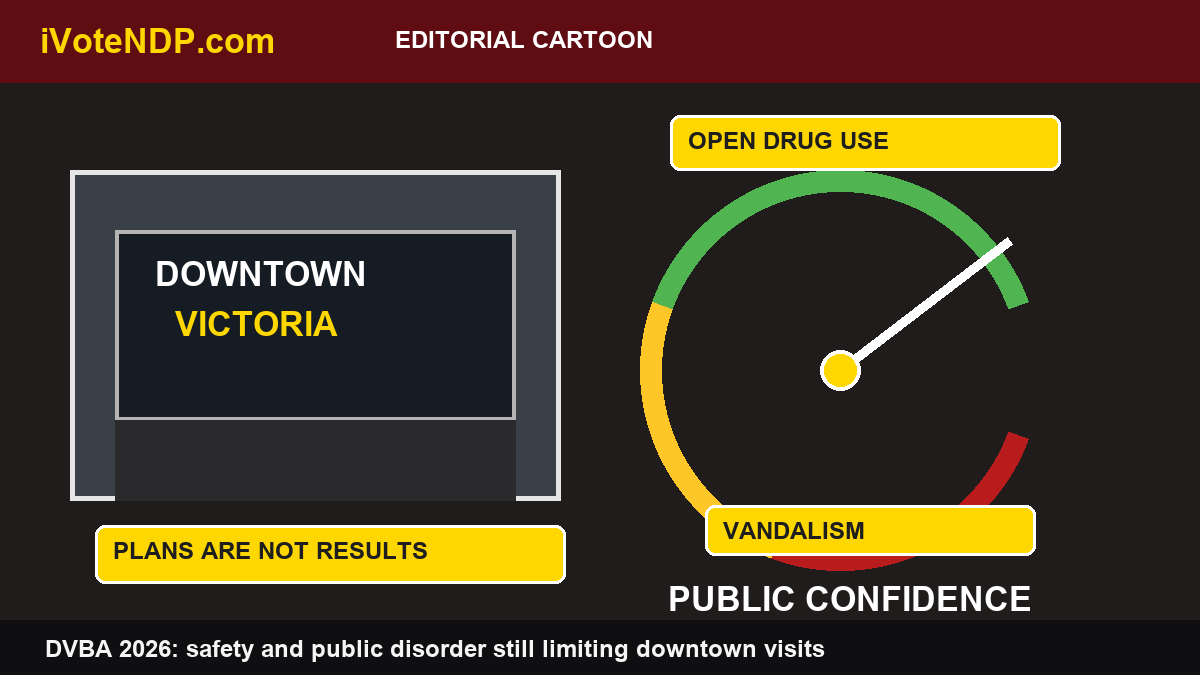
Downtown Victoria’s business community has handed David Eby’s government a simple test: stop measuring public safety by announcements and start measuring it by what workers, customers and small businesses actually experience on the street.
The Downtown Victoria Business Association’s 2026 Annual Report says the core still has real strengths: more than 44 million visits in 2025, strong tourism markers, walkability, restaurants, culture and events. But the same report says the key issues facing downtown businesses include public disorder, open drug use, safety, traffic flow and parking. That is not a partisan talking point; it is the capital city’s business district putting hard data beside the government’s promises.
The numbers should bother Victoria. DVBA says its Research Co. public poll surveyed 1,168 Greater Victoria adults from April 17 to 29, 2026. Among weekly visitors, 51% were moderately or very dissatisfied with safety downtown. Among people who visit less than once a week, 61% selected “do not feel safe” as one of the top three reasons they do not come downtown more often.
Business respondents put the same problem in plainer terms. The report identifies open drug use in public spaces as the top challenge facing downtown as a place for business, with vandalism and property damage second. It also says 65.6% of business respondents believe recent City and VicPD steps are positive but do not yet see a difference in overall safety and security downtown.
That last finding is the accountability gap. Local patrols can help. So can bylaw work. But the visible crisis downtown is also tied to provincial systems: mental health, addictions treatment, supportive housing rules, justice delays, repeat offending, income supports and health services. Municipal governments are left managing symptoms when Victoria controls many of the big levers.
The province knows this. Budget 2026 says B.C. is investing $139 million over three years to reduce repeat violent offending and chronic property crime and to support timely access to justice. A July public-safety release promoted a provincewide program to disrupt street disorder and retail crime, including resources tied to repeat offending, street disorder and retail crime.
Those programs may be necessary. They are not yet sufficient. If downtown businesses still name public drug use as the top issue, if weekly visitors still report safety dissatisfaction, and if infrequent visitors still say fear keeps them away, then the public deserves a dashboard of outcomes — not another victory lap.
That dashboard should be concrete: response times, repeat-offender outcomes, public drug-use calls, vandalism trends, overdose and treatment pathways, supportive-housing safety incidents, business-retention indicators and year-over-year visitor confidence. It should separate what the City controls from what the province controls. It should be public, dated and updated.
This is not an argument against compassion. People trapped in addiction, homelessness or mental-health crisis need help that works. But compassion is not leaving people to deteriorate in public spaces while businesses install gates, workers feel unsafe and families decide not to come downtown. Real compassion produces safer streets and a path out of chaos.
Eby’s NDP has had years to prove its model. Downtown Victoria is now saying, in numbers, that the model is not producing enough visible change. The capital deserves better than policy theatre. It deserves results.