B.C. Says No State of Emergency. Evacuees Deserve the Evidence.
Thousands are displaced, properties are lost, and international crews are arriving. If Victoria says existing tools are enough, it should show British Columbians the resource plan.
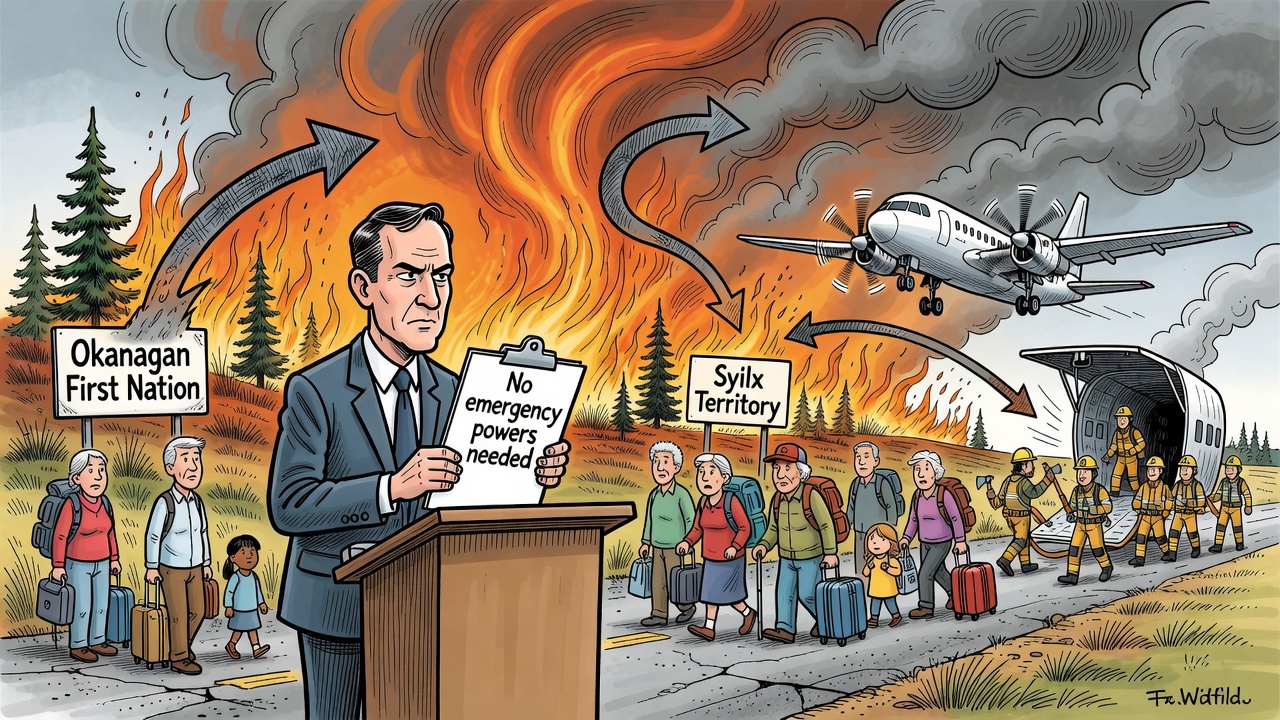
British Columbians are not asking politicians to second-guess firefighters on the line. They are asking Victoria to explain the threshold for emergency powers while families are out of their homes, properties have burned, and outside crews are arriving to help.
CBC reported Monday that the Bradley Creek wildfire west of Vernon, discovered Friday, grew quickly to 26 square kilometres and triggered evacuation orders affecting the Okanagan Indian Band, Spallumcheen and Splatsin First Nation. CBC also reported multiple properties had been destroyed, while OKIB Chief Dan Wilson said officials still had to verify the extent of damage before giving the community complete information.
That is already a serious public-safety test. It is not the only one. CBC reported that the Quilpituk Creek wildfire on the west side of Okanagan Lake led to an expanded evacuation order for Caesars Landing and alerts for Shelter Cove, Secret Point and Cinnabar Creek, with more than 2,200 properties evacuated. Across B.C., CBC cited 126 wildfires burning Monday afternoon and ministry figures of 4,700 properties under evacuation order, with another 3,600 under alert as of 9:30 a.m.
At the same time, CityNews Vancouver reported that more than 100 wildfire personnel from Mexico arrived Monday, with roughly 300 expected during the week, as B.C. battled more than 100 active fires and more than 5,000 people had been evacuated. That support is welcome. It is also a plain signal that the province is in a demanding fire season requiring help from outside its own ranks.
Yet Forests Minister Ravi Parmar told CBC there was no need for a provincial state of emergency at this point. His explanation was that if B.C. needed those tools, it would call one, and that the wildfire service plus out-of-province crews meant the province had the resources it needed.
That answer is not enough. A state of emergency is not a slogan; it is a legal tool with consequences. CBC noted it can give the province extraordinary powers, including powers to restrict travel, use private property, acquire or ration supplies, and conscript help. Those powers should not be used casually. But if the government says the threshold has not been met, it should disclose the operational criteria behind that judgment.
The public should be told what resource levels are available by region, what evacuation-support capacity exists, what shelter and transportation gaps remain, how First Nations and rural communities are being prioritized, and what measurable trigger would change the province’s decision. EmergencyInfoBC’s active-emergency index showed notices from regional districts, municipalities and First Nations across the province Monday, including items tied to Bradley Creek and the Big Bar wildfire complex. That patchwork makes clear why centralized clarity matters.
The opposition has called for emergency action in the South Cariboo; the government says existing tools are sufficient. The defensible position is simple: show the evidence. In a wildfire crisis, confidence is built by clear thresholds, dated data and honest communication — not by asking evacuees to trust that everything is under control.