Incomappleux Road Shutdown Shows the Cost of Access-by-Neglect
When a public resource road is left unsafe, gated, and then deactivated, British Columbians deserve more than a budget footnote.
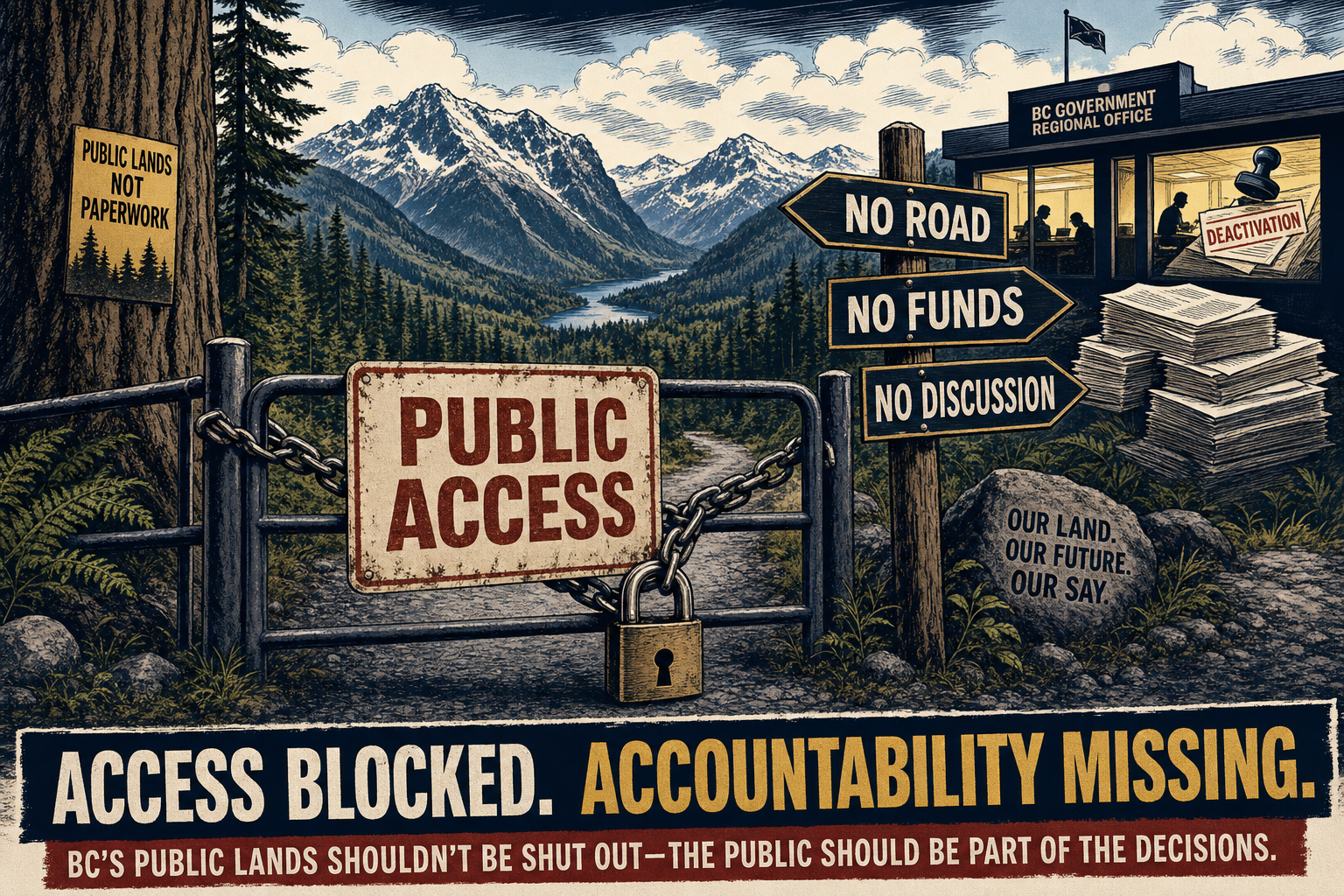
The Incomappleux Valley is exactly the kind of place British Columbians are told public conservation is meant to protect: rare inland rainforest, old growth, wildlife habitat and a landscape southeast of Revelstoke that the province itself calls biologically unique. But the government’s own road records now show the other side of that promise: public access can disappear quietly when nobody is required to keep the road usable.
The Selkirk Natural Resource District lists Incomappleux River FSR 3397.01 as closed at 0.0 kilometres, gated and barricaded because of public-safety risk, including down-rated structures and rockfall hazard. The same provincial page says deactivation planning is underway. This is not a rumour from the trailhead. It is the Province’s road notice.
The FAQ is even more direct. It says the Incomappleux FSR has had repeated issues at the crevice bridge, including a 2006 rockfall that damaged the bridge’s structural integrity. It says other structures on the main road and tributary roads are damaged or unsafe, the road is in disrepair, and there are no funds available for maintenance.
Safety is a real issue. No serious public-access argument should pretend a failing bridge can simply be ignored. The accountability problem is what happens next. The FAQ says the road has been gated since 2017, was slated for deactivation since 2021, has no future industrial access need, and that no harvesting or road construction is allowed in the area because the upper valley became a conservancy and the lower valley is under a Part 13 Forest Act designation.
That is the policy trap. Once conservation decisions remove the industrial reason to maintain a forest service road, the public may lose the practical road too. BC Parks’ current Incomappleux Conservancy page says the conservancy has no road access, trails or facilities. The old-growth page says the Incomappleux Valley South designated area was established in January 2023 and covers 16,400 hectares, including 2,679 hectares of old growth. Premier David Eby’s 2023 release celebrated the broader Incomappleux protection as one of the province’s most significant protected areas in a decade.
Protecting rare ecosystems is a legitimate public goal. But a protected area that ordinary citizens cannot reach by road, cannot enter by trail, and cannot evaluate through normal public use raises a basic governance question: did the public ever get a clear choice between repair, managed access, seasonal access, non-motorized access, or full deactivation?
The FAQ says there were no plans for a public meeting, while notices, letters, email and a comment period were used. That may satisfy an administrative checklist. It does not answer whether recreation users, local residents, landowners, emergency planners and taxpayers saw a transparent comparison of repair costs, liability options and access alternatives before the road moved toward removal.
Incomappleux should not become another example of B.C. land policy being decided through slow attrition: gate the road, cite safety, remove the maintenance case, then call lost access inevitable. If the Eby government wants credit for conservation, it also owes British Columbians a plain accounting of what public access was lost, what alternatives were rejected, and who made that decision.
Sources and records
- B.C. government: Selkirk Natural Resource District road safety information
- B.C. government FAQ: Incomappleux Forest Service Road Deactivation
- BC Parks: Incomappleux Conservancy
- B.C. government: Current Part 13 Old Growth Deferral Areas
- B.C. government release: New conservancy protects rare ecosystems in Incomappleux Valley