Big Bar Evacuation Orders Demand Answers on Wildfire Air Response
When residents under evacuation pressure are publicly asking where the aircraft are, British Columbians deserve clear answers about wildfire response priorities.
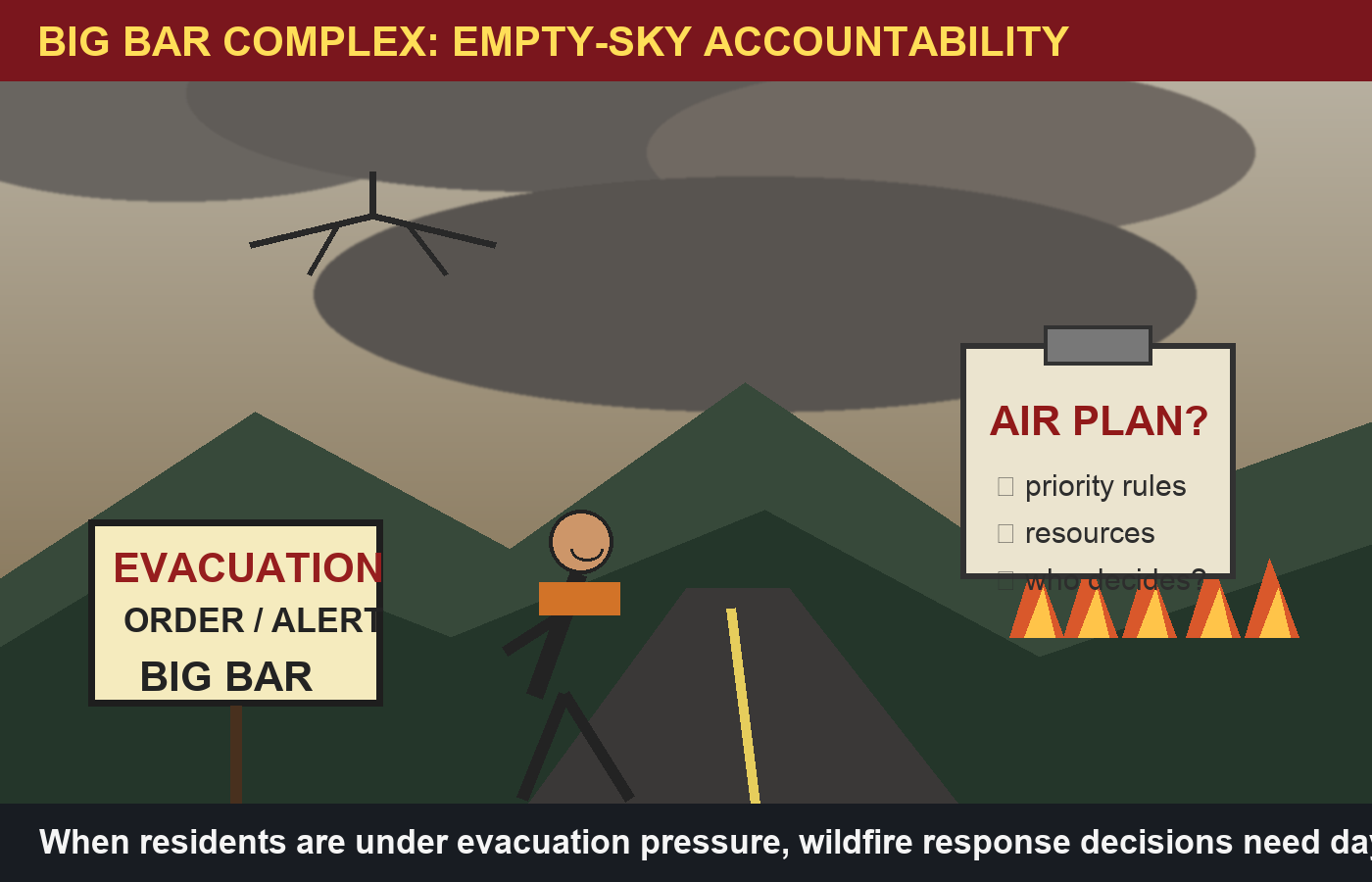
Big Bar residents are not asking an abstract policy question. They are asking it under smoke, evacuation pressure and a fast-moving public-safety clock: where is the air support?
Global BC’s evening video identifies the concern plainly in its own title: residents are concerned with the lack of air response to the Big Bar Complex wildfires. That does not prove every aircraft decision was wrong. It does prove the province now has a public-accountability problem. When people whose homes, ranches, livestock and access roads may be in the path of fire are questioning what they can see overhead, the answer cannot be silence, jargon or a web map alone.
The official emergency record shows why the question matters. EmergencyInfoBC has been tracking the Big Bar Complex as an active emergency event, with evacuation information connected to Cariboo Regional District areas and BC Wildfire Service incident numbers V40848 and V40897. The same public notices identified an evacuation order issued July 31 and a related evacuation alert issued July 30 for communities and areas including Canoe Creek, Dog Creek, Gang Ranch, Canoe Creek Indian Reserve No. 3, Dog Creek Indian Reserve No. 1 and the Lastman Creek area.
Those names should focus minds in Victoria. These are rural and First Nations communities where distance, road access, smoke, livestock movement and communications gaps can turn delay into real danger. Nobody outside incident command should pretend to know, from a distance, whether tankers, helicopters or crews could safely operate over a specific fire at a specific hour. Wind, visibility, terrain, smoke columns, crew safety, aircraft availability and competing fires all matter.
But that is exactly why the Eby government and wildfire officials owe a clearer public explanation. If aircraft were unavailable, say so. If conditions made flying unsafe, explain the threshold. If other fires were assigned higher priority, say what criteria were used. If air attack was used elsewhere on the complex or staged for structure protection, tell residents what changed and when. Accountability does not require second-guessing firefighters. It requires political leaders to be honest with communities about the limits and priorities of the system they run.
B.C. asks rural residents to obey evacuation orders, prepare emergency plans and trust official channels. That trust is earned by timely, specific information. A family watching smoke build over the hills should not have to infer the province’s wildfire strategy from an empty sky.
The public question now is simple: as Big Bar Complex orders and alerts spread, did the province put the right resources in the right place at the right time, and did it explain those decisions to the people most exposed to the risk?
Sources and records
- Global BC video: Big Bar Complex residents concerned about air response
- EmergencyInfoBC: Big Bar Complex event page
- EmergencyInfoBC: Cariboo Regional District evacuation order tied to V40848/V40897
- EmergencyInfoBC: Cariboo Regional District evacuation alert tied to V40848/V40897
- BC Wildfire Service incident page: V40897
- BC Wildfire Service incident page: V40848