Eby’s Density Push Forgot the Classroom
New Westminster’s school-capacity crunch shows the province cannot order more density and leave families waiting for the classrooms, fields and safe buildings that growth requires.
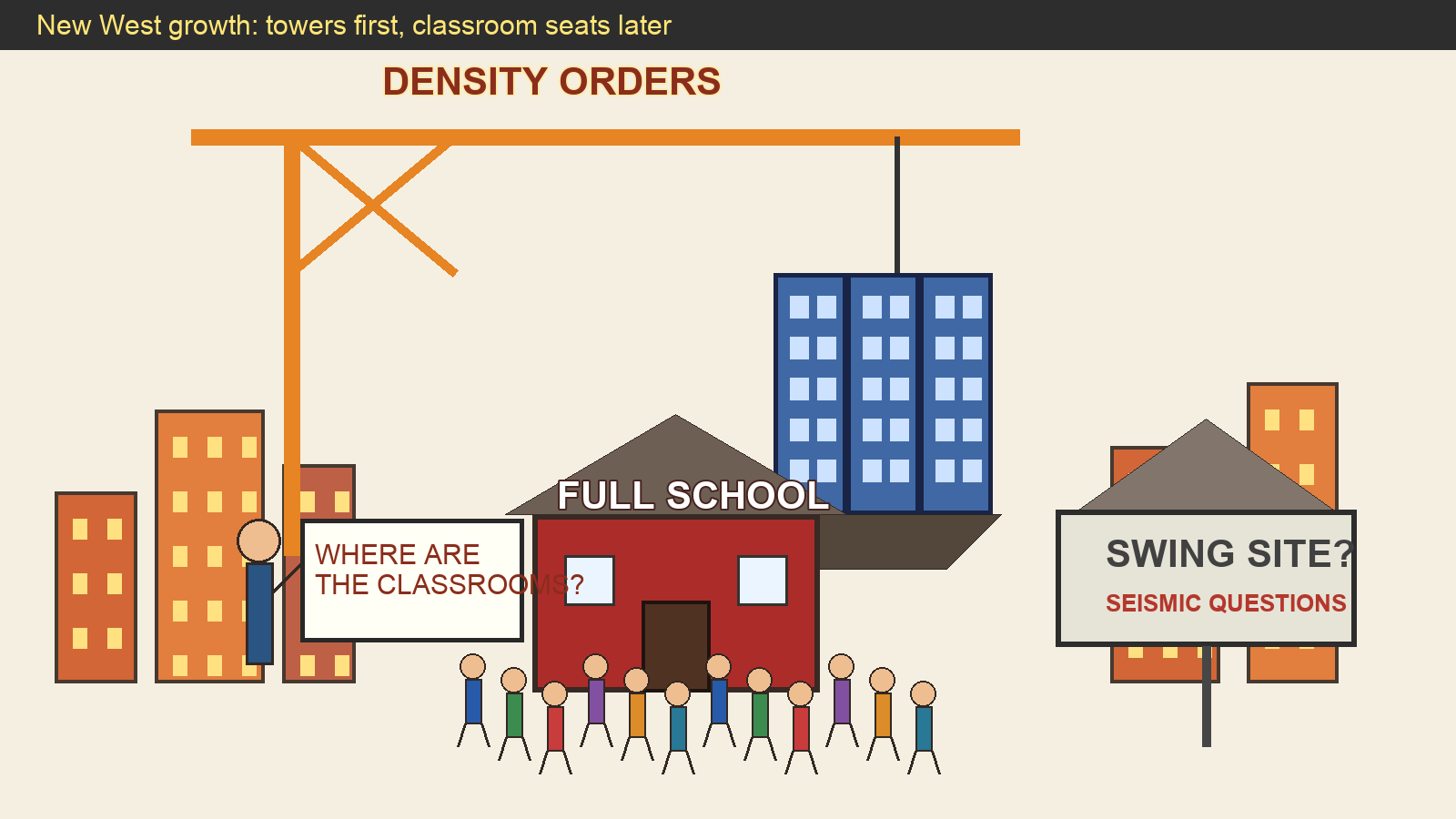
New Westminster is a warning sign for the Eby government’s housing agenda: density without classrooms is not a plan. It is a cost shift to families.
The Tyee reports that New Westminster, with just under 10,000 students, is one of B.C.’s smaller urban districts but also among its most overcrowded. The city’s population grew by more than 20,000 people between 2006 and 2021, reaching nearly 80,000 residents. In the schools, the pressure is even more immediate: public enrolment rose by 1,600 students between the 2023-24 and 2025-26 school years.
That growth has run into a hard physical limit. New Westminster Secondary is the district’s only high school and has nearly 2,000 students. The district is now exploring a major rebuild on the École Lord Tweedsmuir Elementary site: a Grade 6-to-12 “super-campus” for up to 2,300 students, with middle schools converted to elementary schools to replace the seats lost when Tweedsmuir is removed.
The accountability problem is not that New Westminster needs more school space. It plainly does. The problem is how long Victoria has allowed the housing-and-infrastructure gap to widen before families were presented with a disruptive “creative interim solution.”
Lord Tweedsmuir is not just any school. In 2018, the B.C. government announced $6.1 million for a seismic upgrade there, saying the original 1937 portion of the school, including the gym, had been rated at high risk of failure in a significant earthquake. That upgrade was expected to be complete in 2020. Six years later, the same site could be torn down to solve a capacity crisis the province should have seen coming.
The proposed temporary destination raises more questions. The Tyee reports Tweedsmuir students could be moved in September 2027 to Stride Avenue Community School in Burnaby, while Stride’s own students move to a new building next door. The province’s Stride project page, updated March 30, 2026, says the replacement is meant to keep students and staff safe in an earthquake and is scheduled for occupancy in September 2026. A 2021 government release described the Stride replacement as a $22.3-million provincial project for a safer, modern school.
The Ministry of Infrastructure told The Tyee that any temporary accommodation would proceed only if the facility meets required safety and operational standards, and that “no students will be learning in unsafe environments.” Parents are entitled to hear that assurance. They are also entitled to ask why children from a seismically upgraded New Westminster school may have to spend years in an older swing site because permanent school capacity lagged behind growth.
This is the hard edge of the NDP’s density politics. The province can order cities to accept more housing, celebrate more units and talk about affordability. But families do not live in housing targets. They live in neighbourhoods that need schools, fields, safe buildings, child care, roads and transit at the same time the towers arrive.
New Westminster should not have to choose between overcrowding and upheaval. The province should publish the school-capacity assumptions behind its housing push, explain when the Tweedsmuir business case will be decided, and state what safety upgrades or inspections would be required before any temporary move to Stride. If Victoria wants credit for density, it owns the classroom bill too.
Sources and records
- The Tyee: New West Is Densifying. Schools Aren’t Keeping Up
- B.C. government: seismic funding for Lord Tweedsmuir and Richard McBride, March 9, 2018
- B.C. government: Stride Avenue replacement school announcement, April 8, 2021
- B.C. government: Stride Avenue Community Elementary project page, updated March 30, 2026