Sea to Sky Land Rules: Did the Public Know What Just Closed?
The Eby government’s Sea to Sky consultation ended July 20. The question now is whether the people affected understood the scale of the Crown-land rules being proposed before the clock ran out.
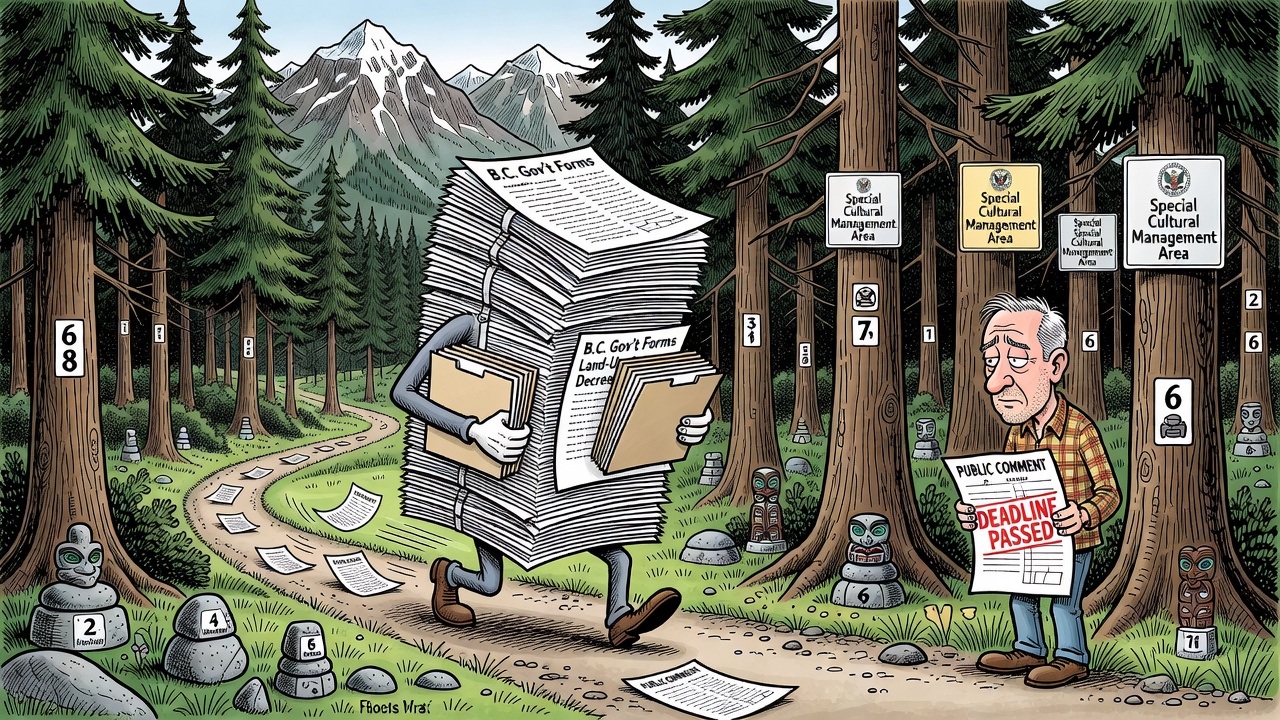
The public-comment window has closed on a major Sea to Sky land-use proposal, and British Columbians deserve a clearer explanation than another quiet government engagement page.
The province says consultation on proposed land-use objectives connected to the Squamish Nation Land Use Planning Agreement Phase 2 ran from May 22 to July 20, 2026. The proposal would implement forest-management direction through a Land Act order. That means this is not, on the official record, a private-property seizure or a land transfer. It is about how public Crown land and forest activity may be managed.
But that distinction does not make it small. Government materials say the process identified 33 Síiyamiin cultural and historical sites covering more than 4,250 hectares. They also identify six special cultural management areas covering more than 15,800 hectares of cultural and ecological importance. Put together, that is more than 20,000 hectares of mapped areas in the Sea to Sky region moving toward new management rules.
The province says, if approved, the objectives would protect nearly 7,250 hectares of forest lands, including 925 hectares of deferred old-growth forest. Supporters will argue that cultural protection, old-growth protection and collaborative planning are legitimate public goals. They are. The accountability question is whether local residents, recreation users, forestry workers, small tenure holders and municipal leaders were given enough plain-language notice to understand what was being changed, where, and with what practical consequences.
This is the NDP’s recurring land-use problem. The government speaks in the language of reconciliation, engagement and stewardship. People on the ground often meet the policy later, when access, harvesting, permitting, recreation use or local economic assumptions have already shifted. A deadline on an engagement portal is not the same as informed consent from the broader public.
The province’s own framing says these proposed objectives are tied to the June 2025 agreement with Squamish Nation and would be implemented under provincial law. That makes Victoria responsible for explaining the decision, not hiding behind process language. If the rules are reasonable, the public should be able to see the maps, the tradeoffs, the affected tenures, the enforcement implications and the evidence used to justify each zone.
Premier David Eby cannot keep centralizing land-use decisions while treating public understanding as an afterthought. In the Sea to Sky, the deadline has passed. Now the public deserves the full ledger: what changes, who is affected, what activities are limited, what rights remain, and whether the government is prepared to defend the policy in direct, ordinary language.