Eby’s Pipeline Gamble Hits 27%: Angus Reid Shows Former NDP Voters Sliding Away
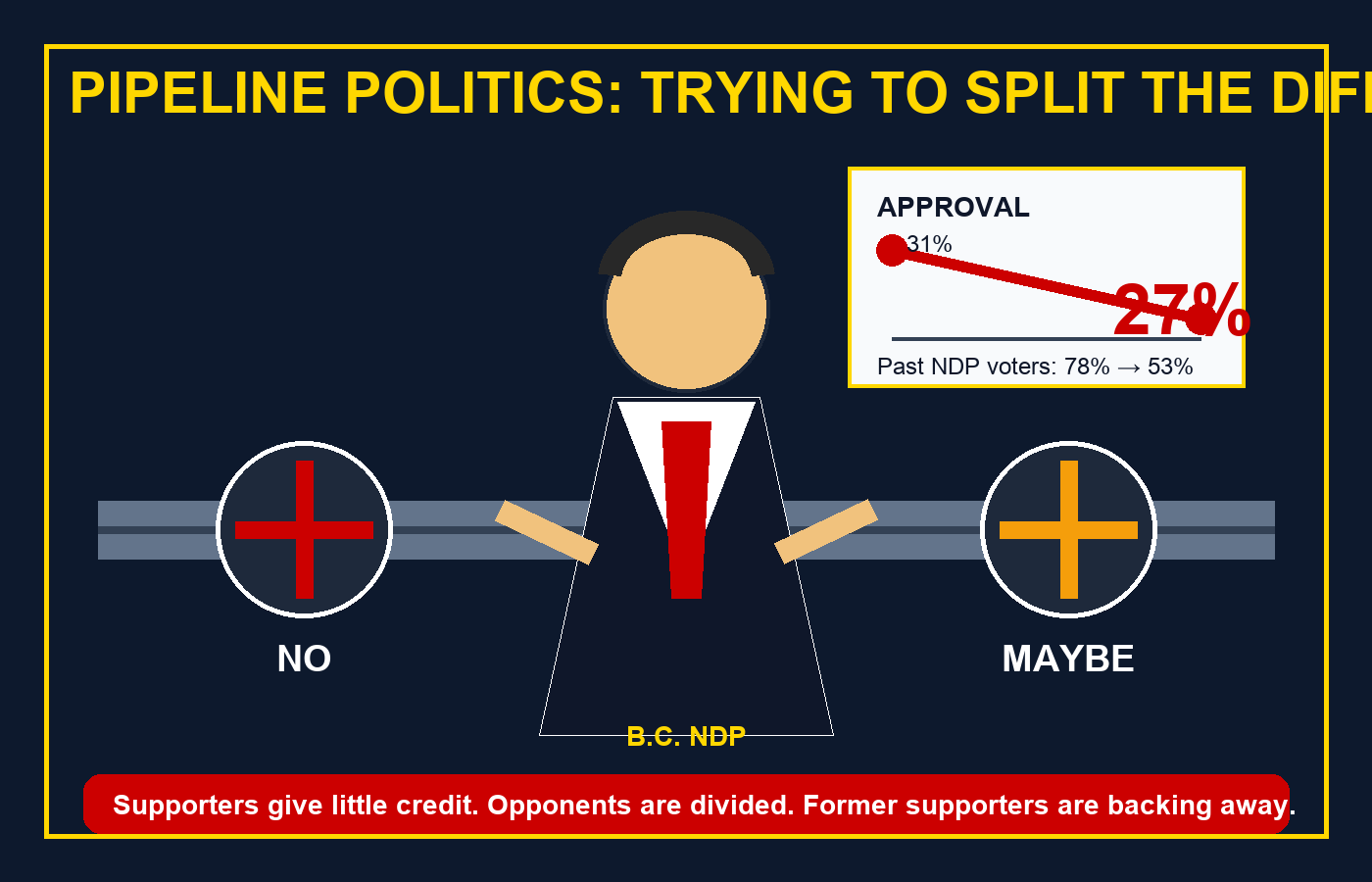
Angus Reid says Eby’s approval has fallen to 27% after the Alberta-to-B.C. pipeline announcement, while approval among past BC NDP voters dropped from 78% to 53% in one month.
David Eby tried to land in the middle of the pipeline fight. New Angus Reid Institute numbers show the resulting political position is punishing.
In a July 23 analysis, Angus Reid says Eby’s approval in British Columbia is now 27%, down from 31% in June and 13 points below December. The same release reports 54% disapproval, while the share of British Columbians unable to give an assessment has more than doubled from 8% to 19%.
The harshest number for the BC NDP is inside its own former coalition. Angus Reid reports approval of Eby among past BC NDP voters fell from 78% in June to 53% in July. That is not an opposition talking point. It is a pollster’s month-over-month measure of people who previously voted for Eby’s party.
The pipeline file helps explain why the politics are so awkward. On July 2, Prime Minister Mark Carney and Eby announced a Canada-B.C. Cooperative Prosperity Agreement. Ottawa’s release said the federal government would maintain the North Coast tanker ban “in accordance with the proposed route of a new trans-provincial pipeline” under the Canada-Alberta bilateral agreement. The backgrounder also committed Canada and B.C. to accelerate major energy and trade corridors, port infrastructure, LNG projects, critical minerals and other resource work.
That left Eby arguing that B.C. had not endorsed the proposed Alberta-to-B.C. oil pipeline, while also accepting a deal that left a southern coastal route alive. CityNews Vancouver, carrying The Canadian Press, reported July 3 that Eby said the agreement did not force him to support the project, but that B.C. would not fight it in court.
Angus Reid’s July survey shows the political bargain is not paying Eby back. Among British Columbians who support the pipeline project, 66% disapprove of his performance. Among pipeline opponents, the split is nearly even: 41% approve and 37% disapprove. In plain terms, supporters are not rewarding him and opponents are not unified behind him.
The poll should not be read as proof that the pipeline announcement alone caused every point of movement in Eby’s approval. Polls measure opinion at a point in time, and governing parties carry many files at once. But Angus Reid specifically framed the analysis around the pipeline announcement and reported a sharp deterioration among past NDP voters in the same period.
That is the accountability issue. Eby presented himself as the premier who could protect B.C.’s interests, preserve environmental safeguards and still keep Ottawa at the table. The public record now shows a premier with 27% approval, a majority disapproving, and former NDP voters far less certain than they were a month ago. If this was supposed to be careful federal-provincial diplomacy, British Columbians are entitled to ask what Eby actually gained — and why so many of his own past voters appear unconvinced.