Three Weeks Without an ER: Hudson’s Hope Shows the Rural Health-Care Promise Is Broken
A rural emergency department closed until Aug. 4 is not a minor service interruption. It is a warning sign for every B.C. community outside the big centres.
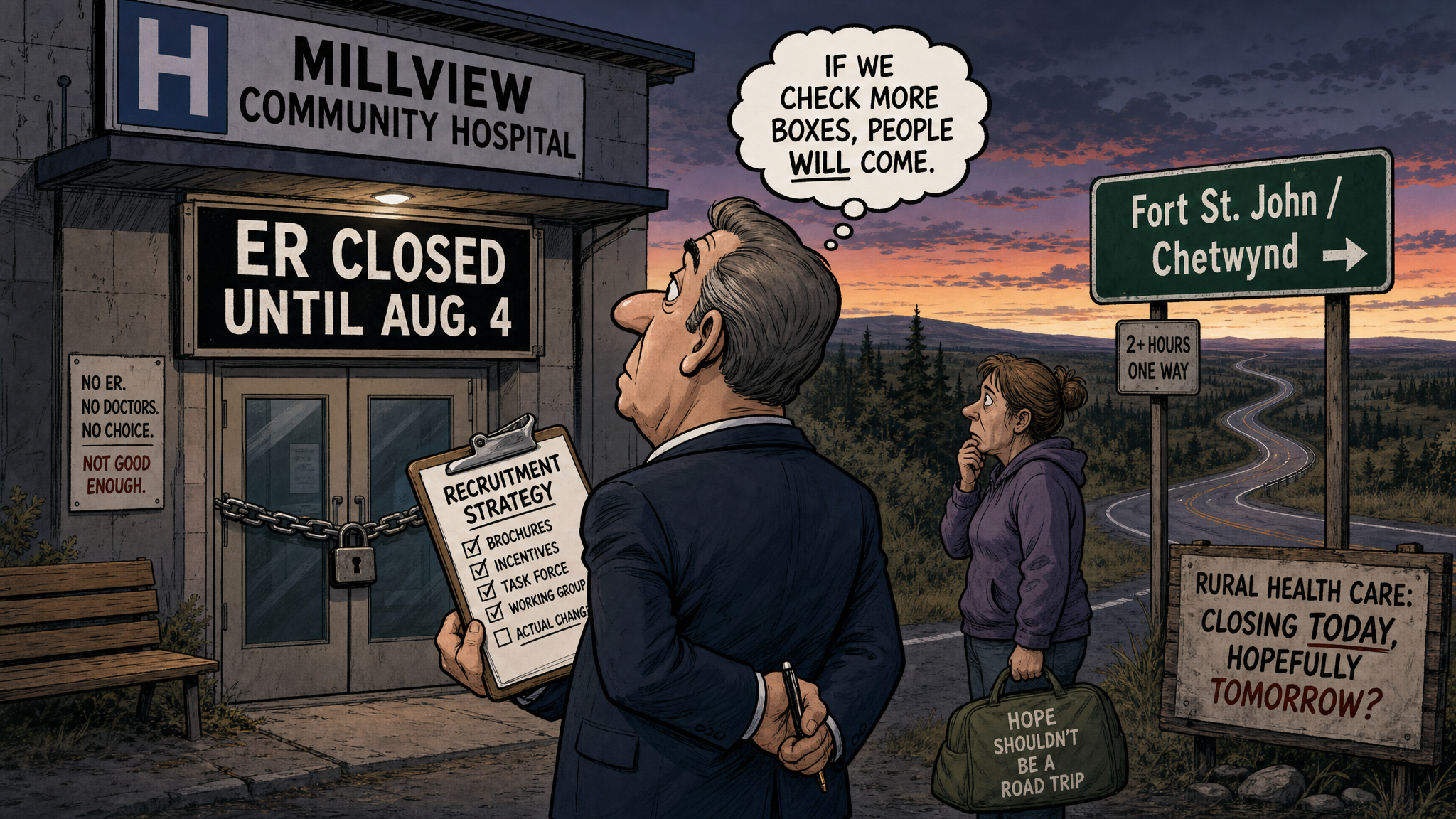
Hudson’s Hope is being told to live without its local emergency department for roughly three weeks. CJDC reported on July 13 that the emergency department at Hudson’s Hope Health Centre is temporarily closed because of ongoing staffing shortages, with Northern Health saying emergency services were not expected to resume until Tuesday, Aug. 4 at 8:30 a.m.
That is not a passing inconvenience. For a rural community, an emergency department is a basic safety net. When it is closed for weeks, residents do not stop having chest pain, strokes, falls, infections or farm and road injuries. They are told to call 911 and hope the system can move them to the nearest available care in time.
The facts are stark. CJDC reported that Northern Health tied the closure to physician staffing availability, that the community was being served by one part-time physician, and that recruitment for a second family physician was continuing. Northern Health’s own Hudson’s Hope facility page lists emergency hours as Monday to Friday, 8:30 a.m. to 4 p.m., with after-hours, weekends and statutory holidays handled through 911 and BC Emergency Health Services.
This closure also did not come out of nowhere. In April, CJDC reported that Hudson’s Hope had seen 21 emergency-room diversions in 56 days. The mayor, Travous Quibell, told CJDC the community had been down one physician since the previous fall, putting strain on the emergency department. The same report said residents needing an ambulance are diverted to Chetwynd or Fort St. John, a trip of at least 45 minutes.
Northern Health has not denied that staffing is a system-wide issue. Its service-interruptions page says staffing shortages and recruitment-and-retention challenges affect services, and it points to an Emergency Department Stabilization Task Force established in May 2024. The health authority says that work includes recruitment incentives, locum and agency staffing, GoHealthBC, virtual services and expanded roles for medical staff.
But a task force is not an emergency room. A recruitment strategy is not a doctor at the door. If the provincial system has had a formal stabilization effort since 2024, then a multi-week closure in July 2026 demands more than sympathetic language and rerouting instructions.
David Eby’s government owns the health-care system British Columbians actually experience, not the one described in announcements. In Hudson’s Hope, the lived reality is a locked emergency department, a thin physician bench and families left calculating distance when minutes matter. Calling that a “service interruption” understates the failure. Rural B.C. needs stable emergency coverage, transparent staffing plans and timelines the public can measure — not another promise that help is being recruited somewhere over the horizon.