Eby’s Pipeline Wall Became a Side Deal
The proposed Alberta-to-Delta pipeline is not approved. But David Eby’s public wall of opposition has already turned into a compensation framework and a promise not to fight in court.
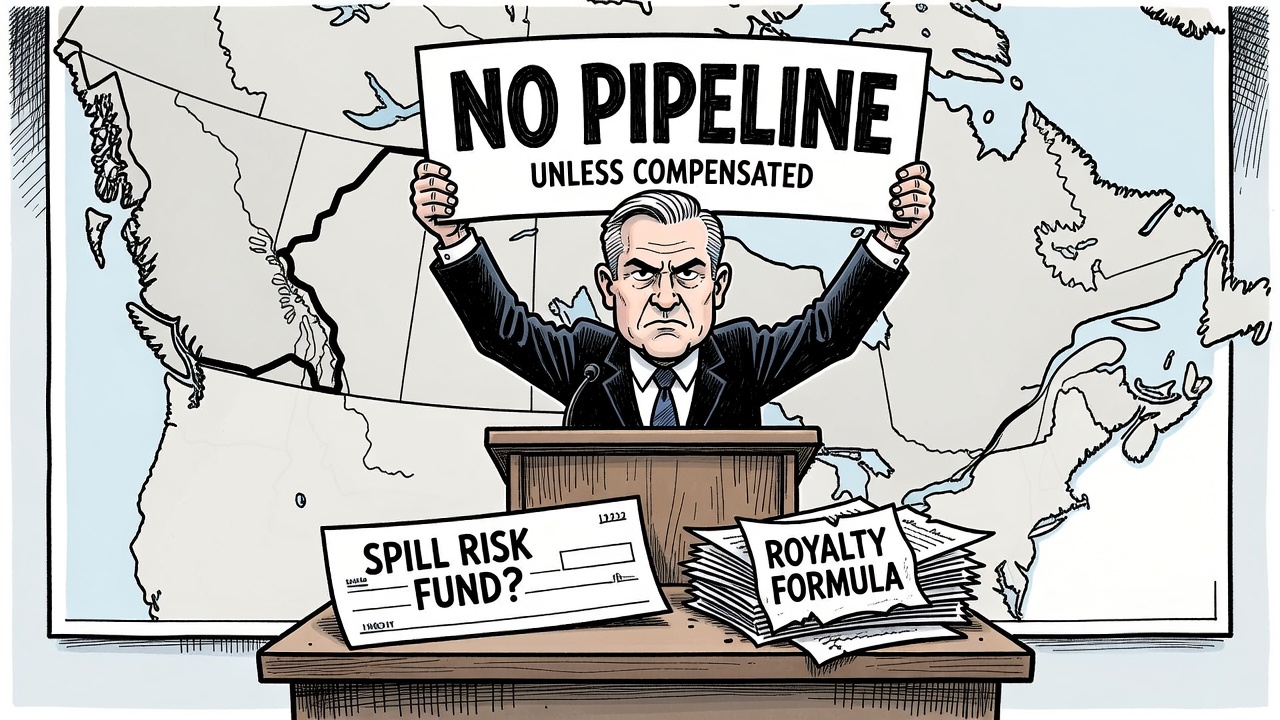
Eby did not stop the pipeline. He converted opposition into a side deal — with the most important numbers still blank.
British Columbians were told David Eby was standing firm against Alberta’s new oil pipeline push. The July 3 record is different: Alberta now has a proposed route to Delta, named project partners, a multibillion-dollar cost range, and a federal-B.C. agreement that moves B.C. from resistance to negotiation.
CityNews Vancouver, carrying Canadian Press reporting, said Alberta formally submitted a route to Ottawa’s major projects office for a West Coast Pipeline running from Bruderheim, northeast of Edmonton, to a terminal in Delta. The proposed line would follow closely along the existing Trans Mountain corridor, move more than one million barrels per day, and ship oil to Asian markets. The reported price tag is $35.2 billion to $43.7 billion, with Alberta already spending $18.3 million on planning.
The same report identified the announced partners as federally owned Trans Mountain Corp. and Pembina Pipeline. Pembina said its initial interest is 10 per cent, potentially rising to 20 per cent once the project is operational. That is not a finished ownership structure, and it is not approval. It is still a proposed project. But it is no longer just a press-conference threat.
Eby’s concession is the accountability issue. CityNews reported that the Canada-B.C. deal does not force him to support the project, but that B.C. would not fight it in court. The official federal release says Ottawa will maintain the North Coast tanker ban in accordance with the proposed route. The backgrounder goes further: B.C. acknowledges the federal-Alberta pipeline agreement, recognizes federal authority over interprovincial pipelines, and commits to acting in good faith on routing and permitting discussions if reciprocal commitments are met.
Those reciprocal commitments are exactly where voters need hard answers. The backgrounder says Canada and B.C. will negotiate a legally binding economic and revenue framework so B.C. shares in the project’s upside. Possible mechanisms include an annual royalty payment to B.C. by the pipeline operator and an environmental liability and emergency response fund held in trust for B.C. and First Nations.
That language sounds reassuring until the missing details are counted. What is the royalty formula? How large is the spill-response fund? Who pays into it, when, and under what triggers? Which B.C. Crown corporations or taxpayers could face up-front costs tied to Roberts Bank, routing, emergency response, or permitting cooperation? Which First Nations were consulted on a southern Delta route, and which were previously consulted under a northern-route premise?
There is a legitimate debate about pipelines, markets, tanker risk, Indigenous consent, jobs and national infrastructure. What is not legitimate is pretending B.C. still has a simple “no” position when the government has already moved to “pay us and protect us if Ottawa proceeds.”
Eby should publish the terms before the pipeline politics harden. B.C. deserves the numbers, the route risk, the First Nations consultation record, and the liability structure — not another slogan delivered after the deal architecture is already built.
Sources and records
- CityNews Vancouver / Canadian Press, July 3, 2026: Alberta announces partners for new pipeline to B.C. coast; Eby says province won’t fight it in court
- Prime Minister of Canada, July 2, 2026: Canada and British Columbia strike new cooperative prosperity partnership
- Prime Minister of Canada, July 2, 2026: Canada-British Columbia Cooperative Prosperity Agreement backgrounder