Cowichan Case: The Door Closed on Montrose. The NDP Still Owes B.C. a Map.
The appeal may decide the law. The transparency failure is already visible.
Update — July 29, 2026
Current status: Montrose’s lost reopening bid is now historical context, but Black Press reported July 21 that Montrose plans to appeal the ruling that declined to add the company to the Cowichan case. This post remains an appeal/transparency watch, not a claim that a final province-wide private-property rule has been settled. Black Press
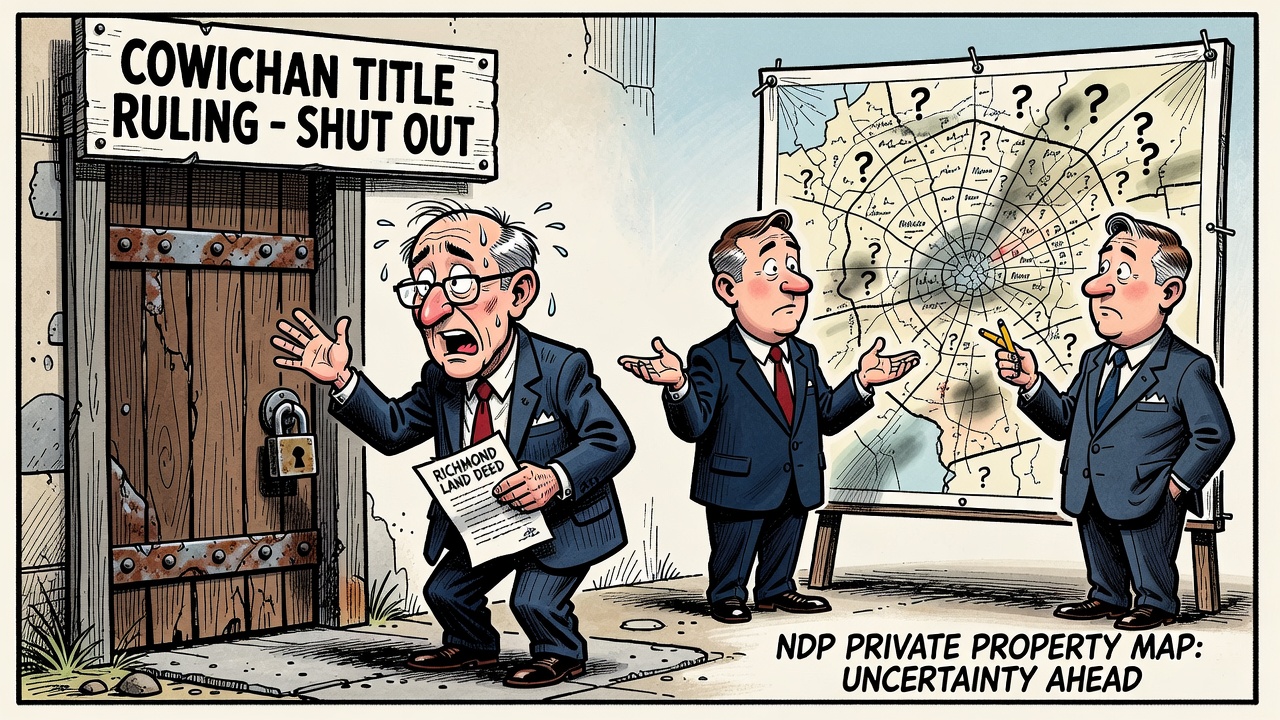
A government cannot call the public consulted if the public only learns the stakes after the judgment lands.
The Cowichan title case is not over. But one door has now closed for a major Richmond landowner that tried to get back into the courtroom.
On June 30, Canadian Press reported that B.C. Supreme Court Justice Barbara Young refused Montrose Properties’ application to reopen the Cowichan Aboriginal title case. CP reported that the judge described the request as an “abuse of process for relitigation.” Montrose had argued that it should have been heard because it is the largest private landowner in the affected title area. The court did not accept reopening the case at this stage.
That has to be stated carefully. This ruling does not decide the pending appeals. It does not mean every B.C. homeowner is about to lose title. It does mean the Eby government’s reassurance strategy is failing a basic public-confidence test: if private land can be inside a title declaration, affected owners, municipalities and taxpayers need clear notice long before they are reading about it in a judgment.
The underlying 2025 ruling declared Aboriginal title over lands in Richmond, including Crown land, City of Richmond land and private land, according to CP coverage and legal summaries. The Province, Canada, Richmond, Vancouver Fraser Port Authority and Musqueam have appealed. Until the appeals are decided, nobody should pretend the final legal answer is settled.
But the governance question is already settled enough to demand action. David Eby and Attorney General Niki Sharma cannot tell British Columbians to “trust the process” while the process produces surprise, uncertainty and emergency courtroom manoeuvres. Reconciliation policy must not be run like a disclosure scavenger hunt.
The NDP should publish a plain-language, province-wide list of Aboriginal title claims in litigation or negotiation where private land, municipal land, infrastructure corridors or resource tenures may be affected. It should explain what notice was given, who was consulted, what the Province’s position is, and what practical effect the government says a claim could have if successful. If the answer is “no effect,” put that in writing. If the answer is “the courts will decide,” admit that too.
This is not an argument against Indigenous litigants bringing claims. It is an argument against a provincial government managing one of the most sensitive legal transitions in B.C. history without enough daylight for the people who may be directly affected.
Montrose lost this round. The NDP’s bigger problem is that British Columbians still do not have the map.
Sources and records
- Canadian Press via larongeNOW, June 30, 2026: B.C. landowner loses bid to reopen landmark Cowichan Aboriginal title case
- The Deep Dive, June 30, 2026: B.C. Cowichan land reopening rejected
- Torys LLP, January 2026: Can Aboriginal title be declared in respect of privately held lands?
- B.C. Government, Aug. 11, 2025: Minister’s statement on Cowichan Tribes court decision