Eby’s Condo Plan Now Has Ethics Questions Attached
What began as an affordability announcement is now also an accountability story: who benefits, what will B.C. pay, and when will taxpayers see the details?
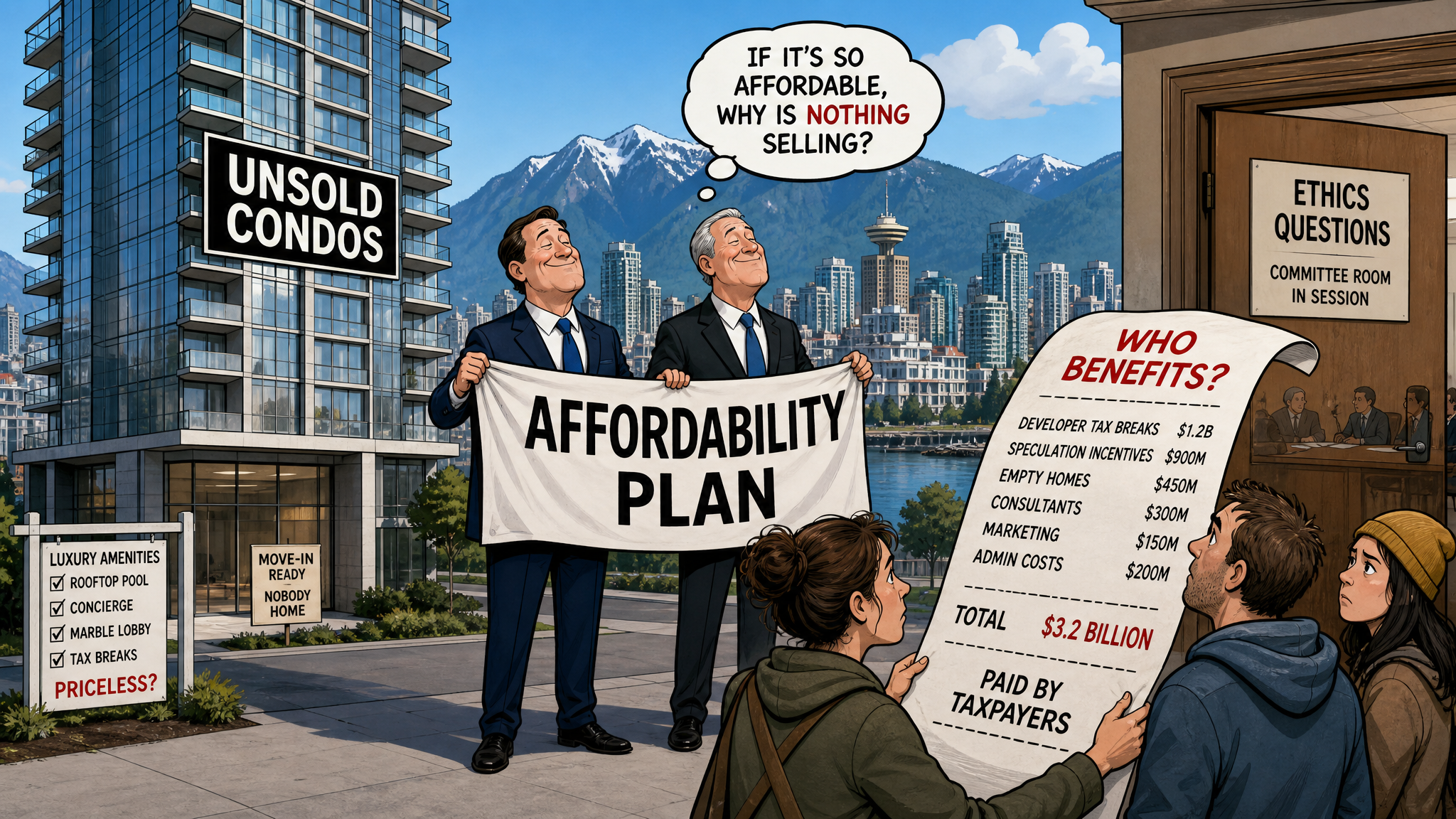
David Eby and Mark Carney sold this as affordability. Taxpayers still need the purchase rules, risk structure and conflict safeguards in writing.
The Eby-Carney vacant-condo plan has moved from policy controversy to ethics-committee territory. Global News reported June 28 that Conservative Leader Pierre Poilievre asked the House of Commons ethics committee to probe the plan, citing potential conflict-of-interest concerns around Prime Minister Mark Carney. That is not a finding of wrongdoing. It is a clear sign that the rollout has become serious enough for Parliament to be asked to examine who benefits.
The basic promise is large. The Prime Minister’s Office said June 18 that Ottawa and B.C. intend to use Build Canada Homes and BC Housing financing tools to convert more than 2,200 vacant condo units in priority growth areas into affordable homes. The same release announced nearly $1.6 billion in federal funding over 10 years, to be matched by B.C. for up to $3.2 billion, to reduce development charges for multi-unit housing by up to 50 per cent in priority communities.
Those numbers matter because this is public risk, not a slogan. CityNews, citing The Canadian Press, reported that Carney described the condo proposal as potentially financing the purchase of 2,200 vacant units, with Ottawa putting up 10 per cent of roughly $1.45 billion and B.C. responsible for the rest under a rent-to-own framework. Before any cheque is written, British Columbians should know the purchase-price rules, eligible buildings, developer eligibility, resale or rent-to-own terms, affordability test and what happens if units do not move.
The government’s own explanation has not caught up with the scale of the commitment. Global News reported June 25 that Carney said developers did not “directly” ask him for the vacant-condo plan and acknowledged governments had not done “a particularly good job” explaining the rollout. If the Prime Minister admits the explanation has been poor, then Eby cannot pretend B.C. voters are being unreasonable by asking sharper questions.
The core accountability issue is simple: a plan advertised as housing relief can still transfer value to private owners of unsold units unless the safeguards are transparent, strict and enforceable. The public does not need partisan yelling. It needs transaction-level disclosure before the province becomes the backstop for a distressed condo inventory problem.
Eby should release the conditions now: maximum purchase discounts, independent appraisals, conflict screens, affordability covenants, rent-to-own income limits, operating subsidies, B.C.’s repayment exposure and a list of communities under consideration. If the answer is that details are coming later, then the criticism is already proven in one respect: the announcement came before the public accountability framework.
Housing affordability is a real crisis. But a real crisis is exactly why taxpayers should reject blank-cheque politics. If this is truly about families priced out of Metro Vancouver, Eby and Carney can show the math. If they cannot, an ethics-committee probe request is not a distraction from the affordability debate. It is the predictable result of launching a billion-dollar housing pitch before proving who pays, who profits and who is protected.
Sources and records
- Global News, June 28, 2026: Poilievre requests ethics committee probe of B.C. condo plan
- Global News, June 25, 2026: Carney says developers did not directly ask for condo plan
- Prime Minister of Canada, June 18, 2026: Canada and B.C. housing partnership
- CityNews Vancouver / Canadian Press, June 25, 2026: Carney addresses condo-buyout proposal
- Conservative Party of BC, June 2026: Opposition criticism of the plan