Eby’s AI Power Bet Needs Public Answers
Hundreds of protesters are asking the obvious question: before B.C. reserves scarce clean electricity for AI data centres, who gets to see the power, water and approval math?
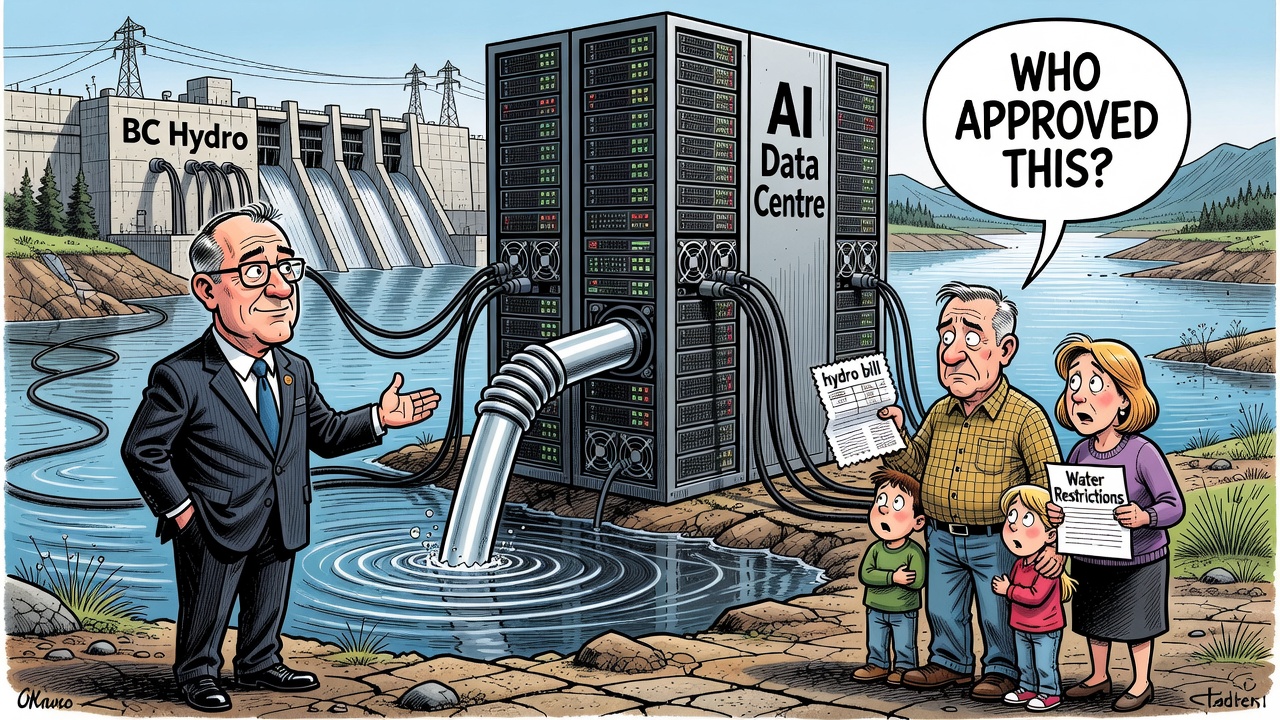
Clean power is not a magic phrase. It is a public asset, and the public deserves the ledger.
Hundreds of people protested near the Vancouver Art Gallery this weekend against proposed AI data centres in British Columbia. CityNews reported it was the second downtown Vancouver protest of its kind within a month, with demonstrators raising concerns about environmental impacts, water use and electricity demand. An online petition opposing the Vancouver AI data-centre proposal had gathered more than 15,000 signatures.
The public concern is not imaginary. In May, TELUS and the federal government announced work toward a proposed sovereign AI data-centre cluster in B.C. TELUS says the plan includes three facilities: an expanded Kamloops AI Factory, a Mount Pleasant facility in Vancouver, and a 150 West Georgia facility. TELUS says it has secured an initial 85 megawatts of clean, renewable BC Hydro power and plans for the cluster to scale to more than 150 megawatts by 2032.
Premier David Eby’s defence, as reported by CityNews, is that BC Hydro gives B.C. an advantage because of low-cost, clean electricity. That may be a selling point for industry. It is not an answer to ratepayers.
BC Hydro’s own 2026 call-for-demand document says storage data centres and AI data centres are contributing significantly to growth in requested electricity demand. The same document says BC Hydro is supposed to allocate electricity strategically while maintaining affordability and reliability for residential, commercial and industrial customers. Its scoring criteria include cost and benefits to BC Hydro, community and provincial economic benefits, environmental impacts and benefits including water-use efficiency, data sovereignty, and First Nation benefits and impacts.
Those criteria should not live only inside an application process. They should be translated into public answers before politicians celebrate the deal. How much power is being reserved? What new generation, transmission or demand-management cost is triggered? What happens to household and small-business rates if large loads arrive faster than supply? What water source will be used, what recycling commitments are enforceable, and who monitors them? Which local governments, First Nations and neighbourhoods get a real say before approvals harden into facts on the ground?
TELUS argues its design will use closed-loop liquid cooling, cut cooling energy use compared with traditional data centres, recover heat, run on 98 per cent renewable power and use far less water than traditional facilities, with plans to incorporate recycled water from BC Place. Those are important claims. They are also exactly why the province should publish enforceable conditions, not just political talking points.
British Columbia can support technology without turning BC Hydro into a private growth bank for the loudest new load. The question is not whether AI exists. The question is whether the NDP government is willing to show British Columbians the trade-offs before public electricity, water planning and local approvals are committed.
If Eby wants credit for making B.C. an AI hub, he should start with the simplest democratic standard: show the ledger, publish the conditions, and let the public see who approved what.
Sources and records
- CityNews Vancouver, June 28, 2026: protest, petition, Eby defence and 150 MW context
- TELUS, May 11, 2026: B.C. sovereign AI cluster, sites, 85 MW secured and 150 MW by 2032
- Government of Canada, May 11, 2026: federal-TELUS sovereign AI infrastructure announcement
- BC Hydro, 2026 Call for Demand: AI/data-centre electricity-allocation process and scoring criteria