Joffre Lakes Shows the NDP’s Park-Access Problem
A legal warning over Pipi7íyekw/Joffre Lakes Park raises the question the Eby government keeps avoiding: who gets locked out of public land, under what authority, and with what accountability?
Reconciliation does not relieve government of the duty to explain how public access rules are made.
Joffre Lakes is not an obscure back road. BC Parks describes Pipi7íyekw/Joffre Lakes Park as a very popular destination that is busy seven days a week and extremely busy on weekends. It is also a park where ordinary visitors are already told to plan around passes, limited capacity, no dogs, no drinking water and strict use rules.
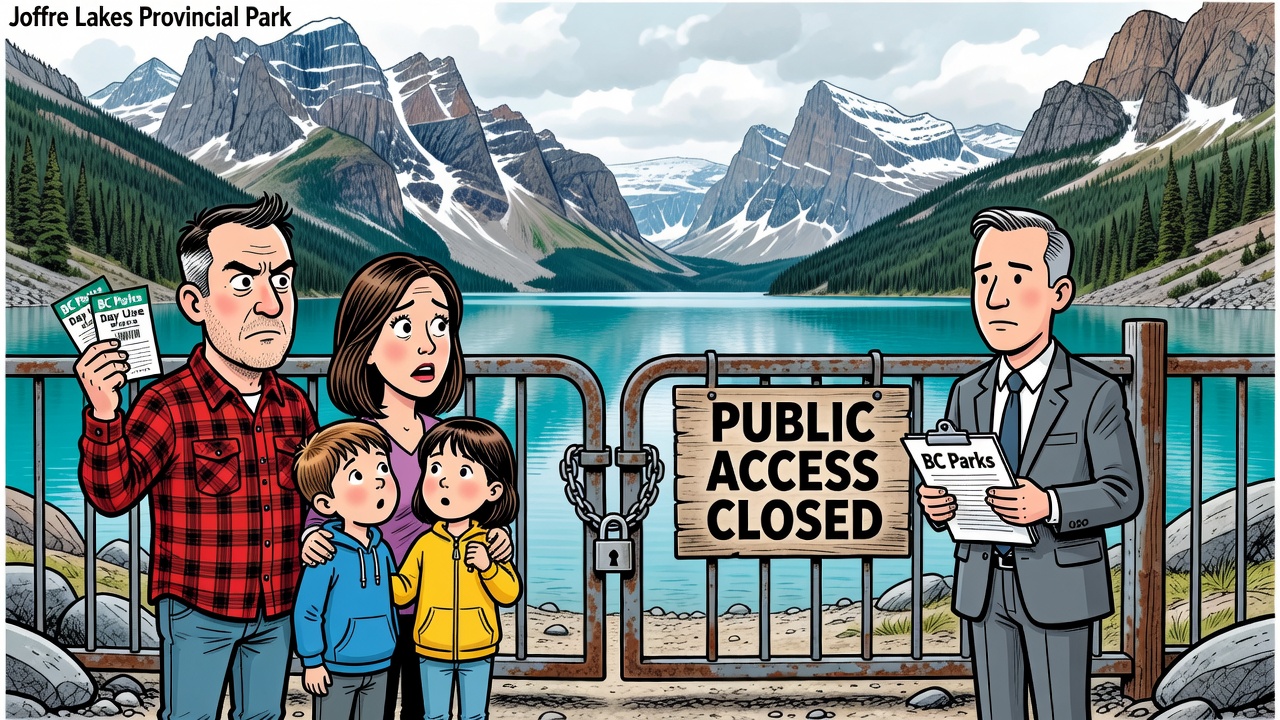
Now the Eby government has a bigger problem than crowd control. Global News reported Friday that constitutional lawyer Marty Moore has sent the province a letter warning that B.C.’s decision to close Joffre Lakes to the public for two stretches could violate provincial law and the Canadian Charter. The closures are from June 20 to 27 and September 8 to 30, while members of Lil’wat Nation and N’Quatqua are allowed access for traditional activities on the land.
The legal allegation is serious, and it should be treated precisely as that: an allegation, not a court ruling. Moore argues the exclusion infringes mobility and equality protections and is inconsistent with the Park Act. Global also reported his warning that the dispute could go to court for judicial review of whether the Charter is engaged and whether government properly exercised its statutory powers and constitutional duties.
The province’s position, as reported by Global, is that the park is collaboratively managed with the two First Nations and that closures allow cultural practices within their territory. That is the government’s case. But a government case still needs public reasons, transparent limits and defensible legal authority.
The numbers underline why this cannot be waved away. Global reported the park will be closed for 31 total days this year, after Lil’wat First Nation identified 75 closure dates over the spring and summer. BC Parks’ own day-use page says trail passes are required from May 11 to October 25, 2026, and that the park is scheduled to be closed to visitors periodically during that time. The same page says the park will be managed to accommodate 500 visitors per day.
That means British Columbians are facing a layered access system: passes, caps, seasonal restrictions and full public closures. If the government believes that system is lawful, necessary and properly balanced, it should publish the legal basis, decision records, consultation process, closure criteria and review mechanism in plain language.
The issue is not whether Indigenous cultural practices matter. They do. The issue is whether an NDP government can close a provincial park to the broader public while offering only broad assurances about collaborative management. Public parks belong in a framework the public can understand and challenge. When access to land is restricted by government, “trust us” is not enough.
At Joffre Lakes, the gate is becoming a test of more than park management. It is a test of whether David Eby’s government can reconcile rights, access and accountability without turning public land rules into closed-door decisions.