Eby Says It’s Not a Bailout. The Condo Math Still Deserves Scrutiny.
Before Victoria helps finance a vacant-condo conversion plan, B.C. taxpayers deserve the purchase rules, affordability test and risk structure — not fall-after-the-fact details.
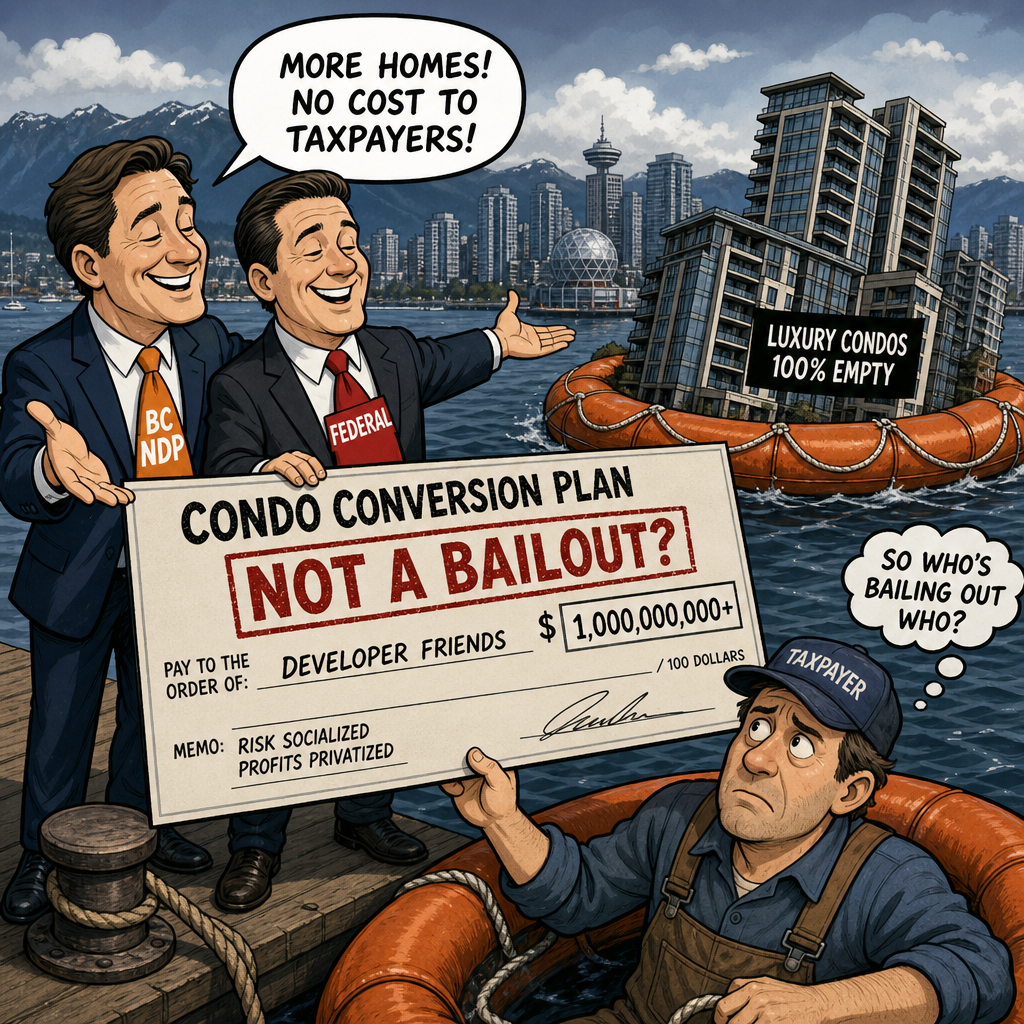
Calling something “not a bailout” does not settle the public-interest test. The numbers do.
David Eby and Mark Carney spent Thursday trying to contain the backlash to their vacant-condo conversion plan. The problem is not that governments want more affordable housing. The problem is that British Columbians are being asked to accept a major financing concept before the key safeguards are public.
The official June 18 announcement said Ottawa and Victoria would launch a Canada-B.C. Partnership on Condo Conversion through Build Canada Homes and BC Housing, using financing tools to convert more than 2,200 vacant condo units in priority growth areas into affordable homes. That is the sales pitch: faster supply by turning empty units into housing people can use.
The harder fiscal detail landed a week later. Canadian Press reporting carried by CityNews said the federal government would put up 10 per cent of roughly $1.45 billion in potential spending and that the units would be offered under a rent-to-own framework. Later Canadian Press reporting through iNhome carried Eby’s clarification: Ottawa would put in 10 per cent of about $1.4 billion, B.C. would put in the second half to bring public cash to just under $300 million, and the rest would be financing.
Carney said developers had not asked him “directly” for the plan and admitted the rollout had not been well explained. Global News reported that he described the concept as financing distressed condos at the right time and at a discount, while also saying there were no specific transactions yet and the structures still had to be determined.
Eby’s defence was equally revealing. He said the plan would not help City of Vancouver developers because “the numbers don’t work there” and the market would correct. Canadian Press reporting through iNhome said he pointed instead to opportunities south of the Fraser, on Vancouver Island and in the Okanagan, including bulk purchases or bankruptcy proceedings. He also said the public should wait to see the program — and that if people hate it, government does not have to do it.
That is precisely why the plan deserves hard scrutiny now. If the final answer may be “we don’t have to do it,” taxpayers should not be softened up with affordability slogans before seeing the math. What is the maximum public exposure? Who sets the discount? What rent-to-own price counts as affordable? Which buildings qualify? What happens if market values fall after government enters as a buyer? And how will government prove it is not merely preventing developers from taking the full market loss?
Eby argues developers will take losses and taxpayers will hold public assets. That may be the government’s case. But the public has not yet seen the purchase formulas, the affordability benchmarks, the risk allocation, or the promised final structure. Those details are not paperwork. They are the difference between a defensible housing intervention and a publicly financed floor under unsold private inventory.
B.C. needs affordable homes. It also needs a government that can tell taxpayers exactly what they are buying, why they are buying it, who benefits, and what happens if the numbers do not work. Until then, “not a bailout” is not an answer. It is a claim waiting for evidence.
Sources and records
- Prime Minister’s Office, June 18, 2026: Canada-B.C. partnership announcement
- CityNews / Canadian Press, June 25, 2026: Carney says condo buyout is about affordability
- Global News, June 25, 2026: video and report on Carney remarks
- iNhome / Canadian Press, June 25, 2026: Eby says plan is not a bailout
- CPAC, June 25, 2026: B.C. Premier Eby press conference video