After Site C’s Blowout, the NDP Is Studying Two More Mega-Dams
The NDP once argued B.C. did not need Site C. Now Adrian Dix says the province is seriously re-examining Site E and Homathko as demand surges.
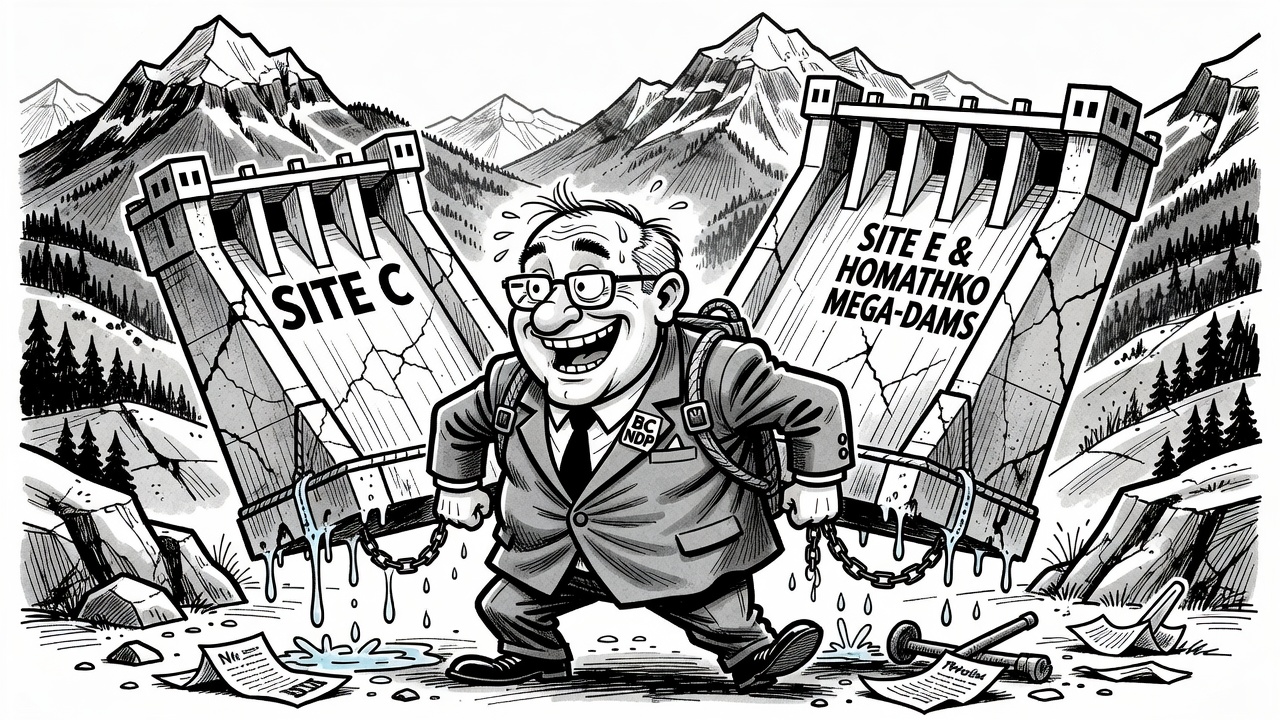
Before B.C. is marched toward another mega-dam debate, the government should explain why its own energy assumptions changed so dramatically.
B.C.’s NDP government is now looking seriously at two more large hydroelectric projects: Site E on the Peace River and a Homathko River project near Bute Inlet. This is not an approval to build. Energy Minister Adrian Dix told Canadian Press the work is technical exploration to determine whether the projects can or should proceed. That distinction matters.
But the political whiplash matters too. The NDP spent years attacking Site C, then continued it after taking office, then watched its price climb to $16 billion, almost double the original $8.8-billion estimate reported by Canadian Press. Last month, Premier David Eby’s government renamed it the John Horgan Dam. Now the same government is studying what could become the next generation of public mega-dams.
BC Hydro’s Powering Growth Plan says electricity use is expected to rise about 50% by 2050, while peak demand on the coldest days could rise 44%. The utility says Site E, near the Peace and Alces rivers and about 60 kilometres from the John Horgan Dam, could provide up to 750 megawatts and roughly 3,000 gigawatt hours a year. Homathko could involve up to four dams and three powerhouses, with up to about 900 megawatts and 4,500 gigawatt hours annually, depending on configuration.
The official line is that B.C. needs to conserve, optimize and build. The government is also promoting Power Smart 2.0, a $1-billion-plus conservation push that it says can save 800 megawatts of capacity and avoid or defer more than $2 billion in infrastructure costs by 2030. Good: the cheapest power is the power customers never have to buy.
That is exactly why taxpayers deserve sharper answers before the NDP normalizes another dam conversation. Which forecast changed? How much future demand is household electrification, how much is industrial policy, and how much is data-centre or resource-sector load? What would these projects mean for affected First Nations, local communities, fish habitat, private land, transmission corridors and rates?
None of those questions is an argument against reliable electricity. They are an argument against repeating the Site C pattern: political certainty first, public clarity later, taxpayers last. If Site E and Homathko are only options, the NDP should publish the assumptions, alternatives, consultation plan and cost-risk framework now. B.C. cannot afford another expensive “trust us” megaproject on this scale.