Eby’s Jobs Economy: Government Payroll Up, Youth Opportunity Down
The May jobs report is not the victory lap the NDP wants. B.C. unemployment stayed above the national rate, while youth and private-sector indicators are flashing red.
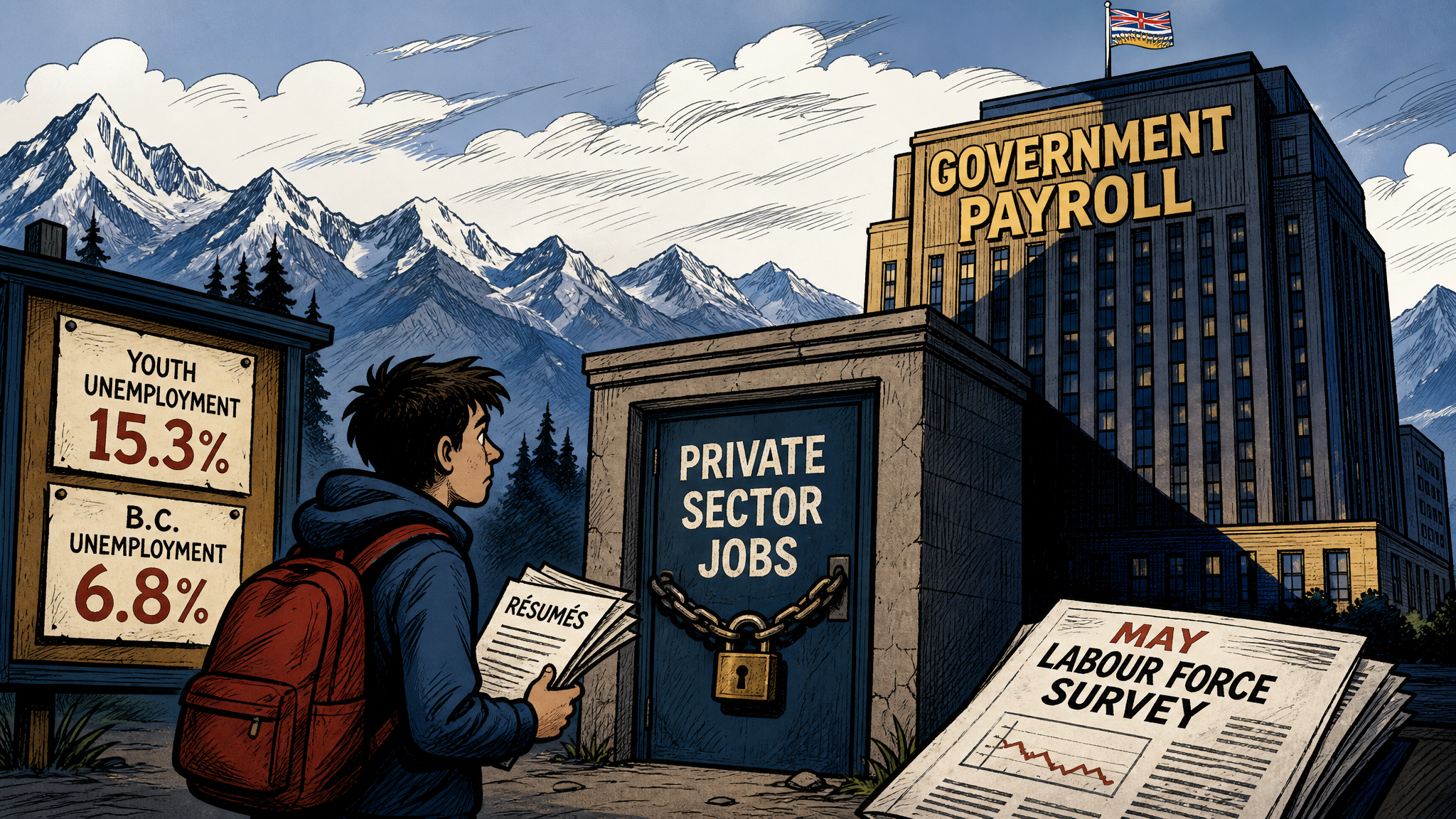
iVoteNDP editorial cartoon, June 7, 2026.
A one-month jobs rebound does not erase a labour market where young British Columbians are still being squeezed.
Statistics Canada’s May Labour Force Survey gave British Columbia one piece of good news: employment rose by 25,000, or 0.9%, in May. But the same release says that gain only partly offset a cumulative loss of 39,000 jobs in February and March, and B.C.’s unemployment rate remained unchanged at 6.8%.
That matters because Canada’s unemployment rate fell to 6.6% in May. In plain English, B.C. was still sitting above the national rate after the monthly rebound. For a government that sells itself as competent economic management, “worse than Canada after a bounce-back month” is not much of a slogan.
The sharper warning comes from the youth and private-sector numbers highlighted by BC Conservative MLA Gavin Dew, the opposition critic for jobs. Dew’s June 5 release says B.C. youth unemployment rose from 14.4% to 15.3% in May, while more than 7,300 young people left British Columbia over the past year. Those figures deserve a direct answer from the NDP, not another affordability talking point.
Dew’s release also points to the structure of the job market under David Eby’s government: over the past year, public-sector employment increased by 17,300 jobs, while private-sector employment declined by 30,500 and self-employment fell by 16,300. Government hiring can provide services, but it cannot substitute for a private economy that lets families build paycheques, businesses and futures.
The sector detail is just as damaging. Dew says B.C. lost 7,500 jobs over the past year in forestry, fishing, mining, quarrying, oil and gas, and 29,600 jobs in wholesale and retail trade. Those are not abstract spreadsheet categories. Resource work supports communities and high wages. Retail jobs are often the first rung for students and young workers trying to get experience.
None of this proves every job loss was caused by one provincial policy. Labour markets move for many reasons, and Statistics Canada’s national report also points to broader pressures, including trade uncertainty and weakness in wholesale and retail. But provincial leaders are responsible for the investment climate they create, the projects they delay, the taxes and costs they impose, and the priorities they choose.
The NDP wants British Columbians to judge the economy by announcements. Young people judge it by whether they can find work, pay rent and stay in the province. On that test, the May numbers are a warning: B.C. cannot build a future on a growing bureaucracy while youth opportunity and private-sector work move the wrong way.