The Report Card Is In: Eby’s Finance Minister Failed Taxpayers
An independent taxpayer report card ranks B.C.’s finance minister dead last in Canada, and the province’s own budget confirms the red ink, tax hikes and debt climb behind the grade.
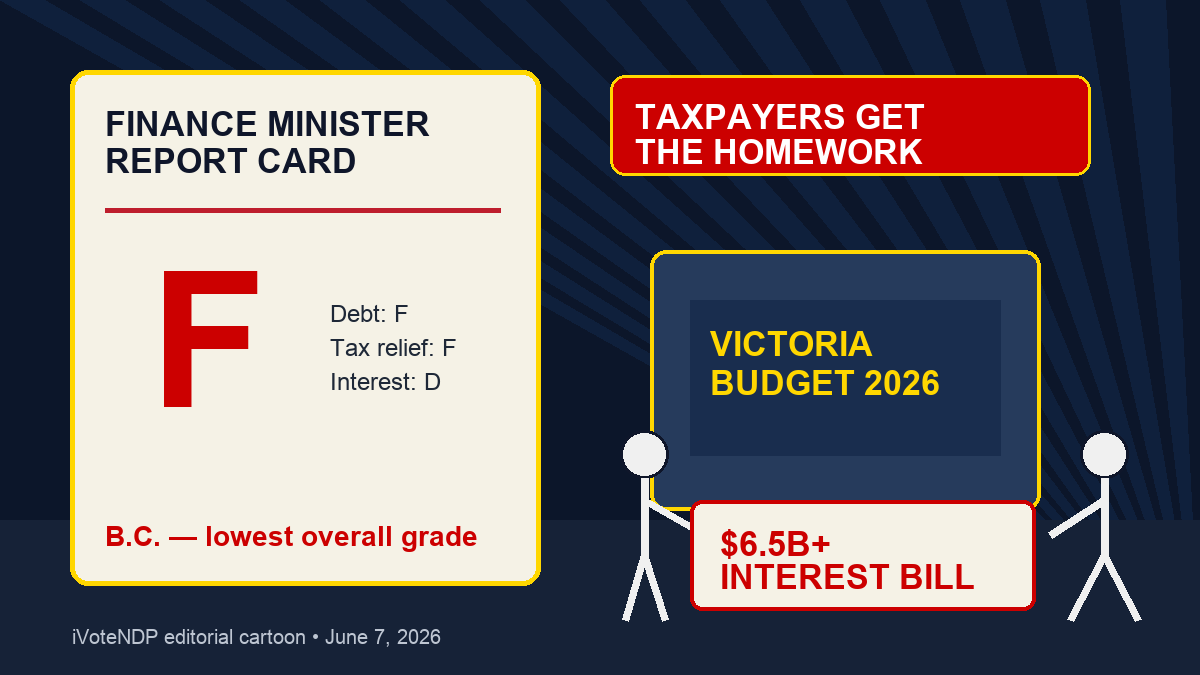
iVoteNDP editorial cartoon, June 7, 2026.
An affordability government cannot tax higher, borrow deeper and then call the result discipline.
The Canadian Taxpayers Federation’s new Finance Minister Report Card gives British Columbians a simple, brutal verdict on David Eby’s fiscal management: Finance Minister Brenda Bailey received an overall F, the lowest grade among provincial finance ministers in Canada.
The report, released May 28, ranks ministers on spending, debt, debt-interest costs, spending per person and tax relief in the latest provincial budgets. Its national table places B.C. tenth out of ten. Bailey’s detailed B.C. breakdown shows an F for debt, a D for debt-interest costs, a B for spending increase, a C for spending per person and an F for tax relief.
That is not just an opposition talking point. The CTF’s numbers are tied to public budget documents, and the province’s own Budget 2026 pages confirm the broad direction: deficits of $13.3 billion in 2026-27, $12.2 billion in 2027-28 and $11.4 billion in 2028-29. The government calls those “declining deficits.” Taxpayers may reasonably call them three more years of red ink.
On debt, the report says B.C. is planning to add more than $26.7 billion compared with last budget, reaching $184.4 billion by year-end, or more than $32,000 per British Columbian. The official fiscal plan separately says taxpayer-supported debt is expected to rise to $189 billion over the three-year plan. Either way, the direction is clear: the NDP is borrowing heavily while asking families to accept higher costs.
The interest bill is the part that should worry every household. The CTF says debt-interest payments will cost B.C. taxpayers more than $6.5 billion, or $1,152 per person, the third-highest per-person cost in the country. Interest does not hire a nurse, open an operating room, house a senior or repair a road. It is the price of past borrowing, sent to bondholders before services can be delivered.
Budget 2026 also confirms new tax pressure. The province says the first income-tax bracket rises from 5.06% to 5.60%, adding $76 for the average taxpayer in 2026, while bracket indexing is paused from 2027 to 2030. The budget also expands the PST base to several professional services and removes exemptions from some goods and services. The government says this protects core services. The report card says it is a tax-relief failure.
Opposition finance critic Peter Milobar seized on the report, saying British Columbians are paying more while government borrows more and families get less in return. The NDP can argue with his framing, but it cannot argue away its own budget tables or the report card’s bottom line.
A government that boasts about affordability should not be raising taxes, piling on debt and celebrating deficits as discipline. Bailey’s F is more than a letter grade. It is a warning that Eby’s affordability pitch is colliding with the fiscal record his government actually wrote.
Sources and records
- Canadian Taxpayers Federation, May 28, 2026: Finance Minister Brenda Bailey receives worst grade in Canada
- Canadian Taxpayers Federation: Second Annual Finance Minister Report Card, May 2026
- B.C. Budget 2026: Fiscal Plan
- B.C. Budget 2026: Budget Highlights
- BC Conservative Caucus: NDP finance minister given F on report card